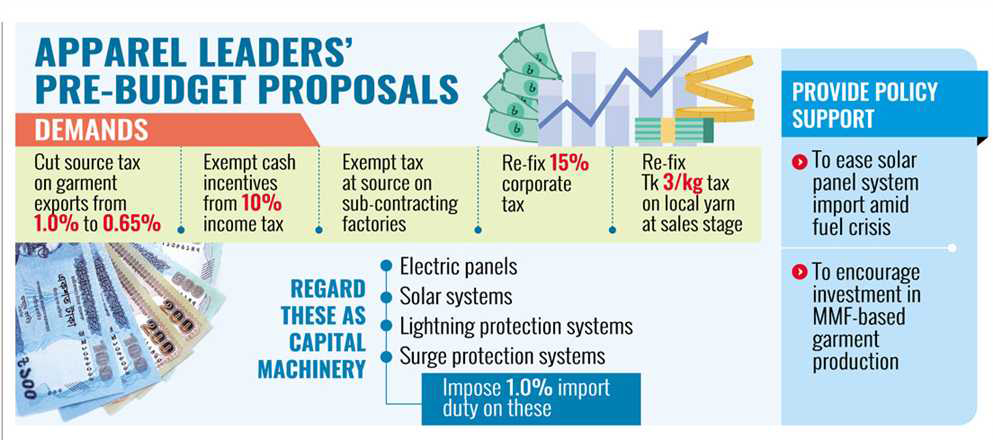
Apparel and associated industries have put forward a slew of pre-budget proposals to the government, including reducing source tax on exports and withdrawing tax on cash incentives and policy perks for solar panels and MMF garments.
Leaders of textile, garment, and their allied industries also seek necessary policy perks to ease the import of solar-panel systems amid the ongoing fuel crisis and encourage investment in manmade fibre (MMF)-based garment manufacturing.
The export-sector leaders tabled the proposals at a pre-budget meeting with National Board of Revenue (NBR) Chairman Abdur Rahman Khan at the latter's Agargaon office in the capital on Sunday.
Bangladesh Garment Manufacturers and Exporters Association (BGMEA) in its written proposals said nearly 400 garment factories had been shut down over the last three years, with many others remaining financially vulnerable.
The association attributes two structural factors to the current slowdown in the industry-rising cost of doing business and a lack of a business-friendly environment.
Policy uncertainty, institutional complexities and infrastructural bottlenecks, alongside rising financing and logistics costs, are affecting the sector, it says.
Speaking there, BGMEA President Mahmud Hasan Khan demanded lowering the source tax on garment exports from 1.0 per cent to 0.65 per cent and exempting cash incentives from the 10-percent income tax.
Explaining the role of sub-contracting factories, he demands waiver of tax at source on such units, saying that they faced "double taxation".
Bangladesh Textile Mills Association (BTMA) President Showkat Aziz Russell demands re-fixing the 15-percent corporate tax and Tk 3.0-per-kg tax on local yarn at the sales stage. The global demand is for MMF-based products, while Bangladesh's garment industry is largely based on cotton, he points out, seeking support to encourage investment in this segment.
He says electric panels, solar systems, photovoltaic cells assembled in modules or made up into panels, and lightning protection systems, and surge protection systems should be considered capital machinery, demanding 1.0-percent import duty on such capital goods.
To reduce the cost and tackle the global energy crisis, Bangladesh Knitwear Manufacturers and Exporters Association (BKMEA) President Mohammad Hatem stresses addressing the difficulties facing factories in importing solar systems.
"Stop bribery and corruption at the income tax and customs wings. We will not demand tax and VAT reduction," Shahadat Hossain Sohel, chairman of Bangladesh Terry Towel and Linen Manufacturers and Exporters Association, told the government's revenue authority.
"Rather, we will pay whatever the rate you ask for."
The NBR chairman told the industry leaders that the revenue board was planning to introduce a QR-code system on packaged products sold on the market to curb value-added tax (VAT) evasion and improve overall tax compliance.
At the initial stage, he says, they have planned to start with tobacco products and gradually implement it for other packaged goods, such as soap, shampoo, bottled water, and sugary items.
He also talks about rewarding individuals who provide information about tax evasion or misconduct and imposing penalties or fines on those evading taxes.
Leaders from Bangladesh Garment Buying House Association, Bangladesh Garment Accessories and Packaging Manufacturers and Exporters Association, Bangladesh Economic Zones Authority, Bangladesh Investment Development Authority, and Bangladesh Export Processing Zones Authority also presented their respective proposals at the meeting.
Munni_fe@yahoo.com
© 2026 - All Rights with The Financial Express

