Bangladesh overtakes China to become second-largest apparel exporter to the United States in value terms, as of the first quarter of 2026, in a major shift in global sourcing patterns amid tariff spats.
Chinese shipments to the American market continue to decline sharply under retaliatory tariff blows from the Trump administration, according to latest statistics.
Bangladesh first emerged as the second-largest exporter of readymade garments to the US market in February this year. By the end of March, the country had further strengthened its position, while Vietnam retained the top spot.
According to the latest data released by the Office of Textiles and Apparel (OTEXA) under the US Department of Commerce, Bangladesh exported apparel worth US$2.04 billion to the US market during January-March 2026, surpassing China's exports of US$1.70 billion during the period.
US apparel imports declined by 7.80 per cent in March 2026 compared to March 2025, falling from US$6.50 billion to US$5.99 billion, according to OTEXA data.
The performance of major exporting countries remained largely negative, with China and India recording the sharpest declines of 37.24 per cent and 32.64 per cent respectively. Bangladesh also posted a contraction of 8.08 per cent, as export earnings fell from US$0.72 billion to US$0.66 billion.
Other exporters, including Honduras, Pakistan and Indonesia, also experienced declines of 16.93 per cent, 8.72 per cent and 7.41 per cent respectively.
In contrast, several countries outperformed the broader market trend. Cambodia recorded the strongest growth, with exports rising 16.22 per cent to US$0.38 billion. Vietnam also maintained steady growth of 2.52 per cent, further consolidating its position as a leading supplier with exports totaling US$1.28 billion in March 2026.
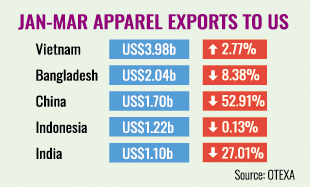
During the January-March period of 2026, Bangladesh's apparel exports to the US declined by 8.38 per cent year on year. However, the fall was significantly smaller than China's steep 52.91-percent decline. China had exported garments worth US$3.61 billion to the US market during the corresponding period of 2025, while Bangladesh's exports stood at US$2.22 billion.
The latest OTEXA figures indicate Bangladesh has emerged as one of the key alternative sourcing destinations for US retailers seeking to reduce dependence on Chinese suppliers amid continuing trade tensions and tariff-related uncertainties.
Vietnam retained its position as the largest apparel supplier to the US market during the first quarter, recording a 2.77-percent growth in exports to US$3.98 billion.
According to OTEXA count, total US apparel imports from the global market declined by 11.63 per cent to US$17.72 billion during January-March compared to the same period last year, reflecting subdued consumer demand and persistent global economic challenges.
During the period under review, Vietnam remained the top apparel exporter to the US market with exports worth US$3.98 billion, registering a 2.77-percent growth year on year. Bangladesh secured the second position with exports amounting to US$2.04 billion despite an 8.38-percent decline, while China slipped to third place as its exports plunged 52.91 per cent to US$1.70 billion.
In terms of volume, Bangladesh exported 690.11 million square metre equivalents (SME) of apparel during the first quarter, registering a 5.97- percent decline from the previous year.
China's export volume dropped by 40.15 per cent to 1,176.97 million SME, highlighting the sharp contraction in Chinese garment shipments to the US market.
Bangladesh also maintained a stronger unit-price position. The average export price of Bangladeshi apparel stood at US$2.95 per SME, substantially higher than China's US$1.44 per SME, which itself declined by 21.33 per cent year on year.
Industry insiders say Bangladesh benefited from the rapid erosion in China's market share following the imposition of higher US tariffs on Chinese goods. "Although Bangladeshi products also faced retaliatory tariffs initially, the country remained in a relatively favourable competitive position compared to several rival suppliers."
Vietnam and Bangladesh currently enjoy comparatively competitive tariff structures on the US market, while Indian products face significantly higher cumulative duties and Chinese goods remain under severe tariff pressure.
Meanwhile, Cambodia emerged as another strong performer on the US apparel market. Its exports rose by 17.60 per cent in value and 18.07 per cent in volume during the first quarter, signalling a growing diversification of sourcing destinations by global buyers across Asia. Mohiuddin Rubel, former director of BGMEA, says, 'The tariff-driven sourcing shift initially boosted purchase orders for Bangladeshi garments, footwear and other products."
However, he notes, the momentum weakened later due to rising product prices, inflationary pressures and higher global energy costs following the Iran conflict.
"Bangladesh now has a strategic opportunity to further consolidate its position on the US market if it can maintain competitiveness, improve lead times, and ensure compliance and supply-chain stability," he says.
newsmanjasi@gmail.com
© 2026 - All Rights with The Financial Express

