Bangladesh is set to seek a binding 12-year transition period to safeguard its export-oriented economy from post-LDC-graduation trade challenges in a high-stakes strategy to be placed at the upcoming WTO ministerial meet.
Officials say the government has finalized a comprehensive Position Paper for placing at the 14th World Trade Organisation (WTO) Ministerial Conference (MC14) will be held in Cameroon on March 26-29.
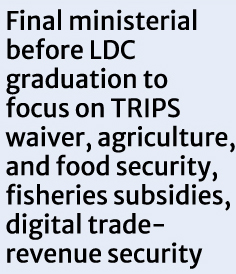 The Position Paper outlines a strategy that balances the prestige of "Developing Nation" status with the pragmatic needs to shield its around U$50billion export economy from the "graduation shock."
"The four-day global trade summit…in Yaoundé will mark Bangladesh's final Ministerial appearance as a Least-Developed Country (LDC) ahead of its scheduled graduation on November 24, 2026," says one trade official.
The Bangladesh delegation, led by the Ministry of Commerce and supported by the ERD or Economic Relations Division, is expected to fly to Cameroon with a clear mandate: 'No agreement is better than a bad agreement that compromises the livelihood of millions of garment workers and small-scale farmers'.
According to the finalised position paper, Dhaka will lead the LDC group in demanding a structured graduation "Support Package".
The centerpiece of this strategy is the extension of LDC-specific Special and Differential Treatment (S&DT) for 12 years to ensure a sustainable transition into the developing-country club.
While MC13 (Abu Dhabi) secured a 3-year grace period for certain LDC supports, Bangladesh is pushing for a more robust 12-year horizon for Duty-Free Quota-Free (DFQF) market access.
"Graduation should be a reward for development, not a penalty for success," a senior official at the commerce ministry involved in drafting the paper told The Financial Express.
"Without a decade-long transition, our RMG sector-contributing over 80 per cent to national exports-could face an immediate tariff hike of 12 per cent in major markets, eroding competitiveness against regional peers," he notes.
"If a star performer like Bangladesh faces a trade crisis after graduation, it sends the wrong signal to every other LDC. Our success is, ultimately, the WTO's success."
Graduation implies a jump in tariffs from 0 per cent to nearly 9.0-12 per cent in the EU and 16-18 per cent in Canada, according a source.
Bangladesh's position is to negotiate Rules of Origin (RoO) that allow for more flexibility, moving away from "double transformation" requirements to maintain competitiveness.
The strategy involves leveraging the G-90 coalition to ensure that developed partners (EU, UK, China, Japan) honor their 3-year post-graduation grace periods (2026-2029) and push for these to be made permanent under GSP+ or similar schemes.
Dhaka is seeking an extension of the TRIPS (Trade-Related Aspects of Intellectual Property Rights) waiver until 2034. The TRIPS is a non-negotiable priority. Under current LDC rules, Bangladesh can produce patented medicines without licences.
Losing TRIPS waiver in 2026 would force the U$3.0-billion domestic generic drug industry to enforce expensive patent regimes, potentially hiking local medicine prices and halting export to other LDCs.
Current WTO drafts suggest members with a global marine catch share of over 0.8 per cent (which includes Bangladesh) must face stricter subsidy disciplines.
The position paper argues for permanent S&DT for graduating LDCs to protect the livelihoods of artisanal/small-scale fishers who rely on government social-safety nets.
Currently, there are around 20 million artisanal fishers across the country.
Bangladesh will insist that subsidies for "overfished stocks" must be protected for at least 7-10 years for graduated LDCs.
As a Net Food Importing Developing Country (NFIDC), Bangladesh's position focuses on securing a "Permanent Solution" that allows the government to buy food at administered prices for stockholding without violating WTO subsidy caps and advocating for exemptions that prevent other nations from banning food exports to LDCs/NFIDCs during global crises.
The global moratorium on customs duties for electronic transmissions is set to expire at MC14.
Bangladesh is currently in a "wait and see" mode. While it benefits from the moratorium for its ICT/freelancing sector, the paper highlights the need to balance the growth of the about U$2.0-billion IT sector against potential fiscal revenue losses.
Bangladesh is likely to support a temporary extension of the moratorium but will demand Technical Assistance and a "Work Programme" that helps developing nations in building internal VAT/GST systems to capture digital trade value.
Beyond issue-specific demands, Bangladesh is expected to use MC14 to push for broader institutional reform at the WTO-most notably the restoration of the Dispute Settlement System and Appellate Body.
Here, the official position rests on some primary pillars. These pillars are support for the immediate restoration of a functional two-tier dispute-settlement system, which has been hampered by a lack of appointments to its appellate body, full alignment with G-90 proposals aimed at making development provisions more "precise, effective, and operational" rather than merely aspirational and rejecting any mandate that forces differentiation among developing member-states.
The position paper argues that without a functioning appellate mechanism, smaller economies are increasingly exposed to unilateral trade measures, arbitrary tariffs and protectionist policies by major powers.
For Bangladesh, a rules-based system with enforceable outcomes is essential as it transitions from preference-dependent status to full competition under WTO disciplines.
Domestically, the government has already operationalised its Smooth Transition Strategy (STS), consisting of five foundational pillars and 157 concrete actions.
The strategy aims to improve logistics through the National Logistics Policy 2025 and implement the Customs Single- Window system to lower the cost of doing business, which is currently seen as a bottleneck for post-LDC competitiveness.
Experts suggest the Yaoundé conference will be a "defining moment" for Bangladesh to leverage its influence as a leader of the LDC group to secure international legal guarantees.
There are 166 members under the WTO of which 75 per cent are developing countries and LDCs.
After takeover by the current interim government, local business community has called for a three-to-six-year deferral of the country's planned graduation from LDC status in November 2026, citing mounting economic headwinds and weak industrial preparedness.
Trade bodies warn that the loss of duty-free, quota-free market access, expiry of the TRIPS waiver for pharmaceuticals and the withdrawal of export subsidies could significantly erode export competitiveness.
With inflation, energy constraints and high interest rates already straining businesses, stakeholders argue the current timeline risks compounding shocks to the private sector.
While economists stress the need for long-term efficiency-driven reforms, businesses maintain that a temporary extension is critical to protecting exports and ensuring a smoother transition.
rezamumu@gmail.com
© 2026 - All Rights with The Financial Express

