Banks now can provide greater funding support in import, export and corporate financing under relaxed single-borrower-exposure rules meant to promote trade and business, amid call for caution.
The central bank raised the exposure ceiling for a single borrower, counterparty or business group from 15 per cent to 25 per cent of a bank's capital with effect until June 2028.
Bangladesh Bank issued Thursday a circular widening the banks' room for trade financing and large business lending through softening the rules.
The latest bending of rules is expected to create additional room for banks to support trade-related financing activities, including letters of credit and guarantees.
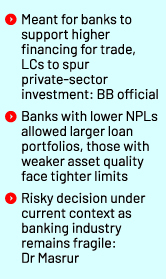
Contacted for an elaboration, a BB official said the central bank revised the single-party borrowers' exposure ceiling to spur private-sector investment amid prolonged economic sluggishness.
Citing an example, he says a bank having capital worth Tk 10 billion could previously lend a maximum of Tk 1.50 billion to one borrower group. Under the revised rule, the limit rises to Tk 2.50 billion.
The central bank also reduced the conversion factor used for non-funded exposure from 50 per cent to 25 per cent on a temporary basis. This means banks will count a smaller portion of instruments such as LCs and guarantees while calculating exposure limits.
Bankers appear are happy that the latest relaxation would create additional lending space on banks' balance sheets and help them finance larger trade transactions without breaching regulatory exposure limits.
They say many banks were approaching exposure ceilings while financing large corporate groups, import activities and trade-related obligations.
According to the circular, the relaxation on non-funded exposure calculation will remain effective until June 2027. The conversion factor will then gradually increase to 30 per cent by the end of 2027, 40 per cent by the end of 2028 and 50 per cent by the end of 2029 before returning to the original rule from January 2030.
The central bank also revised the large-loan-portfolio framework by linking lending capacity with banks' classified loan levels. Banks with lower non-performing loans (NPLs) will be allowed larger loan portfolios while those with weaker asset quality will face tighter limits.
For example, banks with classified loans of up to 10 per cent will be allowed to maintain large loan portfolios equivalent to 50 per cent of total loans and advances. For banks having classified loans exceeding 30 per cent, the limit will fall to 30 per cent.
In 2022, the central bank tightened single-borrower-exposure rules to reduce excessive concentration of loans among large business groups.
Although businesses hail the move, money-market experts caution that increasing the single-borrower limit raises concentration risks for banks, as defaults by large corporate groups could have a proportionately bigger impact on financial stability.
President of Bangladesh Knitwear Manufacturers and Exporters Association (BKMEA) Mohammad Hatem terms this as a good initiative particularly for the good borrowers.
"But it is unfortunate that banks in some cases are not scrutinising the borrowers, which causes the risks in the financial system. I think the status of the real borrowers should be properly assessed," he says.
Founding chairman of Policy Exchange Bangladesh Dr M Masrur Reaz, however, finds this a risky decision under the current context because the banking industry as a whole remains fragile.
The economist notes that the numbers of business group rise and their business avenues keeps expanding. "So, the financing demand of the conglomerates is also increasing."
Before issuing the circular, Mr. Masrur says, the banking regulator should have conducted careful analysis whether the banks are ready to take such increased funding pressure because 30 per cent of the outstanding loans in the sector are classified.
The central bank should concentrate on improving asset quality and capital base of the banks before going for such relaxation. "It (the relaxation) will further intensify the ongoing vulnerability in banks," the economist says on a note of concern.
Dr. Md Touhidul Alam Khan, Managing Director & CEO of NRBC Bank PLC, takes it as a "timely initiative" from the central bank considering the overall sluggish economy and credit growth.
"It will be beneficial to the country and performing business and industrial units, keeping in mind the gradual devaluation BDT to USD," he says.
He also opines that due to this circular, smaller banks may get the opportunity to extend their support to "the good and tested customers".
"However, we need to be very careful while taking extra exposure on large corporates due to high NPL experiences."
jubairfe1980@gmail.com
© 2026 - All Rights with The Financial Express

