The central bank has unveiled a medium-term roadmap to reduce mounting non-performing loans (NPLs) through stricter supervision, faster loan recovery, legal reforms and adoption of internationally practised expected credit-loss standards.
"The level of NPLs remains a key focus area for the banking sector, affecting bank profitability, capital adequacy ratios, liquidity distribution, and the transmission efficiency of monetary policy," the central bank said in its latest Monetary Policy Statement (MPS) for July-December 2026 published on Tuesday.
A key element of the Bangladesh Bank (BB) medium-term roadmap is adoption of the Expected Credit Loss (ECL) framework under IFRS (International Financial Reporting Standard) 9, replacing the existing rules-based provisioning system by 2027.
The BB's latest initiatives come amid a continued rise in classified loans despite a series of policy measures taken by the central bank in recent years.
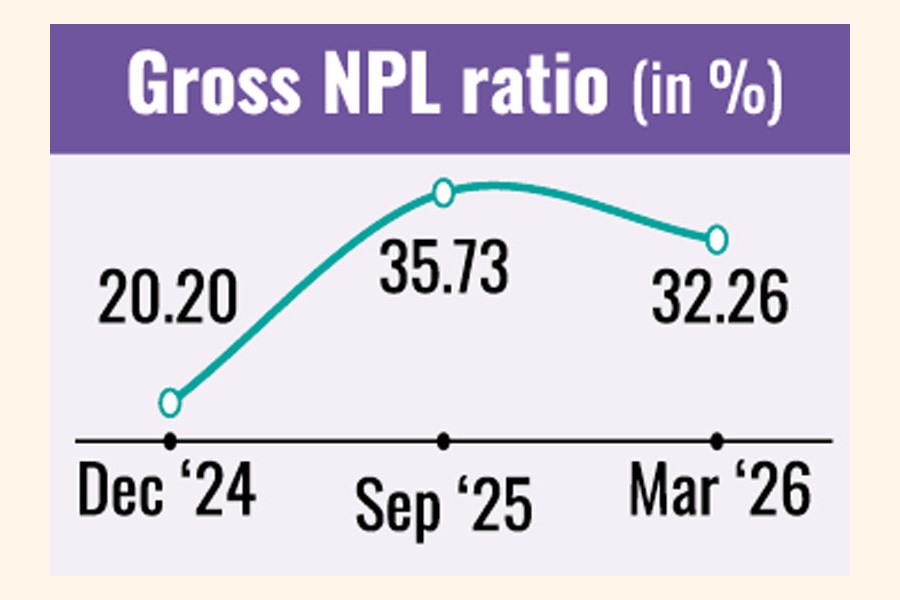
According to the latest assessment, the gross NPL ratio rose from 20.20 per cent in December 2024 to 35.73 per cent in September 2025, before moderating to 32.26 per cent in March 2026.
Under the roadmap, the central bank has outlined a series of structural measures to strengthen NPL management over the medium term.
As part of the strategy, the central bank will strengthen Risk-Based Supervision (RBS) and conduct bank-specific Asset Quality Reviews (AQRs), with particular focus on institutions exposed to governance weaknesses or high credit concentration risks.
The roadmap also links capital restoration and provisioning plans to asset recovery performance, dividend restrictions and supervisory actions. Loan restructuring will be limited to viable businesses, while non-compliant borrowers will face legal and regulatory action.
To accelerate loan recovery, the BB plans to establish specialised recovery units within banks, strengthen legal departments, expedite proceedings under the Artha Rin Adalat (Money Loan Court), and improve collateral enforcement mechanisms.
The roadmap is also backed by two newly-enacted laws -- the Bank Resolution Act 2026 and the Deposit Protection Act 2026 -- intended to give authorities stronger tools to resolve any issue of troubled banks, safeguard retail depositors, and reduce moral hazard in the financial system.
The central bank will also support implementation of the ECL framework by strengthening data infrastructure and enhancing credit risk modelling to detect deterioration in credit quality at an early stage.
Besides, the Distressed Asset Management Act (DAMA) is being finalised to allow banks to offload non-performing assets without utilising taxpayer funds, while targeted reforms to the Money Loan Courts Act will fast-track asset recovery.
Regarding targeted reforms to the Money Loan Courts Act, BB Governor Md. Mostaqur Rahman told reporters that the central bank already recommended settling any cases under the Courts within six months that will help reduce the volume of NPL in the banking sector.
siddique.islam@gmail.com
© 2026 - All Rights with The Financial Express

