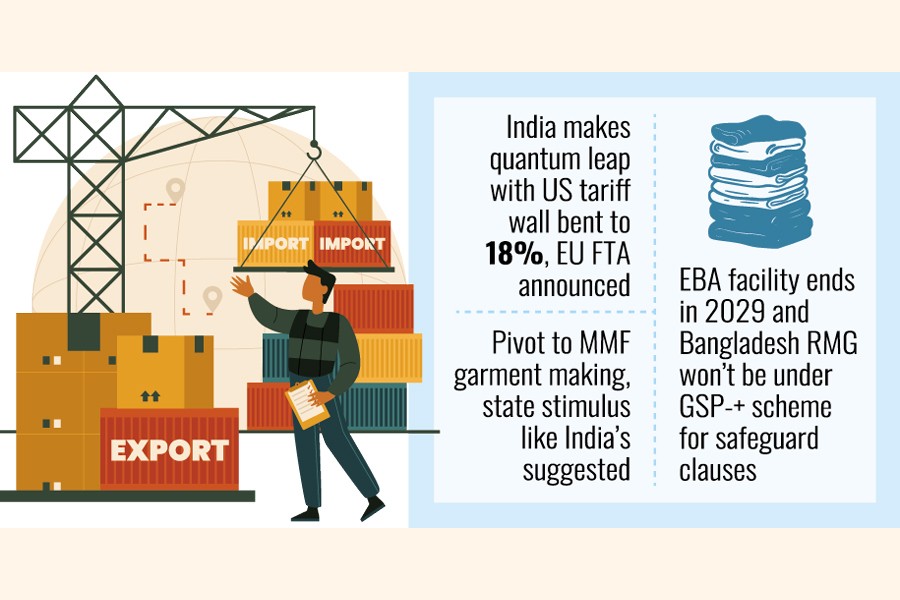
Bangladesh is destined to face break-neck competition both in US and EU markets with India emerging as a major competitor with double advantages of Washington-proposed tariff cutback and trade deal with the 27-nation European bloc.
Industry insiders and experts sound the alarm over the headwinds about to blow from the two destinations Bangladesh heavily bank on for its readymade garment export -- the nation's main export earner -- and urge government action.
The recent announcement of lowering tariffs on Indian-made goods may be subject to as low as 18-percent tariffs, knocked down from the earlier-imposed 50 per cent. The brusque move from Washington came a week after the announcement of the trade deal between India and European Union.
Bangladesh should immediately act to retain duty -free market access to the European Union and enhance its competitiveness by removing supply-side constraints, industry leaders urge.
A slew of must-dos they list to overcome possible impact of the trade deal between the EU and India: coordinated reforms across trade policy, energy pricing and reliability, logistics and ports, access to finance, skills development and regulatory capacity building.
They also stress both product diversification, mostly by way of producing manmade fibre- based garments, and market diversification through exploring potential non-traditional markets.
Local garment exporters will face cutthroat competition and increased price pressure on the EU market after the free-trade agreement (FTA) announced recently between the EU and India comes into effect, possibly in 2027, as it would grant the neighbouring country's garment makers access to the bloc sans duty on apparel exports, they note.
On the other hand, Bangladesh's current duty-free market access there under EBA (everything but arms) scheme is scheduled to end in 2029 as the county is set to graduate from LDC status this coming November 2026 with a three-year transition period.
Though Bangladesh can apply for GSP- plus facility, its garment products would not get duty-free market access there due to safeguard clauses and are likely to face about 12-percent duty, they said, adding that by this time, another competitor - Vietnam -- would also get duty-free market access.
Talking to The Financial Express, Md Shehab Udduza Chowdhury, vice president of Bangladesh Garment Manufacturers and Exporters Association (BGMEA), said India would be in an advantageous position with reduced rate of 18-percent tariffs compared to 20 per cent for Bangladesh.
On the other hand, the trade deal between the EU and India will be 'dangerous' for them, he said, apprehending a possible threat of losing market share there.
"The impact of the deal would be severe for us. Bangladesh is currently facing tough competition on the EU market as India and China are enhancing their focus there to offset US high-tariff impacts," says Faruque Hassan, managing director of Giant Group.
Bangladesh will become less competitive on the EU market once India secures duty-free access there, he warns.
The first and foremost tasks must be to sustain the duty-free market access there, the apparel maker-exporter told the FE, adding that the government also should initiate move to sign FTA to have an even footing on the largest market as a bloc.
Meantime, Chief Adviser of the interim government Prof Muhammad Yunus Sunday directed opening free-trade agreement (FTA) negotiations with the EU forthwith to safeguard Bangladesh's trade preferences on its largest export market.
MA Razzaque, chairman of Research and Policy Integration for Development (RAPID), says the US tariff reduction for India might not immediately affect the local garment shipment over there as Indian competitive advantage would not change because it is in disadvantage due to existing higher tariffs.
"But Bangladesh will face tremendous pressure in the medium term of three to five years as the EU-India trade deal would bring extreme challenges," he told the FE, explaining India with its backward linkages, including cotton to yarn and fabrics, will be a major competitor for Bangladesh which has to depend on imported raw materials.
Besides, there are no supply-side constraints for other major garment-producing countries like India, Vietnam, Indonesia, Cambodia and Pakistan as Bangladesh face, he adds.
The country has to immediately take measures to remove the supply-side constraints like gas and energy shortages, provide supports to the exporters to be ESG-compliant, develop skilled workforce, and reduce electricity and utility costs, ensure special bank interest rate and simultaneously attract foreign direct investment in RMG sector to boost MMF production.
"To ensure global work orders, FDI is a must for RMG and also for overall export diversification," he notes.
Local exporters will also face price pressure as India would be more competitive, says MA Rahim, vice chairman of DBL Group.
The entrepreneur, however, thinks the EU-India deal would not impact Bangladesh's export immediately, but it would affect gradually.
"India will be a strong future competitor for Bangladesh as the neighbouring country has its own raw materials, including cotton, yarn and fabrics, low labour cost while government facilitates the sector with a number of packages to increase competitiveness," Fazlul Hoque, managing director of Plummy Fashions, points out to underscore the urgency of counterbalancing actions.
Besides, India will jump into the market with better market access also to offset the high tariffs imposed by US administration, he notes.
Echoing Hassan's anxiety, Hoque, who ships up to 80 per cent of his total exports to the EU, says they immediately need government support to reduce cost of production and cost of fund, ensure uninterrupted gas supply and other issues that have been eating up competitiveness.
Hoque voices a consequential note: If Bangladesh fails to secure the duty-free market access under GSP-plus or a bilateral free-trade deal after LDC graduation, it will be out of the market.
The industry also needs to diversify its markets and products and produce manmade-fibre garments, exporters suggest.
They have also demanded incentives for attracting both local and foreign investment into man-made fibre or MMF wears to sustain export growth.
In the last fiscal year of 2024-25, the European Union accounted for more than 50 per cent, coming to US$19.71 billion, of Bangladesh's total garment exports worth over 48 billion US dollars.
Munni_fe@yahoo.com
© 2026 - All Rights with The Financial Express

