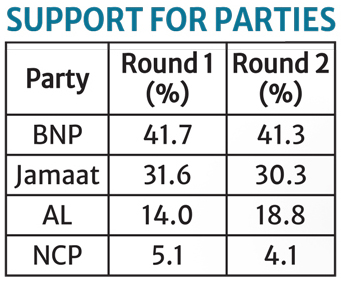
 A majority of respondents - 41.3 per cent - in a latest survey said they would vote for the BNP, while 30.3 per cent showed interest in the Jamaat-e-Islami and 18.8 per cent in the Awami League (AL).
The survey found that support for the BNP remained relatively stable compared to the previous round, when 41.7 per cent supported them.
Support for Jamaat slightly decreased to 30.3 per cent from 31.6 per cent.
However, the most notable finding was the increase in support for the Awami League to 18.8 per cent from 14 per cent.
The findings of the survey titled "People's Election Pulse Survey (PEPS) round 2" were presented at a press conference at the National Archives Auditorium in the capital's Agargaon on Wednesday.
Innovision Consulting, an international advisory and management consulting firm, conducted the survey with technical support from Bangladesh Research Analysis and Information Network (BRAIN) and Voice for Reform, a platform for advocating policy reforms.
The survey was conducted between September 2 and 15 of this year.
It was a follow-up to round 1, which was carried out from February 19 to March 3.
The sample size was 10,413 eligible voters - 69.5 per cent from rural areas and 30.5 per cent from urban ones.
The samples covered eight divisions, 64 districts, and 521 primary sampling units (PSUs).
According to the survey, the share of respondents who said they would vote for the National Citizen Party (NCP) fell to 4.1 per cent from 5.1 per cent in the first round.
If the Awami League cannot participate in the national elections, the BNP will get 45.6 per cent of the votes, and Jamaat 33.5 per cent, it found.
Regarding Awami League's participation in the next national elections, opinions were almost evenly divided. 45.79 per cent said all parties should have the opportunity to contest in the polls, while 45.58 per cent said the Awami League should not be allowed to participate before a trial.
Respondents from universities - 63.05 per cent - favoured excluding the Awami League until a trial, while those from households were more inclined to include them.
Men, urban residents, and the younger generation (Gen Z) were more likely to oppose the Awami League's participation before a trial.
A large majority of respondents wanted a good relationship with both India (72.2 per cent) and Pakistan (69.0 per cent), though a slightly larger percentage favoured distancing from India than Pakistan. The survey had a section to understand the level of dissatisfaction with political parties.
The Awami League faced the highest level of dissatisfaction (33.43 per cent), followed by the BNP at 27.6 per cent, Jamaat at 19.7 per cent, and NCP at 17 per cent.
In terms of voting intention, the BNP was ahead in six divisions, while Jamaat led in Rangpur, Awami League in Barishal, and NCP in Chattogram.
Rubaiyath Sarwar, managing director of Innovision Consulting, led the survey and presented the key findings on Wednesday.
Dr Asif M Shahan, a professor of development studies at the University of Dhaka; Fahim Mashroor, joint convener at Voice for Reform; Shafiqul Rahman, executive director of BRAIN; and Zyma Islam, senior reporter at The Daily Star; took part in a discussion after the findings were revealed.
Fahim said young voters would be an important factor in the national elections.
"Young people are going to cast their ballots for the first time. Their inclination towards parties is not understood yet," he said.
Asif said the two rounds of the survey revealed the number of indecisive voters decreased over the period.
"The more the national elections come closer, the higher the decrease in the number of indecisive voters would be," he said.
saif.febd@gmail.com
© 2026 - All Rights with The Financial Express

