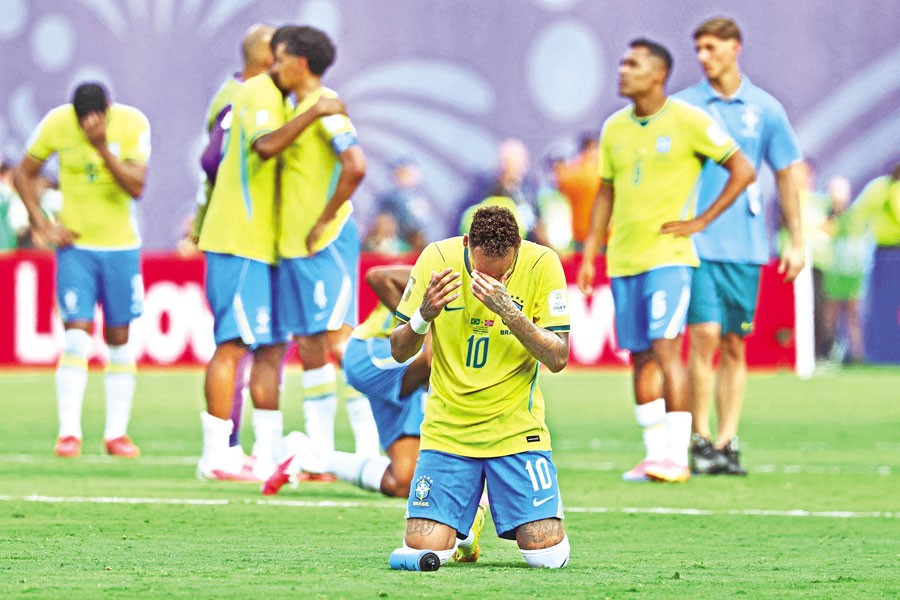
 Brazil's forward #10 Neymar reacts after losing the 2026 World Cup round of 16 football match between Brazil and Norway at the New York/New Jersey Stadium in East Rutherford on Monday.— AFP
 Brazil's 2-1 defeat to Norway on Monday (as per BST) in the FIFA World Cup round of 16 was decided by moments. But it was also the culmination of problems that have been building for more than two decades, report agencies.
The defining image came just 14 minutes into the match. Vinícius Júnior, Brazil's leading scorer at the tournament, stood over the penalty spot with a golden opportunity to put his side ahead. Instead of taking the kick himself, he handed the ball to Bruno Guimarães, whose effort was brilliantly saved by Norway goalkeeper Ørjan Nyland.
By the time Neymar converted another penalty deep into stoppage time-what he later suggested was his final World Cup appearance-it was too little, too late. Brazil's earliest World Cup exit since 1990 was confirmed.
The missed penalty was more than a turning point in one match. It symbolized a team that has lost the confidence, conviction and identity that once made Brazil the benchmark of world football.
Carlo Ancelotti's task had always bordered on impossible. In the tournament's 96-year history, no foreign coach had ever guided a team to the World Cup title. More importantly, the Italian inherited a national side burdened by two decades of disappointment since lifting its fifth World Cup trophy in 2002.
His appointment generated hope that his tactical expertise and vast experience would restore Brazil to the top. Instead, the tournament exposed how far the Seleção have drifted from their traditional identity.
For generations, Brazil represented Jogo Bonito-football built on creativity, flair and fearless attacking play. The unforgettable 1982 team, despite failing to win the tournament, remains celebrated for its artistry. Twenty years later, Luiz Felipe Scolari's side, powered by Ronaldo, Rivaldo and Ronaldinho, won every match on the way to lifting the trophy.
The current Brazil looked nothing like those iconic teams.
Apart from flashes of brilliance from Vinícius Júnior, the team struggled to create chances consistently. The midfield lacked imagination, the attack lacked cohesion, and Ancelotti's side often appeared overly cautious instead of embracing the adventurous football that once defined the nation.
The decline, however, did not begin under Ancelotti.
The warning signs had been visible for years. Brazil were eliminated by France in the 2006 quarter-finals, the Netherlands in 2010, Belgium in 2018 and Croatia in 2022. The traumatic 7-1 defeat to Germany on home soil in 2014 became the most painful symbol of that decline, but it was merely the most dramatic chapter in a longer story.
Since winning the World Cup in 2002, Brazil have now lost every knockout match against European opposition.
Coaching changes have brought little improvement.
Tite departed after Qatar, Fernando Diniz lasted only six qualifying matches, and Dorival Júnior was dismissed following a Copa América quarter-final exit. Ancelotti eventually secured World Cup qualification, but Brazil finished only fifth in South American qualifying, 10 points behind Argentina. Against Norway, those long-standing issues resurfaced.
The decision to let Guimarães take the first penalty immediately became one of the tournament's biggest talking points. Ancelotti later explained that Brazil had spent a year analysing penalty-taking data. Neymar and Raphinha ranked as the team's best takers, but Neymar was still on the bench while Raphinha was injured, making Guimarães the preferred option on the pitch.
The statistics made sense. The outcome did not.
It was Brazil's first missed World Cup penalty during normal play since 1986, and Nyland's save transformed the match. The Norwegian goalkeeper grew in confidence, producing a series of outstanding saves as Brazil's frustration mounted.
Neymar's late goal carried historic significance, making him only the second Brazilian after Pelé to score in four different World Cups. Yet individual milestones could not disguise another collective failure.
After the final whistle, captain Marquinhos accepted responsibility, urging Brazilian supporters to stand behind the next generation rather than blame them. Ancelotti also vowed to stay, insisting the defeat should become "the start of a new adventure."
He acknowledged that Brazil's ageing squad needs fresh talent capable of leading the national team into the future.
That may be true, but Brazil's problems extend beyond personnel.
This is not simply a team in transition. It is a footballing giant searching for its identity. The nation that once dazzled the world with instinctive attacking football now often looks hesitant, predictable and overly dependent on tactical calculations.
© 2026 - All Rights with The Financial Express

