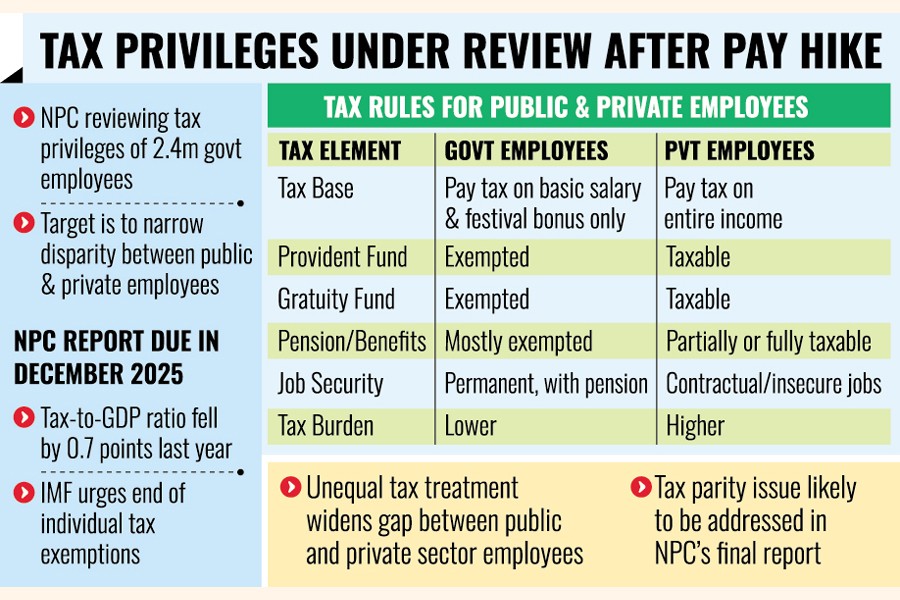
The National Pay Commission (NPC), now working on a new pay scale for government servants, is going to undertake a review of tax privileges enjoyed by the latter to minimize long-persistent disparity with private employees.
It is a long-debated issue which seems still sidelined in the interim government's reform agenda while it is engrossed in raising Bangladesh's low-rated tax-to-GDP ratio, which further slipped 0.7 notches last year.
Recently, the National Pay Commission, headed by former Finance Secretary Zakir Ahmed Khan, sought a report from the National Board of Revenue (NBR) on what tax privileges government officials enjoying now.
The Terms of Reference (ToR) of the commission has this agenda to work on taxation part of the government employees. The NPC is likely to submit its report by December next.
Last week, the NPC circulated survey questionnaire that also do not include taxation part to get stakeholder views.
A senior member of the commission clarifies that the survey questions were prepared for general perspective by avoiding technical and complex issues.
The Pay Commission will sit with different stakeholders and chamber bodies from this month to discuss such "tricky issues", he says.
Revenue officials say the government has also faced pressures from the International Monetary Fund (IMF) to withdraw such entire tax exemptions on individual taxpayers.
Currently, government officials under the eighth pay scale pay income tax only on their basic salary and festival bonus whereas private employees have to pay taxes on their entire income.
Even, provident fund and gratuity fund of private-sector employees are also taxable while the same of their counterpart enjoy exemption.
A number of officials familiar with the Pay Commission's work have said the body is working on this hiatus.
Sources in the NPC say pay hike and upward adjustment of gratuity and provident fund in the pay scale will be proposed as all of the NPC members came into consensus while tax issues may see a revision.
Former president of the Bangladesh Employers Federation Fazlul Huq says such disparity triggers income inequality in a society. "Pay hikes and equal tax treatment are both justified."
Dr Iftekharuzzaman, Executive Director of the Transparency International Bangladesh (TIB), says tax on income is applicable to all--there is "no logic of such deviation".
However, bureaucracy in the state structure supports such privilege so no government can scrap these privileges, he adds.
"If good governance and accountability ensured, such privileges could be justified," he notes in his tax-exemption critique.
Article 27 of the Bangladesh Constitution clearly states "All citizens are equal before the law and are entitled to equal protection of the law."
Constitution-expert Dr Shadeen Malik, however, supports this privilege, terming it 'reasonable classification' although article 27 of the constitution ensures equal law for all citizens.
"It is not absolute as salary and facilities in public services are capped while it is open for private officials," he says to underpin his view.
Government service-holders, constitutional post-holders and the judiciary are the highest beneficiaries of the current income-tax law.
Dr Iftekharuzzaman thinks the privileges or positive incentives must accompany negative incentives and must come with conditions and justification.
Economists and tax experts say Bangladesh cannot afford tax-exempted income for a vast majority of individual taxpayers who are government employees in the pay scale.
Most of the private-sector salaried employees have no retirement benefits, pension, job security.
Purchasing power of the private-sector officials is getting eroded with the consistent inflationary pressure and surging cost of living.
Recently, Finance Adviser Dr Salehuddin Ahmed said the interim government was going to implement a new pay scale in its tenure-and his disclosure triggers a train of thoughts on disparity paradigm.
Experts argue that applying two different sets of tax laws within the same country contradicts constitutional principles, fosters discrimination, undermines justice, and is largely driven by political interests.
Around 2.4 million officials under the National Pay Scale are enjoying lucrative tax waivers.
Dr Fahmida Khatun, Executive Director of the Centre for Policy Dialogue (CPD), thinks it is not unjustified that government officials should enjoy some privileges but initiatives to minimize inequality by expanding social-safety net in health and education must prevail for poor and underprivileged group of people.
doulotakter11@gmail.com
© 2026 - All Rights with The Financial Express

