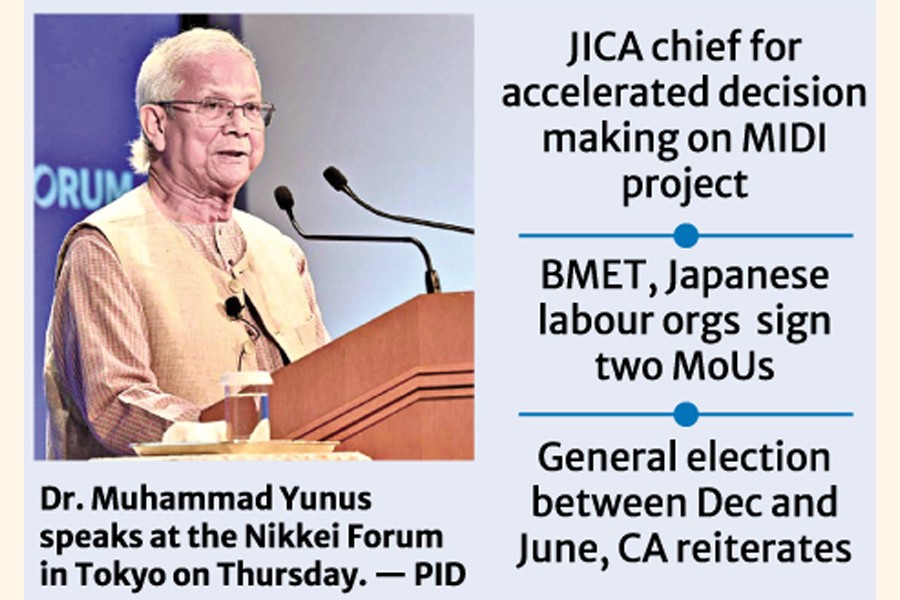
Chief Adviser Prof Muhammad Yunus has requested Japan International Cooperation Agency (JICA) to bolster its support for the Moheshkhali-Matarbari Integrated Development Initiative (MIDI) to transform the seaside into a multimodal hub for quickening Bangladesh's economic growth.
"The MIDI region represents the future of Bangladesh...With access to the Bay of Bengal, we are developing deep-sea ports, highways, and railway links to connect the MIDI region with Nepal, Bhutan, and other parts of South Asia," he told the Japanese development-financing agency's chief.
The appeal was made during a meeting with JICA President Dr Tanaka Akihiko on the sidelines of the 30th Nikkei Forum: Future of Asia, held at the Imperial Hotel in Tokyo, said a spokesperson for the CA Office on Thursday.
JICA initially proposed the development of a deep-sea port at Matarbari. The Interim Government, under Professor Yunus's leadership, is now formulating a comprehensive master plan to transform the entire MIDI region into a hub for ports, logistics, fishing, energy, and power.
"Our vision includes building a megacity in the region," Professor Yunus added, noting that airports are also being upgraded to accommodate increased travel demands.
Dr Tanaka reaffirmed JICA's commitment to the MIDI development but emphasised the need for accelerated decision-making to expedite project implementation.
In response, the head of Bangladesh's post-uprising government announced plans to appoint a senior official to oversee MIDI projects and coordinate efforts with JICA and other potential foreign investors.
The Chief Adviser also revealed plans to establish free-trade zones within the MIDI area, inviting foreign investors to set up manufacturing plants aimed at export markets.
Furthermore, the government intends to create an exclusive fisheries zone in the region, enabling large fishing vessels to operate.
"We need to engage in deep-sea fishing," Professor Yunus explains. "Currently, fishing vessels from neighbouring countries exploit these waters, while our trawlers are too small for deep-sea operations. By developing our capabilities, we can process the catch in the fisheries zone for both export and domestic consumption."
Dr Tanaka remarked that this was possibly the first time he had heard a Bangladeshi leader discuss deep-sea fishing initiatives.
The two sides also discussed Bangladesh's reform agenda following the July uprisings, the country's democratic transition, and the Interim Government's anti-corruption efforts.
Professor Yunus confirmed that general election is scheduled to be held between December and June, after which he plans to return to his previous work once an elected government assumes office.
Additionally, the Rohingya crisis was discussed, with the Chief Adviser seeking increased JICA support for humanitarian responses.
Dr Tanaka expressed his agency's willingness to participate in international efforts addressing the Rohingya crisis.
Meanwhile, Japanese authorities and businesses Thursday announced at an event their plans to recruit at least 100,000 workers from Bangladesh over next five years to meet the country's growing worker shortages, said a spokesperson for the CA Office said.
Chief Adviser Professor Muhammad Yunus, now in Tokyo on a visit, witnessed the signing of two memorandums of understanding at the event organised at Toshi Kaikan conference hall in the Japanese capital.
The first one is between Bangladesh's Bureau of Manpower Employment and Training (BMET) and Kaicom Dream Street (KDS), a Japan-Bangladesh joint venture, and the second between Bangladesh's BMET and Japan's National Business Support Combined Cooperatives, a business federation with over 65 receiving companies operating in Japan, and JBBRA or Japan-Bangla Bridge Recruiting Agency.
mirmostafiz@yahoo.com
© 2026 - All Rights with The Financial Express

