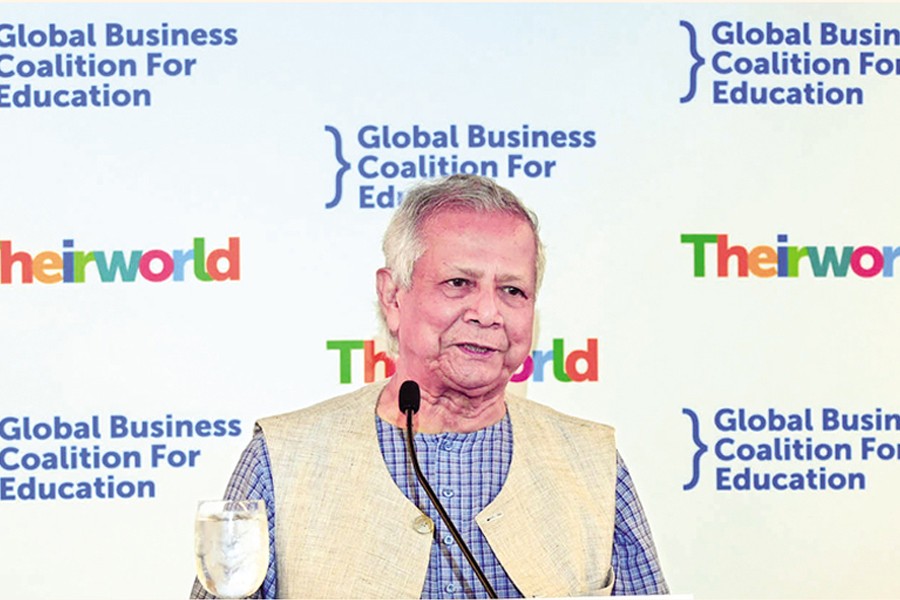
 Chief Adviser Professor Muhammad Yunus speaks at a UN side event on 'Social Business, Youth and Technology' at the UN headquarters in New York on Tuesday. — PID
 Bangladesh seeks international community's ramped-up financial and technical support for countries in transition as reducing aid or cutting UN budgets would prove "counterproductive" during deepening global crises.
Chief Adviser of the interim government Prof Muhammad Yunus made the call at a UN high-level side event on 'Social Business, Youth and Technology' at the United Nations headquarters in New York on Monday.
The Nobel-laureate microfinance pioneer reminds the comity of nations that the world now stands "at a crossroads", faced with the interwoven challenges of climate breakdown, widening inequality, and escalating conflicts.
"These crises are not isolated…They are intertwined-threads of a fragile tapestry, each pulling at the other, shaping the whole of our existence. The power to mend this tapestry does not lie in the past-it lies in the future we dare to imagine, and in the choices we make here and now."
Highlighting Bangladesh's own vulnerabilities, Yunus notes the country is preparing to graduate from least- developed country (LDC) status while managing repeated climate shocks, global economic turbulence, and the burden of hosting 1.3 million Rohingya refugees.
"In such a context, shrinking official development assistance would only intensify the strain," he warns.
The Chief Adviser made a strong international appeal that the world must redouble efforts to expand support and ensure "a just transition for nations facing heightened vulnerability".
Prof Yunus, long recognised as a pioneer of social business, urged a shift away from an economic system "dominated by the relentless pursuit of profit over people".
Instead, he presses for a new model where businesses serve social and environmental goals as much as financial ones.
"Social business is not a niche idea," he said. "It is proof that another world is possible-one where commerce serves humanity, where growth includes everyone, and where profit is measured not only in financial returns but in lives improved, communities strengthened and our planet healed."
He places particular emphasis on the role of the youth in shaping this new vision, urging "the architects of the future" to channel creativity and technological innovation into solving pressing global problems, from climate change to unemployment.
"Unlike previous generations, shaped by outdated systems, today's youth see what could be, not just what is," he said.
Yunus also stresses that emerging technologies-such as artificial intelligence, blockchain and the Internet of Things-must be deployed responsibly.
"The future of technology must be shaped not by ambition alone, but by conscience…"We need more than technical innovation-we need ethical innovation."
Outlining his vision of a "three-zero world"--zero net carbon emissions, zero wealth concentration, and zero unemployment--he urged young people to join "3-Zero Clubs" that commit to living sustainably, minimising waste, and embracing social entrepreneurship.
Closing his address, the head of prost-uprising government of Bangladesh called for unity and renewed multilateralism.
"If we join hands-harnessing the power of social business, the energy of youth and the potential of technology-we can untangle even the most complex global crises. Let us become architects of a new wave-a world built on justice, sustainability and hope."
Meanwhile, several dignitaries met with Chief Adviser Prof Yunus on the sidelines of an event at the UN headquarters, a spokesperson for the CA Office said on Tuesday. Among them were former British Prime Minister Gordon Brown and Queen Mathilde of Belgium.
The Chief Adviser was scheduled to attend the inaugural session of the 80th UNGA on Tuesday.
The same day, he was scheduled to meet the DG of the World Trade Organisation, the President of the World Bank, Ms Máxima, Queen of the Netherlands, and Kris Licht, CEO, Reckitt Benckiser. Also on his busy the schedule is attending a reception hosted by the President of the United States and Mrs. Melania Trump on Tuesday evening.
Meanwhile, BSS adds: Chief Adviser Professor Muhammad Yunus attended the inaugural session of the United Nations General Assembly at the UN Headquarters in the USA Tuesday.
He was accompanied by Energy Adviser Fouzul Kabir Khan, Foreign Adviser Touhid Hossain, and Law Adviser Asif Nazrul.
Prior to the session, the Chief Adviser met with Uruguayan Foreign Minister Mario Lubetkin, former Chilean President Michelle Bachelet, who also served as the United Nations High Commissioner for Human Rights from 2018 to 2022, and President of the World Bank Ajay Banga.
The Chief Adviser was scheduled to join numerous meetings and programmes with distinguished individuals on Tuesday, including a reception hosted by United States President Donald Trump and Mrs. Melania Trump, and a meeting with the President of the World Bank.
Later in the day, the Chief Adviser was set to join a "Meeting of Public and Private Sector Leaders on Social Innovation: Mobilising Financing through Social Innovation" at 2:45 pm in New York.
mirmostafiz@yahoo.com
© 2026 - All Rights with The Financial Express

