A slew of far-reaching ordinances and policy proposals get the interim government's nod to unclog long-stalled reforms in higher education, trade and governance while Bangladesh heads towards a crucial electoral moment.
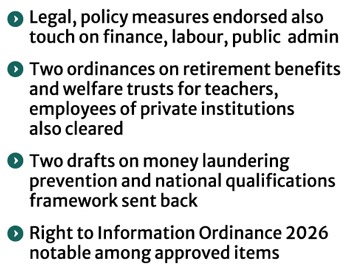 At a weekly meeting of the Advisory Council, chaired by Chief Adviser Professor Muhammad Yunus, ministers signed off on 11 out of 13 agenda items, including the long-anticipated Dhaka Central University Ordinance 2026, and a proposal to conclude Bangladesh-Japan Economic Partnership Agreement (BJEPA).
Two drafts - on money laundering prevention and the national qualifications framework - were sent back for further scrutiny, a move officials framed as evidence of deliberation rather than haste.
The most politically and socially resonant decision is the endorsement of the Dhaka Central University Ordinance aimed at bringing seven government colleges in the capital under a single academic umbrella. For years, these institutions - among them Dhaka College, Eden Mohila College and Government Titumir College - have been trapped in administrative limbo, plagued by session backlogs, inconsistent examinations and overlapping oversight between universities and ministries.
Under the new ordinance, the colleges will become affiliated colleges of a newly created Dhaka Central University, while retaining their individual identities, campuses and ownership of assets.
The government argues that this hybrid model avoids the disruption of a full merger while imposing a unified academic calendar, examination system and assessment framework.
The ordinance sets out a comprehensive governance structure: the President will serve as chancellor, a Vice-chancellor will be appointed from a senate-nominated panel, and the university will be overseen by bodies that include a senate, syndicate and academic council. The University Grants Commission will retain inspection and supervisory powers over academic and administrative standards.
Separate schools for arts, science, social sciences, business studies, law and fine arts are envisaged, each led by a head of school.
Admissions will be centralised, combining SSC and HSC results with an entry test, allowing students to enroll either on the main campus or at one of the affiliated colleges.
Supporters see the move as an overdue attempt to rationalise Dhaka's sprawling public college system and restore academic credibility.
Critics, however, warn that success will hinge on implementation: without adequate funding, staffing and autonomy, they argue, a new university could simply add another bureaucratic layer.
Beyond education, the council approved a suite of legal and policy measures touching on finance, labour and public administration.
These include amendments to the Negotiable Instruments Act and the House Building Finance Corporation law, a Gambling Prevention Ordinance, and the repeal of the Bangladesh Private Export Processing Zones Act. Two ordinances affecting teachers and employees of private educational institutions - one on retirement benefits and another on welfare trusts - were also cleared, addressing longstanding demands from staff in the non-government education sector.
Approval for the Right to Information Ordinance 2026 is notable, given Bangladesh's uneven record on transparency. While details of the amendments were not immediately disclosed, civil-society groups will be watching closely to see whether the new law strengthens access to information or dilutes existing safeguards.
Internationally, the council endorsed a draft Mutual Legal Assistance treaty with Malaysia, a step aimed at improving cooperation on criminal matters, including financial crimes and cross-border investigations.
The green light for signing the Bangladesh-Japan Economic Partnership Agreement carries broader economic and diplomatic implications. Japan is one of Bangladesh's largest development partners and a key source of investment in infrastructure, energy and manufacturing.
An EPA could deepen market access, streamline trade rules and signal policy stability to foreign investors at a time when Bangladesh faces pressure from slowing growth, foreign-exchange constraints and looming graduation from the least-developed country (LDC) status.
mirmostafiz@yahoo.com
© 2026 - All Rights with The Financial Express

