China keeps option open for India to join the proposed China-Myanmar-Bangladesh Economic Corridor if it wants to, Chinese Ambassador in Dhaka Yao Wen indicates.
China will not oppose such move. "We are open. We welcome other countries if they are ready. Definitely. But it is up to them to make that decision," he told reporters Thursday
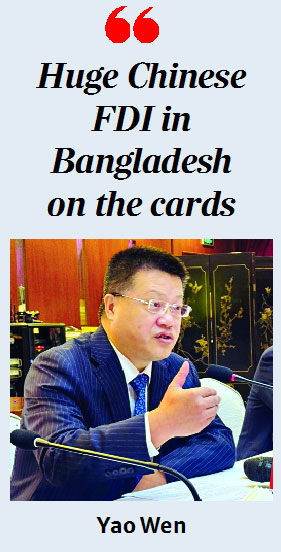 Responding to a question during a media briefing on Prime Minister Tarique Rahman's recent visit to China, the diplomat also said the corridor concept is not new-China proposed the Bangladesh-China-India-Myanmar (BCIM) Economic Corridor years ago.
"However, that could not be achieved. Since China and Bangladesh both want greater regional connectivity, and Myanmar shares the same intention, the three countries can start the initiative together," he added.
"Why can't our three countries begin with what we have now? This cooperation is not the end of the game," the Chinese envoy quipped.
Mr Yao Wen has described Prime Minister Tarique Rahman's recent visit to China as a "complete success" and a historic milestone that has elevated bilateral relations to a new strategic level, paving the way for deeper political trust, expanded economic cooperation, and closer coordination on regional and global issues.
Regarding the Teesta project, the envoy said the project has been conceived by the Bangladesh government which sought China's assistance for its implementation.
Since the project would be vital for the livelihoods of thousands of people in northern Bangladesh, China has agreed to support it, he said and added that during the PM's visit, China agreed to send its top experts to conduct a joint feasibility study with the Bangladesh government.
"The most important thing is that we need a very sound scientific feasibility study. It is extremely important. Whatever we do should be based on a sound feasibility study. China is committed to working with Bangladesh on this and will send its top experts to Bangladesh," he elaborated.
Responding to another question, he said the 2+2 dialogue format is not new for either Bangladesh or China, as Bangladesh has already agreed to establish a similar mechanism with Türkiye.
He mentioned that China has already engaged in the same level of dialogue with several other countries. Since the two countries have entered a new phase of higher-level bilateral relations, such a format is a natural way to deepen engagement.
Under the new format, the two countries will hold regular strategic-level dialogues in addition to meetings between their foreign ministries.
Regarding the implications of the Memorandum of Understanding (MoU) on the Global Development Initiative (GDI), he said, "We have been discussing this for some time, for several years. We are pleased that Bangladesh has now decided to join the initiative by signing the MoU on the GDI. This creates many opportunities for China and Bangladesh to cooperate under this framework.
"More than 190 countries and international organisations around the world have already joined the GDI. We are pleased that Bangladesh has joined this family."
On the prospects for Chinese foreign direct investment (FDI), Yao Wen said during the visit, many Chinese companies expressed interest in investing in Bangladesh, and the Chinese economic and industrial zones in Bangladesh would provide a strong platform for such investment.
According to the Chairman of the Bangladesh Investment Development Authority (BIDA), he said, Chinese companies have so far committed investments worth US$9 billion in Bangladesh.
Responding to another question, the ambassador said Prime Minister Tarique Rahman's father and mother had made tremendous contributions to strengthening China-Bangladesh relations.
"We all understand that our relations were founded by his father, the late President Ziaur Rahman. Those ties were further strengthened when his mother, Begum Khaleda Zia, served as Prime Minister. She visited China at least three times in her capacity as Prime Minister of Bangladesh.
"Now her son, Prime Minister Tarique Rahman, is committed to carrying forward his family's tradition. He also seeks greater support from China for Bangladesh's socioeconomic development," he noted.
"The leaders of the two countries had candid and productive discussions. They reached important new consensus and sent a clear message of stronger communication, deeper mutual trust and closer cooperation."
According to the ambassador, the visit injected "strong momentum" into the future development of China-Bangladesh relations and marked "a milestone in the history of China-Bangladesh relations."
The ambassador said the most significant outcome of the visit was the decision to upgrade the existing China-Bangladesh Comprehensive Strategic Cooperative Partnership into a 'China-Bangladesh Community with a Shared Future in the New Era'.
He described the move as representing the highest level of China's relations with its friendly neighbours in Asia and says it reflects deeper mutual trust, stronger solidarity, closer cooperation and greater convergence of interests between the two countries.
As part of the new framework, the two sides have agreed to maintain high-level exchanges, enhance cooperation between governments, legislatures and political parties, strengthen mutual learning on governance, establish a strategic dialogue mechanism between their foreign ministers and explore a "2+2" dialogue involving diplomacy and defence officials.
Quoting Chinese President Xi Jinping, Ambassador Yao said Beijing would remain a trustworthy friend, neighbour and development partner of Bangladesh regardless of changes in the international environment.
He also noted that Prime Minister Tarique Rahman regards China as a trusted partner that occupies an important place in Bangladesh's foreign policy.
Highlighting what he termed a "new level of trust through mutual support," Ambassador Yao says China reaffirmed its backing for Bangladesh's sovereignty, independence and territorial integrity while expressing support for the government formed after this year's general election.
He said China has also become first country to include support for Bangladesh's "Bangladesh Before All" policy in an official bilateral document.
On the Bangladesh side, he says, Dhaka reaffirmed its commitment to the 'one-China' principle by recognising that Taiwan is an inalienable part of China and opposing all forms of "Taiwan independence".
"I would like to stress here that the current government has taken a more positive and constructive position on the Taiwan question than previous governments. This fully demonstrates Bangladesh's stronger support for China's core interests," the envoy told the reporters.
The ambassador mentioned that the two countries agreed to deepen high-quality cooperation under the Belt and Road Initiative by aligning their development strategies and expanding collaboration in green development, the digital economy, information technology, artificial intelligence, finance, healthcare, education and cultural exchanges.
The two sides have also agreed to continue implementing major flagship infrastructure projects, including cooperation in ports and water-resource development.
Among the key outcomes of the visit, Bangladesh announced that it will establish its first overseas investment office in China to facilitate greater investment cooperation between businesses of the two countries.
mirmostafiz@yahoo.com
© 2026 - All Rights with The Financial Express

