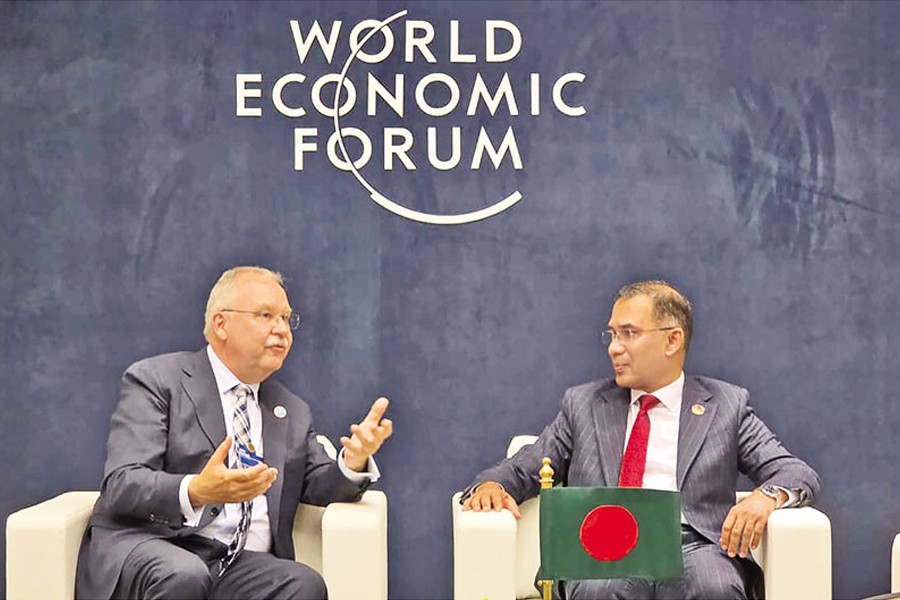
 World Economic Forum (WEF) President Alois Zwinggi meets Prime Minister Tarique Rahman at the Dalian International Conference Center in China on the sidelines of the WEF Annual Meeting on Tuesday. — PID
 Prime Minister Tarique Rahman has made an international appeal to prioritise three cardinal issues like operationalising the Loss and Damage Fund, making climate finance more accessible and adaptation alongside mitigation to offset the adverse impacts of climate change.
"Climate resilience cannot be built by any country alone. It requires partnership, technology, finance, and shared commitment. As we look ahead to COP31 and COP32, we wish to emphasise three priorities," he says.
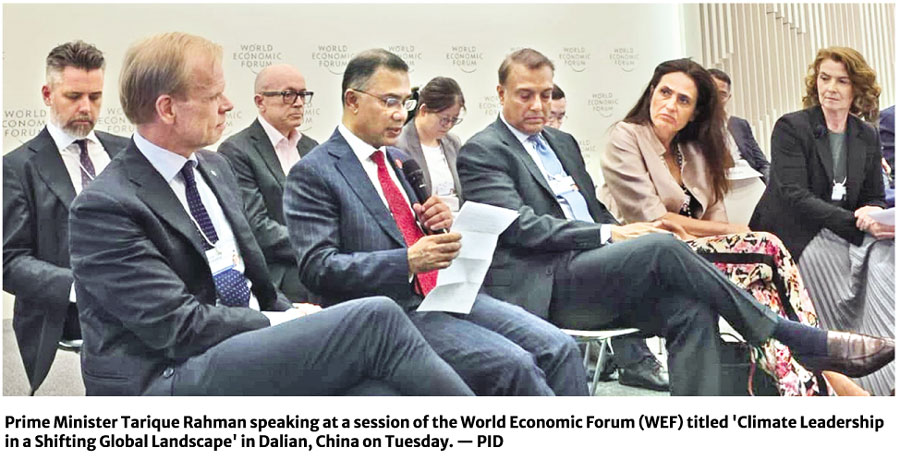
The Prime Minister made the call while addressing a session of the 17th Annual Meeting of the New Champions of the World Economic Forum (WEF), also known as Summer Davos, says a UNB report from Dalian in China.
T titled 'Climate Leadership in a Shifting Global Landscape,' the session was held at Dalian International Conference Centre.
Raising the three priorities, Tarique Rahman said, "First, the Loss and Damage Fund must move from promise to delivery, with accessible and predictable support for victim nations."
"Second, climate finance must become more accessible, concessional, and responsive to the needs of vulnerable countries. It should also accelerate technology transfer and private-sector investment. In this regard, we need greater mobilisation and operationalisation of the Green Climate Fund (GCF)."
And "Third, adaptation must stand alongside mitigation. For countries like Bangladesh, adaptation is not a policy option, it is a necessity."
The Prime Minister adds that the New Collective Quantified Goal (NCQG) of $300 billon falls short in meeting the mitigation and adaptation requirements for the developing countries as pointed out by the UNCTAD.
He says Bangladesh believes climate action is not a cost. "We see this as a much-needed investment for prosperity, stability, and shared future. Together we all here can build a future that is greener, safer, more sustainable, and more just."
Tarique Rahman says they are at the meet not only as a frontline state in climate crisis but also as a nation with aspirations to provide global solutions. "We refuse to be defined by our struggle rather we choose to be defined by our resilience."
Citing his party BNP's election manifesto, he told the meet that Bangladesh is committed to becoming a leading climate-resilient nation. "Environmental protection, sustainable development, and green growth are now at the heart of our nation-building strategy. Personally, this is also a cause I deeply care about and push for. It is about protecting lives, livelihoods, and future generations."
The Prime Minister informs that his government aims to excavate around 20,000 kilometres of rivers and canals over the next five years to restore water flow, reduce flood risks, and revive wetlands. "We are advancing the initiative of Padma Barrage on our principal river to ensure water security, support agriculture, and address climate shocks. We are also modernising the Teesta Barrage in the northern part of Bangladesh through a comprehensive masterplan."
He also mentions that the government is committed to planting and maintaining 250 million trees over the next five years. "Through a nationwide movement involving schools, communities, and young people such as the 'one student, one tree programme' we will expand forest coverage, restore biodiversity, create green jobs, and reduce temperature."
Tarique Rahman said the government of Bangladesh is protecting forests, wetlands, wildlife habitats, and vulnerable coastal ecosystems. "We are investing in rainwater reservoirs in rural areas and introducing greener building standards."
At the same time, the government has set a target to generate at least 20% of Bangladesh's electricity from renewable sources by 2030 through solar, wind, waste-to-energy, and other solutions, he said.
The Prime Minister said they also encourage green industries such as jute products and eco-friendly transports, including electric vehicles. "A national carbon market will be developed to unlock green investment and carbon-credit opportunities."
He says Bangladesh is also planning to transform waste into resources through integrated waste management, recycling, organic fertiliser production, and circular economy initiatives. "We have already made great strides in ensuring green manufacturing. Now we can proudly say that among the top 100 LEED-certified factories in the world, 69 are from Bangladesh."
Tarique Rahman notes that leaders around the world must set aside their differences and deliver on their climate commitments for the millions whose lives are at stake. "COP31 should reaffirm the goals and spirit of the United Nations Framework Convention on Climate Change (UNFCCC) and the Paris Agreement," he says, adding that the World Economic Forum provides a valuable platform to foster dialogue, build consensus, and encourage collective action in this regard.
"It is time to turn climate pledges into actions, and commitments into results, so that the world can embrace the future with confidence," he says, expressing the hope that COP31 will rise to this challenge, and pledging that Bangladesh stands ready to play its part.
On June 24, Prime Minister Tarique Rahman is scheduled to hold a meeting with the Prime Minister of Kazakhstan in the morning. After taking part in additional engagements, he will depart Dalian for Beijing by train in the afternoon.
Meanwhile, Prime Minister Tarique Rahman has called for stronger global action to address calamitous climate change and support vulnerable nations during a meeting with World Economic Forum (WEF) President and Chief Executive Officer Alois Zwinggi.
The meeting took place on the sidelines of the WEF Annual Meeting of the New Champions in the Chinese city of Dalian on Tuesday, where numerous climate-related issues facing Bangladesh came up for discussion.
The meeting, held at the Dalian International Conference Centre, focused on climate change, renewable energy, environmental protection and sustainable development, according to officials accompanying the Prime Minister on his China tour.
At the outset, Zwinggi congratulated Tarique Rahman on assuming office as Prime Minister and expressed his interest in working closely with Bangladesh on issues related to climate resilience and sustainable development.
During discussion, the Prime Minister praised the World Economic Forum's initiatives aimed at addressing the challenges posed by climate change and promoting sustainable growth.
He urges the international community to undertake coordinated global efforts to assist climate-vulnerable countries, particularly delta nations such as Bangladesh that face increasing risks from rising sea levels and extreme weather events.
mirmostafiz@yahoo.com
© 2026 - All Rights with The Financial Express

