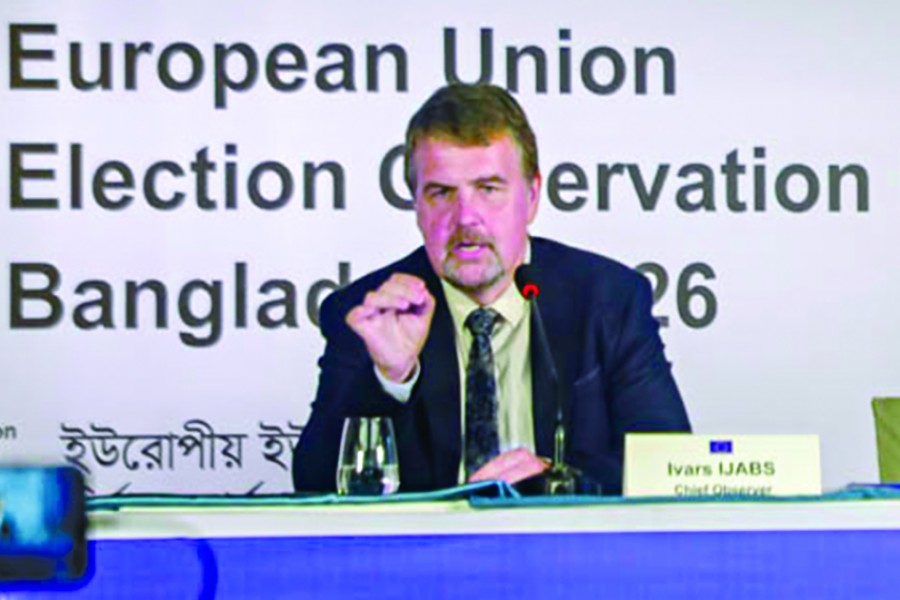
 EU Election Observation Mission’s chief observer Ivars Ijabs at a press briefing on Sunday
 Bangladesh's upcoming national elections will be crucial in strengthening democratic institutions by ballot, European Union's election-observation team says in its firsthand situation analysis.
The preview came Sunday after the continental bloc formally deployed a full-scale mission to monitor the post-uprising polls, scheduled for February 12.
Its chief met with the chief adviser of the interim government and also briefed the press on the deployment and comprehensive observation programme.
The European Union Election Observation Mission (EU EOM), deployed at the invitation of the Bangladeshi government, is led by Latvian MEP Ivars Ijabs as chief observer. The mission began its activities late December 2025 and now expanded with the arrival of 56 long-term observers, who will be stationed across all 64 districts of the country.
It marks the EU's first fully fledged election observation mission in Bangladesh since 2008 -- another crossroads in the country's often-fractious politics.
Speaking at a press briefing in Dhaka on Sunday, Ijabs said the mission reaffirmed the importance of the partnership between the EU and Bangladesh, built on mutual respect and a shared commitment to democratic principles.
During his first visit, he met election stakeholders at various levels to gather firsthand information on the ongoing electoral process.
The EU observers will monitor key aspects of the polls, including election preparation, the legal framework and its implementation, campaign conduct and the resolution of electoral disputes.
The mission will engage with election authorities, political parties, the judiciary, civil society and the media, while also assessing the overall space for political and civic participation, including that of women, young voters and other marginalised groups.
A dedicated media -and social -media monitoring unit will examine the role of both traditional and digital platforms in enabling voters to make informed choices.
Overall, the mission will evaluate whether the elections are conducted in line with national law and in accordance with regional and international democratic standards to which Bangladesh has committed.
"Our technical assessment is guided by three core principles: independence, impartiality and non-interference," Ijabs told the press.
"We will observe the process, but we will not certify the results. These elections belong solely to the people of Bangladesh."
At full strength, the mission will include nearly 200 observers from all 27 EU member-states, as well as Canada, Norway and Switzerland.
This will comprise a core team of 11 analysts based in Dhaka, 56 long-term observers, 90 short-term observers to be deployed shortly before polling day, and observers from EU member-states and partner countries' diplomatic missions.
A delegation from the European parliament will also join the mission.
Emphasising the significance of the vote, Ijabs said the election must be held peacefully and in a credible and transparent manner to bolster public confidence. The EU believes Bangladesh is capable of holding a participatory, fair and credible election.
The EU EOM will release a preliminary statement and hold a press conference in Dhaka on 14 February, two days after the polls.
A comprehensive final report, including recommendations for future elections, will be published and presented to the authorities around two months later.
All observers are bound by a strict code of conduct, and the mission operates in line with the Declaration of Principles for International Election Observation endorsed under the United Nations auspices in 2005.
Meanwhile, during the meeting with the EU mission head, Chief Adviser Professor Muhammad Yunus said a level playing field would be ensured for all political parties in the upcoming polls, insisting there are no major obstacles to holding a free and credible vote.
Ivars Ijabs, the EU Election Observation Mission's chief observer, called on the head of interim government at the state guesthouse Jamuna, according to the chief adviser's press secretary, Shafiqul Alam.
However, Yunus warns that the biggest challenge facing the vote is the spread of misinformation and disinformation on social media, which is often used "to incite violence".
He also cautions that supporters of the fallen autocratic regime could attempt to sabotage the election, though he stresses that security forces are fully prepared to deal with any challenge.
The chief adviser thanked the European Union for deploying the election-observation mission, describing it as vital for a credible election and for Bangladesh's democratic transition.
During the meeting, Yunus said the interim government is campaigning - and will continue to campaign -- for a "Yes" vote in the referendum, alongside efforts to raise public awareness. He said the government had sought legal advice and received written opinions from top legal experts confirming there was no legal impediment to advocating a "Yes" vote.
Briefing reporters, Mr Shafiq said the courtesy meeting did not include any discussion about the Awami League or its participation in the election. Instead, the focus was on the referendum process.
He said the EU ambassador stressed the importance of a "Yes" vote, noting that it would allow the implementation of a necessary reform agenda.
According to Shafiq, the head of EU mission said observers would be deployed across the country, monitoring all regions. The team will engage with major political parties as well as other stakeholders as part of its assessment of the electoral process.
Quoting Yunus, the press secretary said the chief adviser assured the EU that the upcoming parliamentary election and referendum would be conducted in an orderly manner and would be "free, fair, credible and peaceful".
He described the vote as a "festive election" and told the EU chief poll observer that both the interim government and the Election Commission were fully prepared.
Yunus also outlines extensive security measures, including the use of body-worn cameras at high-risk polling centres. Security personnel will wear cameras to monitor any deterioration in law and order, with footage linked centrally through an app to allow real-time monitoring from upazila, district, divisional levels and Dhaka. CCTV cameras will be installed at all polling centres, while the army will act as a rapid-response striking force, if required.
The press secretary added that Yunus noted an "election wave" was currently sweeping the country, although formal campaigning would begin on 22 January. He said the presence of EU observers "amounted to a major endorsement of Bangladesh's electoral process and was crucial for strengthening democratic institutions".
The chief adviser also pointed to strong enthusiasm among young voters, saying that youth participation would be a key feature of the upcoming polls.
mirmostafiz@yahoo.com
© 2026 - All Rights with The Financial Express

