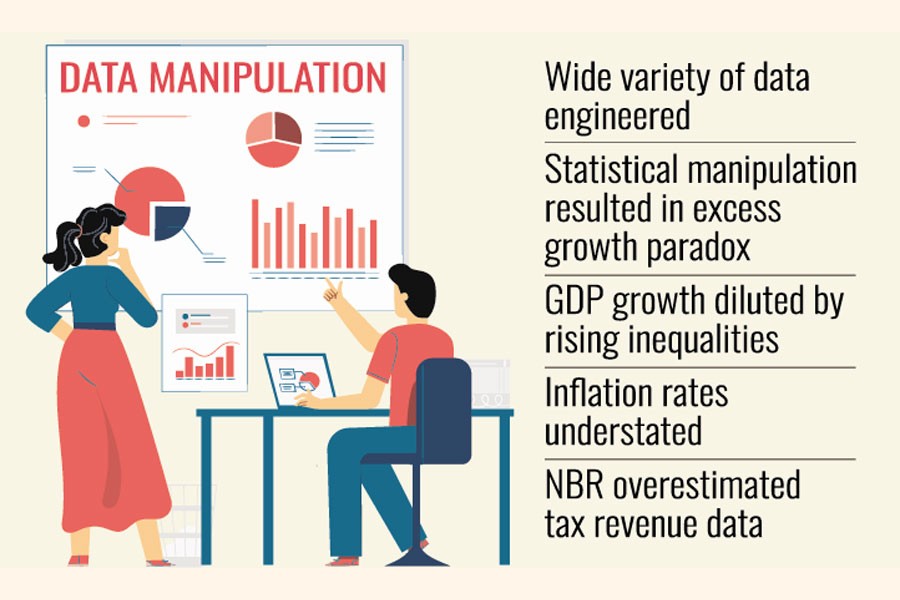
The past regime cooked macroeconomic data according to its will for political appeasement, the White Paper committee has found.
"Was growth real?" the committee questioned in the draft White Paper shared with newsmen on Sunday after handing it over to Chief Adviser to the interim government Dr Muhammad Yunus.
The paper mentioned that not just the growth data, but also the statistics on inflation, poverty, inequality, education, health, food security, energy, financial, and fiscal and monetary development reported by different data-producing institutions under the auspices of the past regime had been engineered.
"…the data ecosystem is highly foggy and toxic for the gullible," it mentioned, referring to the consultations made to prepare the White Paper.
The paper mentioned that the pace of growth was far slower during the Awami League rule, and the slope of the growth path in the past decade was the opposite of that portrayed in official data.
"The quality of the 4-5 per cent annual gross domestic product (GDP) growth the economy did achieve was severely diluted by rising inequalities in income, wealth, and opportunities," it said.
Terming the "fastest" growing variant a "statistical artefact", the paper mentioned that the overdose of "unnayan" (development) to glorify the few "rights" (Padma bridge, Dhaka Metro) and justify the many blatant "wrongs" (corruption) at best struggles and, in most cases, fails to pass some very basic fact checks.
The interim government inherited an economy in a deep flux. "How we got there is a story of stasis in structural reforms, reform reversals, institutional decadence, global adversities, and a growing gulf between the reality on the ground and the perceptions of policymakers leading to macro-financial recklessness."
These had sleep-walked the economy into a low middle income growth trap, it said. "The excess growth paradox is a figment of statistical manipulation," noted the publication.
"There is strong evidence that GDP growth has tended to be overstated irrespective of political regimes, but the overstatement itself grew noticeably in the past decade," it said, adding public perception and corroborative evidence from various consultations suggested inflation rates were understated.
Macroeconomic balances that are relatively easy to record, report, and reconcile have large inaccuracies generally favouring the establishment bullishness, it said.
Also, the paper said the balance of payment data, considered relatively free from systematic bias, entered the flux zone with a story changing the revision of export data. The foreign exchange reserve reporting became controversial with the publication of discrepancies in an International Monetary Fund (IMF) report in 2020.
Moreover, the data on the financial sector balance sheets became increasingly problematic with departures from standard accounting practices, as revealed in the recent financial stability reports of the Bangladesh Bank, said the White Paper.
It said the data on tax revenues typically came with over-estimation by the National Board of Revenue (NBR), allegedly at times deliberately by the top, and inevitably long and variable lags from the office of the Comptroller and Auditor General of Bangladesh.
Mismatches between Bangladesh Bureau of Statistics (BBS) survey data and administrative data measuring the same social outcome indicate nontrivial noise in social indicators, it said, adding survey data on various social indicators relating to public health, education, vulnerability, and the environment struggle to match their official counterparts, suggesting the latter may have been padded.
It pointed out that the revision of poverty estimation and data collection methodologies increased the magnitude of poverty reduction from 2010 to 2022 relative to previous estimates for the same period.
"Political influence on data generation and reporting reached an unprecedented high under the past regime," noted the committee.
The White Paper said true inflation may have been in the 15-17 percentage range rather than the Consumer Price Index's (CPI) 9 to 11. A survey by the Bangladesh Institute of Development Studies (BIDS) found 15 per cent food inflation in December 2023, which was officially reported by the BBS at 7.9 per cent.
A calculation based on price changes reported by the Centre for Policy Dialogue (CPD) covering coarse rice, soybean oil, lentil, onion, fish, beef, mutton and eggs (using rural weights) suggested an annual rural food inflation rate of 11.7 per cent during FY19-23, compared with the average 6.7 per cent rural food inflation reported by the BBS for the same period.
The paper also mentioned that people actually experienced as high as 18.1 per cent inflation this July compared to 11.66 per cent declared by the BBS.
syful-islam@outlook.com
© 2026 - All Rights with The Financial Express

