Bangladesh's customs administration is set for a major overhaul under a broad-based accord signed Monday with the United Kingdom for faster foreign trade clearance sans red tape and revenue leaks, officials said.
The National Board of Revenue (NBR) of Bangladesh inked the memorandum of understanding with the UK's His Majesty's Revenue and Customs (HMRC) to modernise its systems and strengthen trade facilitation.
The agreement, signed in Dhaka, provides for British experts providing technical assistance, training and advisory support to help the NBR implement key reforms.
Among the priorities are introducing stronger risk-management systems, implementing the World Trade Organisation Trade Facilitation Agreement and expanding the newly launched Authorised Economic Operator (AEO) programme which grants trusted traders easier and faster access on borders.
Officials say the reforms are designed to cut red tape and reduce delays at ports--a longstanding source of frustration for businesses and international partners.
"This agreement is a valuable step in our efforts to modernise our customs and improve trade facilitation," says NBR chairman Md Abdur Rahman Khan.
"We welcome the UK Government's technical support and look forward to working together to strengthen our systems and drive economic growth."
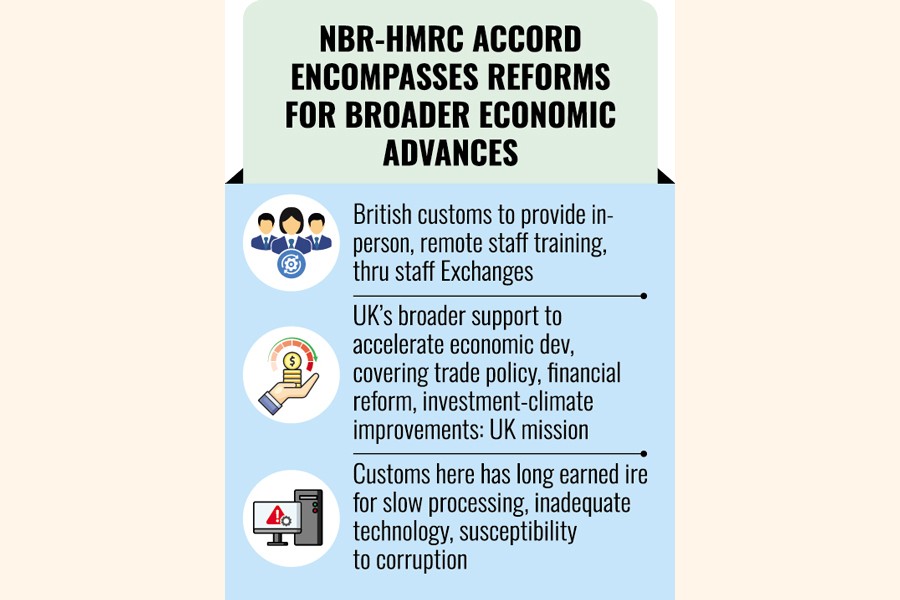
Under the accord, HMRC will impart in-person and remote training to customs staff, share expertise through staff exchanges and give advice on new approaches to risk profiling and information-sharing.
The British High Commission in Dhaka describes the agreement as part of the UK's broader support to Bangladesh's economic development, which also covers trade policy, financial-sector reform and investment-climate improvements.
"This reflects the UK's commitment to supporting Bangladesh's economic development," said Martin Dawson, deputy development director at the British High Commission. "Efficient customs systems will play a vital role in unlocking growth as Bangladesh graduates from least- developed country status."
Bangladesh is due to exit the UN-designated least-developed-country category in 2026-in a leap that will forfeit many of the preferential trade benefits it currently enjoys. Economists say the switch will require the country to become more competitive on the global market, with smoother customs procedures essential for businesses that rely on quick-delivery times and international supply chains.
Customs in Bangladesh has long been criticised for slow processing, inadequate technology and susceptibility to corruption. Reform efforts in the past have often been undermined by capacity gaps and entrenched interests. Observers say outside partnerships such as the new UK initiative could help introduce best practices and improve trust with international trading partners.
The UK's support, however, comes at a delicate time. Bangladesh is still adjusting to economic headwinds, including pressure on foreign-exchange reserves and declining export competitiveness. Faster, more transparent border systems could ease some of these strains, but the challenge will be ensuring that reforms translate from paper to practice.
For now, officials in Dhaka are keen to present the deal as a signal of international confidence. "This MoU shows our commitment to strengthening institutions and preparing for the future," says an NBR official involved in the negotiations.
"It is not only about customs-it is about Bangladesh's place in the global economy."
mirmostafiz@yahoo.com
© 2026 - All Rights with The Financial Express

