Massive deregulation across major financial sectors of the "over-regulated" country is expected to be reflected in the coming national budget being crafted by the newly elected government.
Finance and Planning Minister Amir Khosru Mahmud Chowdhury dropped a broad hint at such changes on Saturday during an exchange- of- views meeting with editors of print, electronic and online media on the upcoming budget."Bangladesh is an overregulated country and needs deregulation," he says.
The meeting, held at the Finance Division, was attended by Finance Secretary Dr Khairuzzaman Mozumder, Bangladesh Bank Governor Md Mostaqur Rahman and Financial Institutions Division (FID) Secretary Nazma Mobarek, among others.
The finance minister says the government is also considering the securitisation of public-infrastructure assets to mobilise funds for new projects.
"The Jamuna Bridge now carries no liabilities. It can be securitised, and the proceeds can be used for other development projects," he explains the new government's financial ideas.
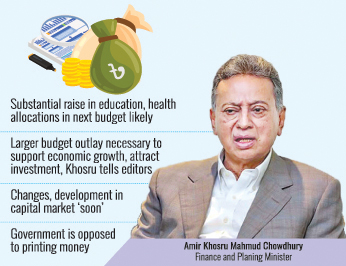
On the size of the budget, the economic pointsman of the government headed by BNP chief Tarique Rahman says a larger outlay is necessary to support economic growth and attract investment.
Addressing demographic challenges, the finance minister stresses the need for increased investment in health and education to harness the country's demographic dividend.
He mentions that out-of-pocket healthcare costs remain high in the country, and for this reason, the government aims to improve the healthcare system.
"Once people become technically skilled, they will find employment both at home and abroad," he says while arguing increased allocation for the education.
The minister reiterates that the government is opposed to printing money. On the capital market, Mr. Chowdhury says the government has significant plans to strengthen the sector.
"You will see changes and development in the capital market soon," he says, adding that well-reputed and structured companies have been reluctant to float shares on the market as they believe that this is a "casino".
He hopes deregulation and greater participation by institutional investors could help improve market conditions.
On the recovery of laundered funds, Bangladesh Bank Governor Mr. Rahman says efforts are under way to retrieve such assets.
"We want to ensure that these funds cannot be consumed by plunderers," he tells the press in a strongly worded resolve of the regulator.
He warns that news of money printing could negatively affect the country's credit ratings, increasing borrowing costs for both the government and the private sector.
The new governor rules that fluctuations in government accounts held with the central bank are normal.
FID Secretary Ms. Mobarek says a taskforce has been formed to recover siphoned-off money. "The process is complex."
National Board of Revenue (NBR) Chairman Md Abdur Rahman Khan tells the meet efforts would be intensified to boost tax mobilisation, particularly through value-added tax (VAT).
He says although Bangladesh has over 12.8 million Taxpayer Identification Numbers (TINs), only about 5.0 million returns are filed.
"We will issue notices to those who have not submitted their tax returns."
He also says that corporate tax rates for both listed and non-listed companies have been reduced over the years from as high as 50 per cent.
Speaking at the programme, The Financial Express Editor, Shamsul Huq Zahid, points out that Bangladesh is facing weak revenue mobilisation, which is further strained by the Middle East crisis.
"In this context, the plan to raise the budget size to around Tk 9.0 trillion will be challenging," he says, cautioning that increased bank borrowing and 'high-powered money' could fuel inflation.
Channel I Head of News Mr. Shykh Seraj stresses the need for greater investment in agricultural research to ensure food security.
Speaking at another event, Finance Minister Amir Khosru has said the government plans to step up spending on health and education to fully harness the country's demographic dividend. A large share of the increase will go for vocational education to build skilled manpower, boost employment and raise remittance inflows.
He says the government also aims to tap the "longevity dividend," noting that older citizens can continue contributing to productivity. However, higher allocations may face challenges linked to the inheritance economy.
The minister made the remarks at the pre-budget discussion organised by the Ministry of Finance on the day, attended by members of the Economic Reporters Forum (ERF) and journalists covering the ministry.
He says the economy must recover from past damage caused by money printing and heavy borrowing from local banks. "Such policies," he warns, "drive up interest rates and crowd out private investment, undermining sustainable growth."
The current government, he adds, is committed to avoiding inflationary financing through high-powered money and to easing pressure on the private sector-principles that guide its economic policy.
He alleges that past "patronage politics" concentrated economic power in a few hands, pushing the economy towards oligarchic control. The government is now prioritising the "democratisation of the economy" to reverse this trend.
To ensure inclusive growth, he says, steps are being taken to empower women directly through the "family card" programme. As primary managers of household finances, women's access to funds can improve both savings and investment outcomes.
The minister stresses expanding primary healthcare to reduce out-of-pocket expenses, which erode living standards. Better access to basic care, he says, effectively raises real incomes.
He describes SMEs and startups as the backbone of the economy, noting that SMEs remain the largest source of employment. Efforts are also underway to integrate rural cottage industries, artisans and the creative economy into the mainstream.
Initiatives to upgrade product design, branding and marketing for rural artisans are being rolled out to help them reach global markets -- boosting both jobs and exports.
He adds that sectors such as sports, culture, theatre, film and music are gaining policy attention as emerging contributors to GDP.
On current challenges, he says the private sector is under strain from weak banking discipline, currency depreciation and persistent inflation, with many industries underperforming.
Raising the tax-to-GDP ratio remains "very difficult" under current conditions, he notes, as stronger business activity is essential for higher revenue collection, though efforts are ongoing.
He has also highlighted energy security, with plans to cut import dependence by exploring domestic resources and expanding renewable-energy use.
On market management, he says prices cannot be controlled through enforcement alone. Markets should function based on demand and supply, supported by stronger supply chains and lower business costs.
He concludes that deregulation will be key to attracting investment, as excessive barriers continue to deter investors.
newsmanjasi@gmail.com
jasimharoon@yahoo.com
© 2026 - All Rights with The Financial Express

