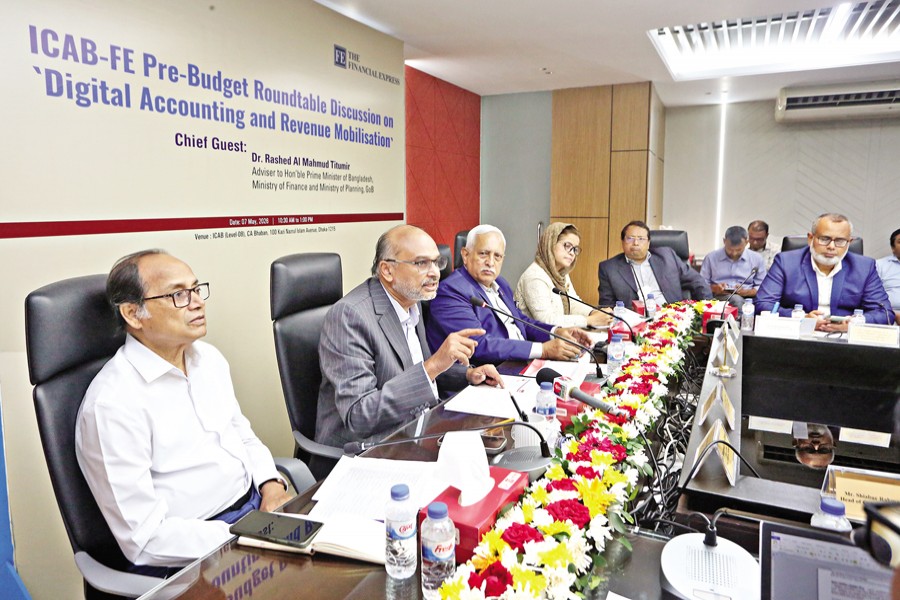
 Dr Rashed Al Mahmud Titumir, finance and planning adviser to the prime minister, addresses a pre-budget roundtable as the chief guest at CA Bhaban in the capital's Karwan Bazar on Thursday. The event, jointly organised by The Financial Express and the Institute of Chartered Accountants of Bangladesh, was chaired by Financial Express Editor Shamsul Huq Zahid. — FE photo
 Ensuring accountability and transparency in utilising taxpayers' money is imperative and digitised interface linking government authorities is the tool to get to the goal, experts say.
Speakers at a pre-budget discussion Thursday came up with this and numerous other suggestions for reforms on economic and financial front for government authorities to emulate.
They also emphasised the importance of changing the mindset of both taxpayers and the government as while many tax payers seek to evade taxes, authorities often create unnecessary hassles and impose penalties on taxpayers.
The speakers at the meet, titled 'Digital Accounting and Revenue Collection', called for greater digitisation of the tax system to ensure a hassle-free, quick and time-saving process.
The discussion brought together chamber leaders, association representatives, business leaders and former bureaucrats.
The event was organised by The Financial Express in partnership with the Institute of Chartered Accountants of Bangladesh (ICAB) at the ICAB office in Dhaka.
Prof Dr Rashed Al Mahmud Titumir, Finance and Planning Adviser to the Prime Minister, was chief guest at the programme, presided over by Editor of The Financial Express Shamsul Huq Zahid.
Among others, Bangladesh Textile Mills Association (BTMA) President Shawkat Aziz Russell, Metropolitan Chamber of Commerce and Industry, Dhaka (MCCI) President Kamran T Rahman, American Chamber of Commerce in Bangladesh (AmCham) President Syed Ershad Ahmed and ICAB President NKA Mobin were present and spoke.
Dr Titumir says taxpayers may receive receipts against tax payments by detailing how their tax contributions are spent on education, healthcare and social security.
"The government hopes to introduce such a system through the next budget," he tells the meet.
The adviser mentions that the "culture of political patronage" was one of the major reasons behind "tax evasion and fraud" in the country.
"The oligarchy remained in power in exchange for special privileges in different sectors, including taxation. This is where the root of tax evasion and fraud lies," he says.
He points out that Bangladesh's tax-GDP ratio currently stands at only 6.6 per cent -- one of the lowest in the world.
The adviser highlights two types of reforms -- "detachment" and "attachment".
He explains the concept: detachment refers to reducing direct contact between taxpayers and tax officials while attachment means informing citizens about how their tax money is spent.
The development economic professor-turned government functionary says the present government does not want to raise tax rates rather it aims to increase domestic wealth generation by expanding the economy.
Investment is the key which will create resources and employment, notes.
Dr Titumir mentions that the government has already formed three taskforces for economic reforms.
And initiatives have been taken to integrate the informal sector into the mainstream economy, reopen closed industries, provide incentives to small and cottage industries, and revise SME policies.
He also says the government is promoting equality-based regional development through the 'One-Village, One-Product' initiative.
In addition, artists, designers, game developers and fashion entrepreneurs are being recognised as important contributors to the creative or orange economy.
Stressing the importance of Bangladesh Bank's independence, Dr Titumir says effective coordination between fiscal and monetary policies is essential.
The central bank is working on refinancing schemes and special loan programmes to reopen closed industries and address other key issues, he notes.
President of BTMA Shawkat Aziz Russell questions the government over the utilisation of tax revenue. "What do you do with the tax money?" he asks, proposing the formation of a dedicated cell to monitor whether public funds are being spent properly.
Referring to former finance minister late Saifur Rahman's role in supporting industrialisation, Mr Russell says the country is no longer on the same path.
"Our businesses are collapsing. Factories are closing. The government is failing to ensure the environment needed for business, while policy reforms are not taking place," he tells the pre-budget discussion meet.
"If you fail to collect taxes, you arrest me and put me in jail. But there must also be accountability regarding how my tax money is spent," he adds.
He criticises excessive government expenditure and urges authorities to clearly disclose allocations for industries, health and education in the upcoming budget.
The ICAB President, NKA Mobin, says the size of the upcoming national budget may reach Tk 9.0 trillion, while the revenue-collection target could be around Tk 6.0 trillion.
Sustainable revenue collection would require greater emphasis on direct taxes. "However, if VAT evasion and tax evasion continue, it will not be possible to increase revenue collection," he cautions.
ICAB Council Member Sabbir Ahmed suggests that the government must move away from the conventional paper-based accounting and reporting system to build an accountable financial structure.
"If a digital accounting system is introduced, immediate reporting can be ensured, financial supervision strengthened, and opportunities for tax evasion and fraud reduced," he says while presenting a keynote on digital accounting and revenue mobilisation.
He laments that the country's economy is still largely driven by cash transaction, which undermines formalization of economy.
AmCham President Syed Ershad Ahmed alleges that the three wings of the National Board of Revenue (NBR) often harass businesses.
He stresses customs automation and says digital accounting and auditing systems could reduce corruption, improve Bangladesh's image among foreign investors and lower business risks by enhancing transparency.
"Foreign investors often perceive Bangladesh as a corrupt country. Although corruption cannot be eliminated entirely, it can be reduced to a tolerable level through digital systems," he says.
Chairing the session, FE Editor Shamsul Huq Zahid observes that both taxpayers and tax authorities show reluctance toward digital compliance.
He feels that necessary reforms would be difficult and disruptive, often facing resistance from vested interests.
"Without genuine political will, meaningful progress in revenue mobilisation will remain elusive," he says.
Chairman of the taxation and corporate affairs committee of the ICAB Mr MBM Lutful Hadee stresses the necessity of a fully integrated data ecosystem linking banks, the NBR and other authorities.
Without such coordination, digitisation risks becoming merely a "digital version of a manual system", he warns.
To accelerate adoption, he proposes waiving audits for businesses using digital accounting systems and simplifying approval procedures for accounting software.
Former NBR member Farid Uddin criticises a lack of progress despite repeated reform recommendations, saying that political commitment matters more than new ideas.
He refers to the two key reform reports and argues that in the past 54 years, such works never happened.
He mentions that even different wings within the NBR fail to share data and cautions against dependence on external financing for digitisation.
He also acknowledges that ICAB had not been able to fully perform its responsibilities over the past 15 years due to various constraints.
"Transparency remains the cornerstone of meaningful reform."
Dhaka Chamber of Commerce and Industry (DCCI) President Taskin Ahmed tells the meet that Bangladesh is approaching a critical stage ahead of its graduation from the least-developed country (LDC) category.
He notes that Dhaka and Chattogram account for 87 per cent of total revenue collection, while the remaining 62 districts contribute only 13 per cent.
ICAB Vice-President Moniruzzaman, Economic Reporters' Forum (ERF) President Doulat Akter Mala, and Furniture Association representative Tanvir Mahmud Dipu, among others, also spoke at the event.
jasimharoon@yahoo.com, bdsmile@gmail.com
© 2026 - All Rights with The Financial Express

