Umpteen differences of opinion between the Asian Development Bank and the Bangladeshi financial-sector regulatory agencies delay the launch of ADB-sponsored taka-denominated bonds for both local and global subscriptions, officials say.
The Manila-based lender plans to introduce the local-currency bonds first on the domestic market and later for overseas subscription.
Back in December 2019, the ADB in a letter to the government first expressed interest in issuing both onshore and offshore taka bonds in and outside Bangladesh. Earlier, an ADB delegation, led by then ADB country director Manmohan Parkash, met then finance minister AHM Mustafa Kamal late November discussing the matter.
However, things didn't progress as expected.
In a latest bout, the ADB in May last year submitted its proposal to the Economic Relations Division (ERD) on the issuance of bonds. Later, the Economic Relations Division forwarded the proposal to the Finance Division, Bangladesh Securities and Exchange Commission (BSEC), the National Board of Revenue (NBR), Bangladesh Bank, and the Financial Institutions Division for their opinion.
The ERD later forwarded the regulatory bodies' opinion to the ADB in November last year seeking its response on the opinions. The ADB in the first week of May forwarded its response to the ERD.
A senior official at the Economic Relations Division told The Financial Express an inter-ministerial meeting was scheduled to be held on June 14 last with ERD secretary Shahriar Kader Siddiky in the chair to discuss the regulatory agencies' comments on ADB's proposal and the subsequent response from the Asian Bank.
The meeting was organised to discuss how to lessen the differences of opinion between the ADB and the government bodies on the lender's proposal. However, the meeting was later postponed.
Sources say in the proposal the ADB has sought an evergreen approval from the ministry of finance to undertake local-currency operations on a recurring basis as its bond issuances are linked to multiple projects that may require extended implementation periods.
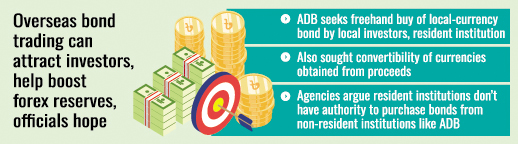
However, Bangladeshi officials argue that the sale of BDT bonds on the international market can play a positive role in familiarising the country to investors and investing the proceeds within Bangladesh can help increase foreign-currency reserves. "Nonetheless, approval granted should have a defined time limit."
Also, the ADB has sought permission from the government to allow local investors or resident institutions to buy local-currency bond without prior approval from the regulator concerned.
However, the government agencies say resident institutions do not have a general authority to purchase bonds from a non-resident institution like the ADB. They say, it is essential for local investors/resident institutions to obtain approval from central bank to invest in ADB's bonds as it is identified as a capital account transaction.
In response, the ADB fears that the requirement to obtain prior approval before investing in ADB bonds "would effectively limit ADB's potential investor base".
The ADB also sought approval for exchange of bonds proceeds into other currencies which the government agencies find the basis for this request "not clear" as the funds are intended for investment in Bangladesh.
In response, the ADB says, the ability to freely exchange proceeds of its debt enables ADB to efficiently manage liquidity, meet debt service obligations, and allocate funding in support of development operations.
"For onshore bonds, ADB shall reserve the right to convert the bond proceeds. For offshore bonds, ADB will need to convert the USD proceeds into BDT in order to support loan operations in Bangladesh and thereafter convert BDT back into USD to redeem the offshore BDT-linked bond," said the lender.
Also, the ADB has sought confirmation of tax exemption to all investment income arising from its investments in Bangladesh and also interest payments by ADB on its local currency bonds.
The ADB also demands that its local-currency bonds be exempt from local-registration requirements as "this will limit ADB's Taka bond operations". The ADB also wants permission to use the word 'Bank' in its marketing material without having a domestic banking licence.
The regulatory bodies have opined that using the word 'bank' without a banking licence is not allowed in the Bank Company Act 1991.
Furthermore, the Bank seeks confirmation that all domestic institutional investors, including pension funds, provident funds, insurance companies and financial institutions, may invest in the local-currency bonds.
However, the financial-sector regulators say the pension funds, provident funds, insurance companies, banks and financial institutions are the main investors in government bills and bonds. "Therefore, raising fund from these investors by onshore bond and investing that fund in the government bill/bonds could be recognised redundant and not viable for market development."
However, the ADB says its bonds are "not meant to compete with local government bonds/bills. ADB bonds will only be issued on the back of ADB projects".
The sponsor also seeks confirmation that the local-currency bonds will be eligible instruments for reserve requirement purposes of commercial banks in Bangladesh.
In response, the regulatory bodies mention that according to the current policies, no bank, financial institution, or any other international organisation is allowed to participate in Central Bank Repo or Reverse Repo/Standing Lending Facility using any securities other than government securities which are the eligible instrument for statutory reserves.
"If bonds issued by the ADB were allowed for use in central bank Repo and Standing Lending Facilities and eligible instrument for statutory reserves, it could substitute the demand for government securities and impede the government's ability to finance its budget deficit, thus hinder government's debt-servicing and-fiscal planning," they say in their opinion.
"Granting ADB bonds this facility as an alternative instrument to government securities could have a negative impact on the government's debt management and fiscal policy," they add.
A senior ERD official says the differences have to be minimised between the two parties through discussions for a way forward.
Contacted Wednesday, ERD secretary Shahriar Kader Siddiky told The Financial Express that a special assistant to the Prime Minister is working on the local-currency- bond issue alongside different bodies under the Ministry of Finance.
"They can give an idea how it is advancing," he says, expressing his lack of knowledge about the progress on the matter.
syful-islam@outlook.com
© 2026 - All Rights with The Financial Express

