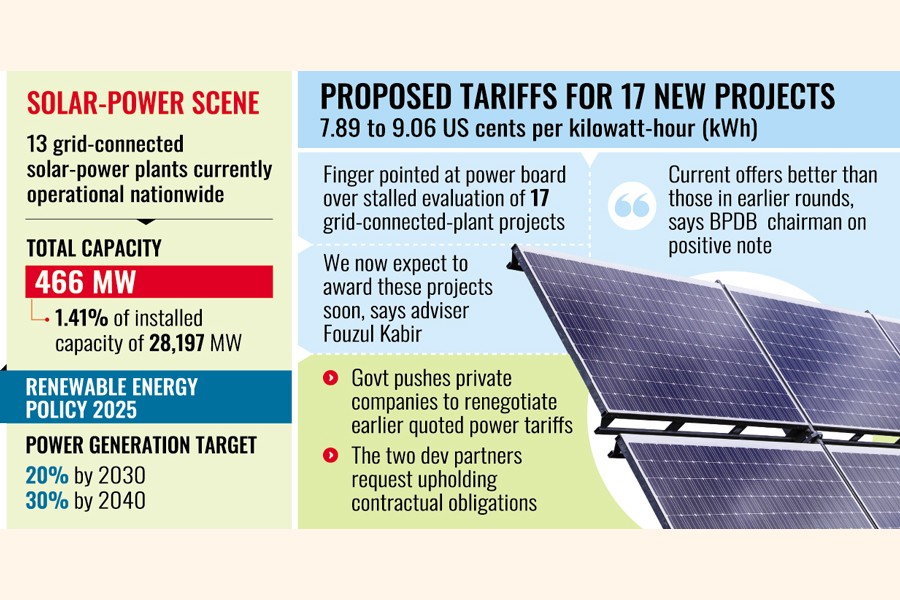
Bangladesh's solar ambitions seem losing steam as 17 recently proposed solar-power plants, each offering the reduced tariffs ever, have been left waiting for approval while some previously contracted ones lie in limbo.
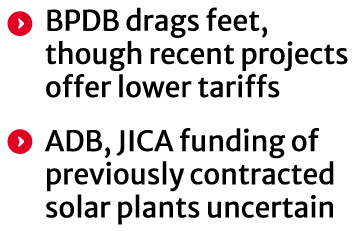 Sources say the "bureaucratic dithering" is frustrating sponsors, foreign investors and energy experts alike, as the current push--locally and globally--is for transition to clean, renewable energy to save the planet from disasters of global warming.
The fresh projects could have marked a breakthrough in the nation's transition to clean energy, but insiders alleged Bangladesh Power Development Board (BPDB) authorities were dragging their feet, even as the government pledges to boost renewables generation under its new Renewable Energy Policy 2025.
Unless the evaluations move forward soon, the country risks missing out on affordable, homegrown solar power - and with it, leaving its 2030 renewable-energy goals cloaked in uncertainty.
Officials and project sponsors claim the state-run Bangladesh Power Development Board (BPDB) has 'intentionally' slowed down the evaluation process for these solar plants, despite the offering of significantly lower tariff rates than previous ones.
Bidders for the new projects proposed tariffs ranging from 7.89 to 9.06 US cents per kilowatt-hour (kWh) - much lower than the bids approved during the previous Awami League government.
Currently, 13 grid-connected solar-power plants are operational nationwide, with a combined generation capacity of 466 megawatts. That represents only 1.41 per cent of Bangladesh's total installed power capacity of 28,197 MWs, according to BPDB data.
To boost renewables' contribution to the national energy mix, the current interim government recently launched the Renewable Energy Policy 2025 with the target of 20-percent renewable power generation by 2030 and 30 per cent by 2040.
But, insiders warn, the sluggish progress on new solar projects could push these goals out of reach.
Contacted for updates, BPDB Chairman Md Rezaul Karim said the technical evaluation of the project proposals had been completed. "We found the technical offers responsive, and financial evaluations will be completed soon."
"The offers we received are better than those in earlier rounds, and we hope to award some projects shortly."
In the latest tenders, the BPDB received tariff offers as low as 7.89 US cents per unit for solar plants in northern Bangladesh, around 24.3-percent lower than the 10.42 US cents previously awarded under the former government.
In the Chattogram region, the lowest offer came in at 7.95 US cents, roughly 34.3-percent lower than earlier tariffs of 12.10 US cents.
For the Mymensingh region, offers stood at 8.88 cents, about 10.6-percent lower than the previous 9.93 US cents, while in Sylhet, bids were 9.06 cents, around 8.3-percent lower than the prior pricing of 9.88 cents.
The power board has not yet opened tenders for Dhaka and Khulna regions, where previous projects received letters of intent (LoIs) at 10.00 and 9.98 cents respectively.
The deposed former Awami League government had issued LoIs for several such projects under the now-defunct Quick Enhancement of Electricity and Energy Supply (Special Provisions) Act 2010 (amended 2021).
However, no implementation agreements (IAs), power- purchase agreements (PPAs), or land-lease agreements (LLAs) were signed.
"Instead of awarding those projects, we retendered to secure lower tariffs - and that goal has been achieved," Fouzul Kabir Khan, Adviser of the post-uprising government for the Ministry of Power, Energy and Mineral Resources, told The Financial Express.
"We now expect to award these projects soon," he added. "Solar-based plants are our priority, and they will help reduce fossil-fuel dependence and diversify our energy mix."
Mostafa Al Mahmud, President of Bangladesh Sustainable Renewable Energy Association (BSREA), welcomes the lower tariff bids but cautions that implementation could be challenging.
"It's encouraging that the government received better rates, but timely execution will be the real test," he says.
Energy-expert Professor M Tamim, Vice-chancellor of Independent University, Bangladesh (IUB), echoes the sentiment.
"The government should immediately award and implement these projects," he suggests.
"They will lower generation costs, especially during daytime, and avoid capacity payments since solar plants don't require such provisions."
Meanwhile, foreign investments in Bangladesh's private-sector solar-power projects, particularly from two major development partners, have faced hurdles for government's unwillingness to maintain commitment to existing agreements on grounds of overrated tariff quotes.
Officials have said the Asian Development Bank and Japan International Cooperation Agency agreed to invest at least in three private solar-power plants in Bangladesh which got government approval during the past regime.
One of the projects-- the Dynamic Sun Energy Power Limited plant-- is a 100-megawatt plant owned by Paramount Textiles Ltd, wherein the ADB and JICA agreed to invest $121 million.
The plant, located in Pabna, started power generation earlier this year.
The ADB and JICA are also working on funding a 20-mw solar-power plant owned by Joules Power Limited, and funding a 50-mw plant owned by Germany-based firm ib vogt.
Sonagazi Solar Power Limited, owned by ib vogt, is supposed to get $65 million and Joules Power's Muktagacha Solartech Energy Limited (MSEL) is supposed to get $24.3 million worth of financing from the development partners.
However, their hopes faded as the interim administration is not providing "government guarantee" to secure the foreign funds, though the government did it during the signing of power-purchase agreements (PPA) with the project developers.
The government, sources say, wants the companies now lessen power tariffs agreed while signing the PPA by the past government.
Amid the stalemate, the ADB- JICA duo in a recent letter to the energy adviser reminded about upholding the contractual obligations to ensure compliance.
They expressed "certain concerns" regarding recent developments in Bangladesh's private power sector, specifically the tariff-renegotiation requests initiated by the Power Development Board.
Hoe Yun Jeong, Country Director, ADB, and Takehiro YASUI, a Director-General, JICA, in the jointly signed letter also wrote that the BPDB requested a revision of the contractually agreed tariffs for the plant of Dynamic Sun Energy Power Limited.
"There are indications that BPDB may wish to align the status of the government guarantee with the outcome of the tariff re-negotiation," they wrote. "Without this guarantee, ADB and JICA funding of USD121 million cannot be disbursed to the project."
"We would like to underscore that adherence to legally-binding contracts is essential for attracting international investors and lenders to Bangladesh's projects," they state in the letter, adding, "We convey our strong concern regarding BPDB's attempts to re-negotiate contractually agreed tariffs and urge the government and the BPDB to uphold their contractual obligations."
Contacted, a senior official of Paramount Group told the Financial Express that whenever they request the government for the guarantee, the government in return asks them for renegotiation of power tariffs.
"A number of projects are facing similar problems. Foreign funds won't be disbursed to them unless government guarantee is available," he said.
Jane Chakarawet, Investment Director APAC, Ib Vogt Singapore Pte Ltd, in an e-mail communiqué declined to comment on the "specific topic at this time".
Contacted Monday, an official of the ADB told the FE writer that they were yet to receive a reply the letter.
"Unless there is government guarantee, we can't disburse the fund. Because, it was our condition," he said, preferring anonymity.
The BPDB chairman, Rezaul Karim, told the FE that the government is requesting the developers to lessen tariffs to some extent in order to lower spending in power sector.
He thinks in some cases power tariffs were set exorbitantly which can be easily cut down.
Azizjst@yahoo.com
syful-islam@outlook.com
© 2026 - All Rights with The Financial Express

