Bangladesh's efforts to diversify its export basket beyond single-item dependence on ready-made garments (RMG) have made little headway over the past five fiscal years.
Even four of the country's five largest non-RMG export sectors are still earning less than they did in the financial year 2021-22.
Data from the Export Promotion Bureau (EPB) show leather and leather products, jute and jute goods, agricultural products, home textiles and engineering products -- the country's five leading non-RMG export sectors --have remained largely stagnant over the period, highlighting the economy's continued dependence on apparel exports.
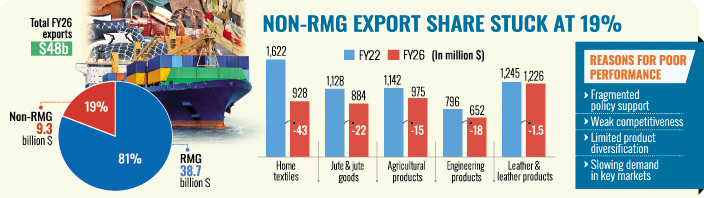
In the just-past FY26, Bangladesh earned around US$48 billion from merchandise exports, of which the RMG sector contributed US$38.7 billion, accounting for more than 81 per cent of the total notwithstanding a 1.64-percent year-on-year decline.
Non-apparel sectors together accounted for only about 19 per cent of the total export earnings, a share that has remained virtually unchanged over the past five years.
Exporters and trade experts attribute the sluggish performance to fragmented policy support, weak competitiveness, limited product diversification and slowing demand in key export markets.
Among the five major sectors, only leather and leather products have nearly regained their FY22 export level. Exports stood at US$1.245 billion in FY22 before declining for two consecutive years and recovering to US$1.226 billion in FY26.
Even so, leather exports have remained in the US$1.0-1.2-billion range for years without achieving the breakthrough long expected from what is widely regarded as Bangladesh's second-largest export prospect.
Meanwhile, Commerce and Industry Minister Khandaker Abdul Muktadir told parliament Tuesday that Bangladesh has the potential to earn as much as US$10 billion annually from leather and leather goods made from domestically produced rawhides.
He said the country is currently realising only 0.26 per cent of its leather-export potential because the relocation of tanneries from Hazaribagh to Savar remains incomplete due to the failure to fully operationalise the Central Effluent Treatment Plant (CETP). The government, he adds, is working to make the CETP fully operational.
Among the remaining sectors, home textiles posted the steepest decline over the five-year period. Export earnings fell from US$1.622 billion in FY22 to US$928 million in FY26, a contraction of nearly 43 per cent.
Jute and jute goods exports declined from US$1.128 billion to US$884 million, while agricultural-product exports fell from US$1.142 billion to US$975 million. Engineering-product exports also remained below their FY22 level, dropping from US$796 million to US$652 million, although the sector recorded the strongest recovery in FY26 with annual growth of more than 21 per cent.
Agricultural exports, after falling sharply to US$827 million in FY23, recovered to US$989 million in FY25 before easing to US$975 million in FY26. Likewise, jute exports rebounded 7.75 per cent in FY26 after several years of downturn, while engineering-product exports climbed from US$536 million in FY25 to US$652 million, signalling renewed momentum despite lying below their FY22 level.
Dr M Masrur Reaz, Chairman of Policy Exchange Bangladesh (PEB), attributes the sluggish performance primarily to weak global competitiveness.
"Our major non-RMG sectors have not developed sufficient competitive capacity to compete effectively in international markets," he told The Financial Express.
He says only a handful of firms in each sector possess internationally competitive production capabilities while most enterprises lack the scale, productivity and technological capability needed to expand exports significantly.
According to him, policymakers have long before identified non-RMG sectors as future export drivers but they failed to formulate and implement comprehensive sector-specific strategies covering technology adoption, skills development, productivity enhancement and coordinated policy support.
He says competitiveness depends not only on enterprise capability but also on an enabling business environment, including efficient logistics, trade facilitation, customs reforms, regulatory improvements and easier access to imported raw materials.
Recent policy measures, including extending bonded-warehouse facilities to non-RMG exporters, are positive but insufficient on their own, he notes.
"A single incentive cannot transform a US$1.5-2.0 billion export sector into a US$10 billion industry. Bangladesh needs a comprehensive sector-development strategy backed by broad-based policy support."
He has also stressed the need for internationally recognised compliance and certification systems, particularly for agro-processing, leather and footwear, alongside a well-defined market-access strategy tailored to different global markets.
"Preparing a sector for global competition requires coordinated action on regulation, skills, technology, logistics, infrastructure, and market access. There is no alternative to a comprehensive and integrated approach," says Dr Masrur Reaz.
Bengal Meat Chief Executive Officer Ahmad Ferdous Md. Asif says Bangladesh's meat-processing industry continues to face two major challenges-price competitiveness and compliance.
"We can produce export-quality products, but competing internationally remains difficult because of high production costs and compliance shortcomings."
According to him, Bangladesh still lacks internationally recognised systems for livestock traceability, disease control, veterinary services and regulatory oversight, limiting the country's access to premium export markets.
Addressing these weaknesses would require sustained public investment in institutional capacity and internationally recognised certification systems, he says.
PRAN Group Managing Director Eleash Mridha points out that the reduction in cash incentives for agro-processed products from 20 per cent to 10 per cent after 2022 weakened exporters' competitiveness.
He also cites the suspension of aromatic rice export, disruptions to Red Sea shipping, the Russia-Ukraine war, the Iran-Israel conflict, rising raw-material costs and labour unrest as key factors behind slower export growth.
However, he expresses optimism that exports would recover as the government has retained the 10-percent cash incentives, introduced partial bonded- warehouse facilities and resumed selective rice exports.
Mr Mridha says PRAN's exports now total around US$700 million, including more than US$350 million worth of agro-processed products, accounting for roughly one-third of Bangladesh's agro-processing exports.
Md Saiful Islam, proprietor of Foresight Business Solution, appreciates the government's intention to diversify the country's export basket as commendable, but complicated procedures are preventing new exporters from benefiting from existing policy support.
"It is very difficult for exporters of new products to obtain cash incentives because they first need prior approval for their products," he says.
"The policy should be more export-friendly."
Saiful Islam mentions that his company exports a range of light-engineering products to the US market, but the existing FE Circular No. 3, dated February 28, 2006, does not provide any guidance on incentive eligibility for such products.
"Because there is no policy direction, we are now in a dilemma over whether we will receive the cash incentives," he says.
"These incentives are designed to make exporters more competitive. If we are deprived of them, it will hurt our competitiveness and result in business losses."
He says the company has already applied to the Ministry of Commerce requesting that the issue be addressed.
According to Saiful Islam, US buyers imported more than US$0.5 million worth of various products from his company last year.
"If the government provides cash incentives based on realised export proceeds, it will encourage exporters and help boost the country's exports," he says.
The company boss expects their exports to more than double in the current fiscal year.
newsmanjasi@gmail.com
© 2026 - All Rights with The Financial Express

