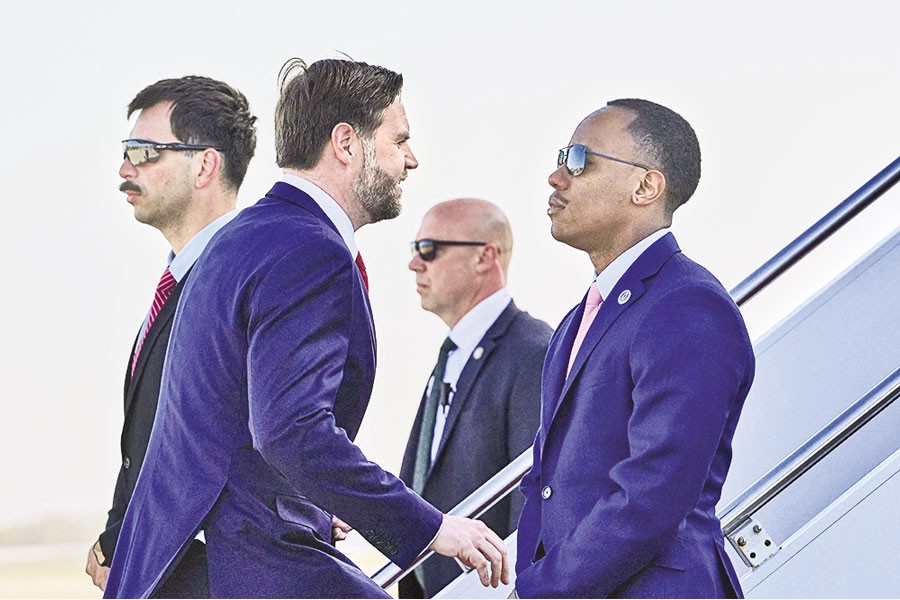
 US Vice President JD Vance boards Air Force Two at Joint Base Andrews, Maryland, on Friday, as he departs for Pakistan for talks on Iran. — AFP
 BEIRUT (Lebanon) April 10 (AFP): European and Arab states have pressured Israel to stop targeting Beirut, a Western diplomat told AFP on Friday, two days after deadly Israeli strikes on Lebanon that left more than 300 people dead.
 On Thursday afternoon, the Israeli military issued a warning of incoming strikes for large, densely populated areas of southern Beirut, but had not carried out the threat as of midday on Friday.
The Western diplomat, who asked to remain anonymous in order to discuss sensitive matters, said on Friday, "There is ongoing diplomatic pressure from European states, Gulf states and Egypt on Israel to prevent renewed Israeli airstrikes on Beirut after 'Black Wednesday'".
More than 300 people, mostly civilians according to a Lebanese military source, were killed in the wave of simultaneous Israeli strikes on Wednesday on Beirut and other areas of Lebanon.
The strikes were launched despite the announcement hours earlier of a truce between the United States and Iran, with Israel and the US saying it did not apply to Lebanon.
Thursday's Israeli warning included areas home to major hospitals and the road to the country's only international airport.
Public Works and Transport Minister Fayez Rasamni said, in a statement carried by the state-run National News Agency (NNA) on Thursday, that he had "received assurances" from foreign diplomats that the airport and the road leading to it would be spared.
Meanwhile, Mohammad Zaatari, director of the country's largest public medical facility, Rafic Hariri Hospital, told AFP: "We have received assurances, including from the International Committee of the Red Cross that the hospital would not be targeted."
The World Health Organization on Thursday called on Israel to cancel its evacuation warning for the Jnah district of Beirut because around 450 patients were in the Rafic Hariri and Al-Zahraa hospitals in the district, including 40 in intensive care.
In southern Lebanon, Israeli strikes hit several villages during the night and on Friday, the NNA reported.
An AFP photographer saw firefighters extinguishing a fire in a building blown apart by a nighttime strike in the village of Habbouch, near Nabatiyeh.
Hezbollah, for its part, claimed several rocket launches on northern Israel, as well as attacks on Israeli troops advancing in the border area.
Iran's Supreme Leader Mojtaba Khamenei has said Tehran will take the management of the Strait of Hormuz "into a new phase," as tensions persist despite a fragile ceasefire with the United States.
In a statement broadcast by state media, Khamenei said Iran would "seek compensation for every single loss inflicted" and pursue damages for those injured in the war. While he did not clarify what the new phase of Hormuz management would entail, the remarks signal a potential shift in Tehran's strategy over the vital global oil route.
He stressed that Iran "never sought war and we're not seeking war," but warned it would "not back off from seeking our legitimate rights in any way," including support for what he described as the "entire resistance front." He also called on pro-Iran supporters to mobilise publicly, saying their voices could influence the outcome of ongoing negotiations.
Meanwhile, US President Donald Trump said Israel would "scale back" strikes on Lebanon ahead of talks with Iran in Islamabad, expressing optimism about a potential deal. However, Israeli Prime Minister Benjamin Netanyahu rejected the notion of a truce in Lebanon, declaring "there is no ceasefire" and vowing continued attacks against Hezbollah.
The conflicting positions have cast doubt on the durability of the two-week ceasefire, with disputes over Lebanon and the Strait of Hormuz emerging as key sticking points.
According to The Financial Times, Iran's senior wartime leader said two of the measures included in the ceasefire deal with the US had not been fulfilled, casting doubt on talks scheduled to take place in Pakistan this weekend.
"Two of the measures mutually agreed upon between the parties have yet to be implemented: a ceasefire in Lebanon and the release of Iran's blocked assets prior to the commencement of negotiations," Mohammad Bagher Ghalibaf said in a post on X.
"These two matters must be fulfilled before negotiations begin," Ghalibaf, Iran's parliamentary speaker, said.
Iran has yet to confirm whether its officials will attend negotiations with the US, which are set to begin in Islamabad on Saturday.
However, JD Vance said he expected "positive" talks with Iran in Pakistan today (Saturday) as he prepared to fly to a high-stakes round of negotiations on the ceasefire announced earlier this week.
Before boarding Air Force Two for the flight to Islamabad, the US vice-president said:
We're looking forward to negotiation. I think it's going to be positive.
The President gave us some pretty clear guidelines, and we're going to see.
If the Iranians are willing to negotiate in good faith, we're certainly willing to extend the open hand. If they're going to try to play us, then they're going to find the negotiating team is not that receptive.
Vance is leading the US negotiating team alongside Steve Witkoff, the special envoy, and Jared Kushner, the president's son-in-law.
The initial days of the ceasefire have been mired in discord between the US and Iran over whether it applies to Lebanon, Iran's control over shipping through the Strait of Hormuz and the fate of Iran's stockpile of highly enriched uranium.
© 2026 - All Rights with The Financial Express

