Second thoughts on gains from trade deal with an economic biggie show Bangladesh's exports to Japan are destined to decline significantly for privilege contraction once the partnership pact takes effect shortly.
Insights find that after the bilateral Economic Partnership Agreement (EPA) enters into force, nearly 20 per cent of Bangladesh's products will fall out of the purview of duty-free and quota-free (DFQF) market-access privilege.
The deal is scheduled to be signed by the last week of this month, as expected by the two sides earlier. Commerce Adviser Sk Bashir Uddin is scheduled to have talks with foreign minister of Japan over telephone Monday on EPA signing and inform the media about the deal-making progress.
Officials say products like leather, leather-goods, and footwear, which constitute around 10 per cent of Bangladesh exports to Japan, would not be eligible for DFQF facility immediately after the EPA comes into force.
They say during the negotiations, Japan had offered Bangladesh DFQF facility on these products in phases.
However, Bangladesh side insisted on keeping the products in "renegotiation" category for further negotiation in a later stage of partnership.
Firoj Uddin Ahmed, a joint secretary at the ministry of commerce, at a recent workshop with representatives of different ministries said due to "sensitivity" with leather, leather-goods, and footwear in Japanese society, Tokyo never gave DFQF facility on these products immediately while signing EPA or FTA with any country.
However, a scrutiny reveals that out of 78 HS lines under chapters 41, 42 and 64, 65 HS lines are currently duty-free under several EPAs signed by Japan with countries like Mexico, Malaysia, Chile, Thailand, and Indonesia. Other lines will also be duty-free by 2034.
At the meeting, commerce secretary Mahbubur Rahman, replying to a query, said almost all countries have "sensitivity" on farm products. "However, commerce ministry will continue trying to get highest facilities in case of agri-products in the EPA."
Japan put products in 1259 HS Line on a 9-digit sensitive list while offered DFQF facility to products in 509 HS Line in 9-digit one in phases. Moreover, the East Asian nation put 206 HS Lines in renegotiation category and one HS Line under tariff-rate-quota (TRQ) category that means such products would not be eligible for DFQF facility just after the deal enters into force.
Presently, Bangladesh, being a least-developed country (LDC), enjoys DFQF facility in case of 98.7 per cent of products on the Japanese marker. The commerce secretary recently told The Financial Express: "We will get duty-free access of the entire products that presently enjoy the similar facility on the Japanese market."
However, a close examination of record of the workshop reveals that Bangladesh will enjoy DFQF market access on 78.9 per cent of products the day the treaty takes effect.
This means some 20-percent products will remain out of the purview of the DFQF facility now-a lapse that comes under critical scrutiny by experts.
"It is not clear why Bangladesh could not negotiate DFQF access on those products even though other countries could negotiate, and Bangladesh is currently enjoying DFQF market access under generalised system of preferences (GSP)," says a trade expert, preferring not to be quoted by name.
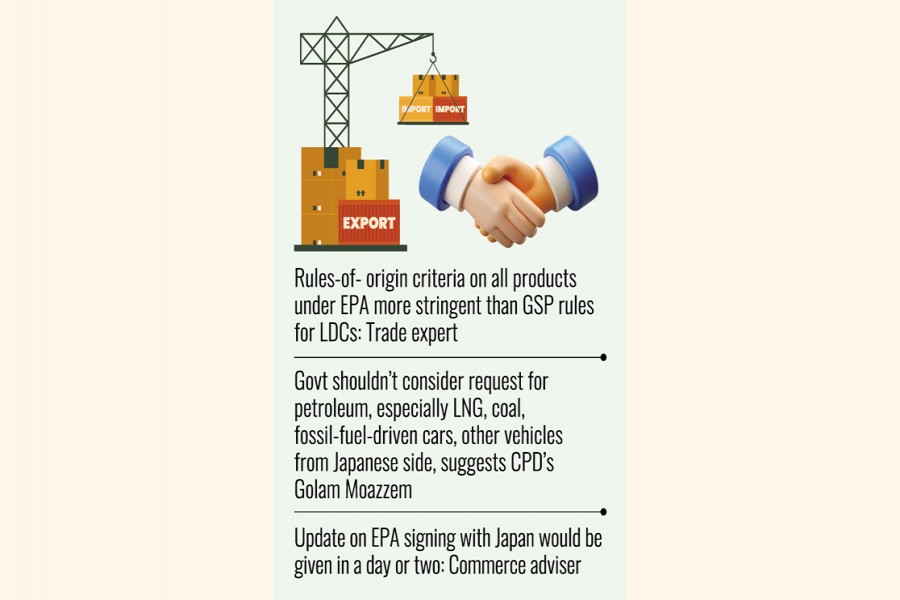
He is skeptical as to whether Bangladeshi manufacturers will be able to meet the rules-of- origin criteria on all products as negotiated under the EPA. He thinks the ROO criteria under the EPA are more stringent than GSP rules of origin for LDCs.
The expert mentions that Bangladesh has made commitment on 93 sectors in services sector. Questions are there whether Bangladesh is going to open these sectors and relax rules and regulations for all countries or only for Japan on the date of coming into force of the agreement. Contacted, Ayesha Akther, an additional secretary of the ministry of commerce, who led the EPA negotiation with Japan, declined to reply to a query on the opening of services sector and other DFQF issues.
In fiscal year 2024-25 the country exported goods worth $1.41 billion to Japan while imports came to around $1.51 billion.
In the scanty export basket are mainly readymade garments, home textiles, leather and leather goods, footwear, and sea foods. On the other hand, Bangladesh mainly imports iron and steel, vehicles, mineral fuels, oils, distillation products, machinery, nuclear reactors, boilers, manmade staple fibers, optical, photo, technical, medical apparatus, manmade filaments, impregnated, coated or laminated textile fabrics, and electrical and electronic equipment, and plastics, among others.
Commerce Adviser Sk Bashir Uddin Thursday told The Financial Express over the telephone that an update on the signing of the EPA with Japan would be given in a day or two. He wouldn't give further details about the up-and-coming trade deal with the world's third-largest economy.
Dr Khondaker Golam Moazzem, Research Director at the Centre for Policy Dialogue (CPD), says Bangladesh needs to conduct a detailed analysis about how much it would benefit from Japan's request list and how much it would cost for Bangladesh.
"At the same time, Bangladesh needs to analyse how much Bangladesh's offer to Japan would have implications for other potential EPA partners, including China, India, Singapore, S. Korea, Malaysia, and other countries under different levels of discussion," he told the FE on Friday.
He suggests the government should not consider Japan's request for petroleum, especially LNG, coal, and fossil-fuel-driven cars and other vehicles.
"Bangladesh should also build partnerships in trade in services, including temporary skilled migrations, as well as digital services."
syful-islam@outlook.com
© 2026 - All Rights with The Financial Express

