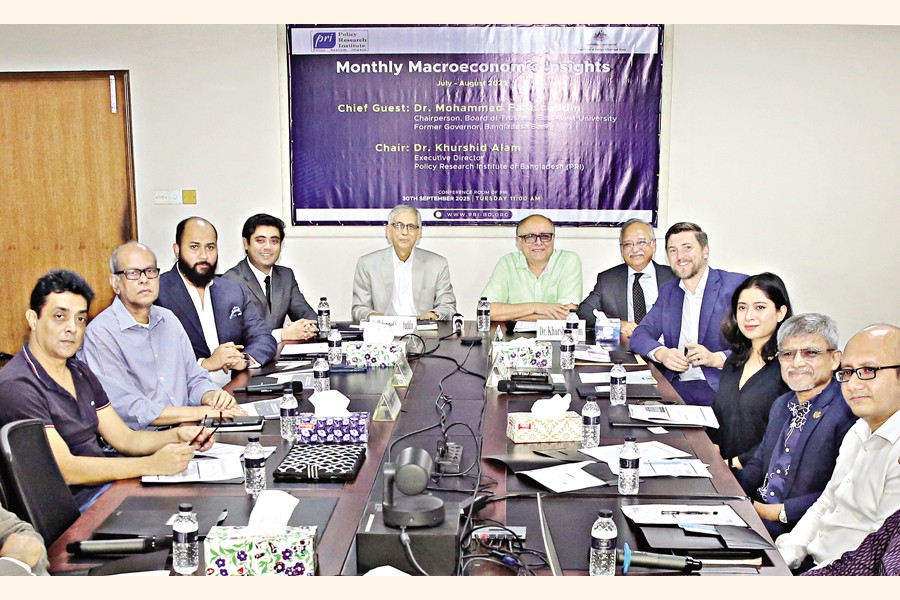
 Experts pose for a photo at a programme titled 'Monthly Macroeconomic Insights', organised by the Policy Research Institute of Bangladesh (PRI) in Dhaka, on Tuesday. Former Bangladesh Bank Governor Mohammed Farashuddin was present as the chief guest with PRI Executive Director Khurshid Alam chairing the event. — FE Photo
  When political power converges with economic interests, the result is the rise of corporations that function much like the East India Company of colonial times, warns Dr. Mohammed Farashuddin.
Speaking at a Policy Research Institute (PRI) event in Dhaka on Tuesday, the former Bangladesh Bank Governor cautioned that 10 to 15 such companies had already been identified in Bangladesh, and that they must face justice.
Simply freezing their assets, he argues, would not suffice--those assets should be recovered and transferred into state accounts to strengthen public finances.
Farashuddin made the remarks while delivering the keynote speech at the 'Monthly Macroeconomic Analysis (MMI)' event organised by the private research-body Policy Research Institute (PRI) in Banani, Dhaka. The session was chaired by PRI Executive Director Khurshid Alam.
"I think we have come to a situation where the government should take a very clear stance that these are the 10, 12, or 15 delinquent companies. We will go all the way to punish them, collect evidence, and pursue every possible course," he told the meet.
On the matter of freezing bank accounts, Mr Farashuddin cautions that it is not always the best approach. "To maintain trust in the banking system, decisions on this matter must be taken carefully."
He said, "If the spouse or children of a delinquent individual are financially independent, there is no reason to freeze their accounts. Yet this is happening, and I do not think it will yield positive results. It could undermine confidence in banks."
The former chief of the central bank advises the government to limit account freezes to only a few cases, particularly among "the 10-15 delinquent individuals already identified".
Turning to money laundering-another blight on the economy-- Farashuddin notes: "Money laundering occurs in almost every country. According to the Financial Integrity Institute of Washington, an average of $7.0 billion has been laundered annually since 2004. But a friend of mine heading a taskforce has found it could be as high as $17 billion. These figures are based on the Financial Integrity Institute, so we should not dramatise the issue. We should proceed cautiously, steadily, and do our job."
Addressing large-scale corruption in recent years, he admits there is no doubt it has taken place, but stresses there is no reason for despair. "We need to find our own solutions.
"The current government has so far stayed on the right path. Bold policy decisions are necessary. Bangladesh Bank must be strengthened. Above all, tax collection must increase."
On bank governance, he argues that the only proper role of a board of directors is policymaking, but in Bangladesh, boards often encourage lending instead. "Lending and policy-making should be separated."
Earlier in the programme, PRI Chief Economist Ashikur Rahman presented a paper on the macroeconomy for July-August 2025.
He warned that some "East India Companies" in Bangladesh had pushed the economy to the brink. "If we fail to protect the independence and efficiency of economic institutions, especially the central bank, new East India Companies could emerge again," he said.
Rahman added that the biggest weakness in past economic stability was the lack of independence and efficiency in economic institutions. "In this context, the new Bangladesh Bank ordinance must be approved with due importance."
Kamran T. Rahman, President of the Metropolitan Chamber of Commerce and Industry, Dhaka (MCCI), observes that while the economy remains stable, growth has slowed.
Some indicators, such as exports and remittance inflows, showed improvement in the latest quarter, but private-sector investment remains below expectations, and inflation continues to be a major challenge, he points out.
Former President of Dhaka Chamber of Commerce and Industry (DCCI) Rizwan Rahman remarked, "No country can completely stop money laundering. Our failure is in not controlling it. It is still happening. Many individuals who fled abroad had not already established permanent residence, so they launder money from the country for survival."
Khondokar Sakhawat Ali, Visiting Research Fellow at the BRAC Institute of Governance and Development (BIGD), emphasised that Bangladesh Bank must be allowed to operate independently to curb money laundering and ensure proper economic governance.
He argues that due to various influences-from businesspeople, politicians, bureaucrats, the military-civil administration, and media-intellectual circles-the central bank cannot fully perform its role.
"Those laundering money today are part of our civil society. The state must take firm action to stop them," he told the audience.
newsmanjasi@gmail.com
© 2026 - All Rights with The Financial Express

