Bangladesh is among 60 countries coming under latest two-pronged US trade scrutiny over forced labour and industrial overcapacity, hot on the heels of tariff wars.
The United States launched Thursday investigations into 60 countries that also include China, India and the European Union over what is stated as failure to act on forced labour.
 The probe move came a day after US trade ambassador Jamieson Greer launched a trade investigation into the manufacturing sectors of 16 economies, including Bangladesh, over excess industrial capacity and production in these countries that are said to be undermining US industrialisation efforts.
Initiated by the US Trade Representative (USTR), the Thursday-launched investigations under Section 301(b) of the Trade Act of 1974 will determine policies and practices "related to the failure to impose and effectively enforce a ban on the importation of goods produced with forced labour" and whether these burden or restrict US commerce.
The 60 economies subject to these rechecks are the largest trading partners of the United States.
"Despite the international consensus against forced labour, governments have failed to impose and effectively enforce measures banning goods produced with forced labour from entering their markets," Ambassador Greer said in a statement issued on Thursday.
For too long, American workers and firms have been forced to compete against foreign producers who may have an artificial cost advantage gained from the scourge of forced labour, he added.
"These investigations will determine whether foreign governments have taken sufficient steps to prohibit the importation of goods produced with forced labour and how the failure to eradicate these abhorrent practices impacts U.S. workers and businesses," he notes.
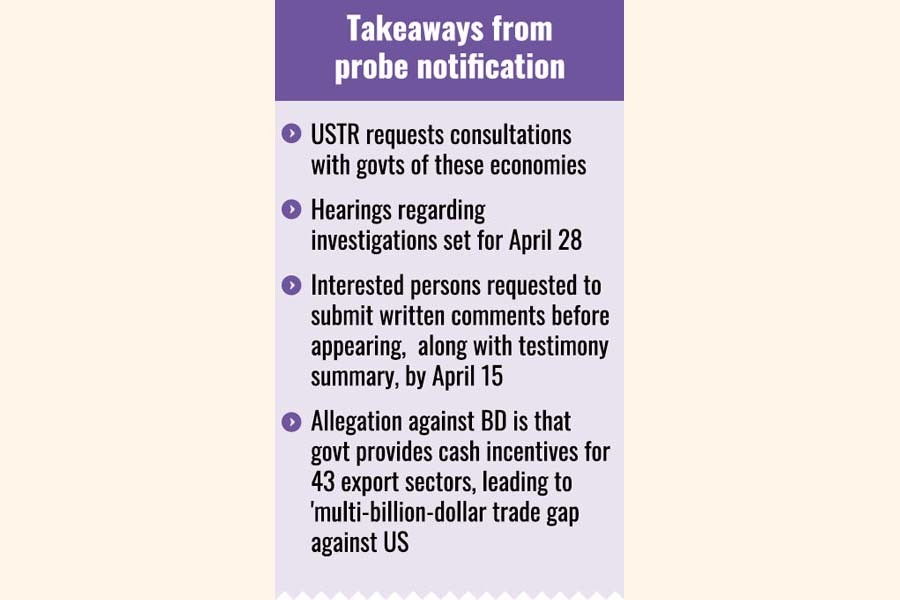
The USTR has requested consultations with the governments of these economies in connection with these investigations.
It will hold hearings in connection with these investigations on April 28, 2026 and requested interested persons to submit written comments before appearing at the hearing, along with a summary of the testimony, by April 15, 2026.
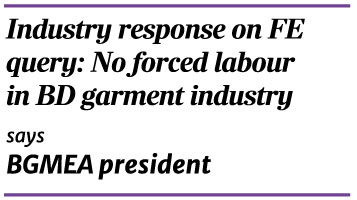
Asked about the new developments on the trade front, Bangladesh Garment Manufacturers and Exporters Association (BGMEA) president Mahmud Hasan Khan said, "We are confident that there is no forced labour in the country's readymade garment industry."
However, he terms the inclusion of Bangladesh in the investigation over forced labour 'uncomfortable'.
The BGMEA leader also says whenever any issue is raised or discussed about labour or labour law, it is assumed that these are only for garment industry while those are for all industrial sectors, not only for garment.
He further notes that Bangladesh has to be well-prepared and inform the US authorities concerned.
Economies subject to investigations are Algeria, Angola. Argentina, Australia, The Bahamas, Bahrain, Bangladesh, Brazil, Cambodia, Canada, Chile, China, Colombia, Costa Rica, Dominican Republic, Ecuador, Egypt, El Salvador, the European Union, Guatemala, Guyana, Honduras, Hong Kong, China, India, Indonesia, Iraq, Israel, Japan, Jordan, Kazakhstan, Kuwait, Libya, Malaysia, Mexico, Morocco, New Zealand, Nicaragua, Nigeria, Norway, Oman, Pakistan, Peru, the Philippines, Qatar, Russia, Saudi Arabia, Singapore, South Africa, South Korea, Sri Lanka, Switzerland, Taiwan, Thailand, Trinidad and Tobago, Türkiye, the United Arab Emirates, the United Kingdom, Uruguay, Venezuela and Vietnam.
According to the Federal Register notice, the March 11 investigation allegation against Bangladesh is that government provides cash incentives for 43 export-oriented sectors, including domestic textile and leather products, which have contributed to a 'multi-billion-dollar trade gap with the United States in favour of Bangladesh'.
"Evidence of structural excess capacity and production exists for Bangladesh, which has a bilateral goods trade surplus of $6.15 billion with the United States. This bilateral surplus is led by exports in the textiles sector," the notification reads.
Furthermore, Bangladesh's cement industry is wrestling with significant excess capacity in the midst of the industry's worst downturn in years, with Bangladesh's national consumption of cement dropping to 38 million tonnes in 2024 -- less than 40 per cent of total capacity -- and declining further in 2025, according to the notice.
Munni_fe@yahoo.com
© 2026 - All Rights with The Financial Express

