A strategy change in government bank borrowing becomes clear in a switch from long-term treasury bonds to short-term treasury bills to dodge "distortion" in interest regime as bankers bid big at auctions.
Officials and bankers have said under the latest borrowing mechanism, the government has discarded the auctions of T-bonds with 15-year and 20-year terms for the last three consecutive months while the auction of these investment instruments remained stalled for two more months of the calendar year.
The bidding on the long-term government securities used to take place every month.
Sources at Bangladesh Bank (BB) have said auctions of the T-bonds took place only in three months of this year where the central bank supplied major chunk of the fund requirement on their own to the government through 'devolvement mechanism'.
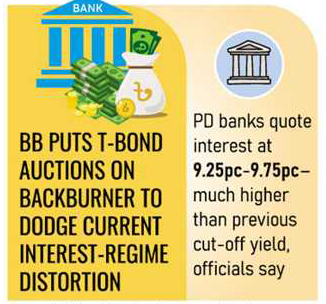
Seeking anonymity, a BB official says the participating primary dealer banks, which are allowed to take part in the bidding on government securities, have been placing higher rates of interest, starting from 9.25 per cent to around 9.75 per cent, which is much higher than the previous cut-off yields.
The cut-off yields for T-bond having 15-year and 20-year terms in May bidding were 8.65 per cent and 8.80 per cent respectively.
"If the government allows such higher rates for long-term securities, it will trigger many problems, like enhancing the interest liabilities of the government and pressure on the reserve money of the BB," the official says about the reason for the hiatus.
Simultaneously, the BB official views, acceptance of the T-bonds at higher rates will start fueling up other yields in T-bonds and T-bills, which will make it difficult to bring the reference rate called as SMART under the target.
"That's why the bidding on long-term securities has been cancelled in recent months," the central banker says.
He mentions that the government is now focusing more on short-term bank borrowing by issuing treasury bills to meet its major share of budget-financing shortfalls.
According to the BB data, the government has borrowed around Tk 39.0 billion through T-bonds under the tenure of 15 and 20 years so far this year and around 50 per cent of the funds were 'high-powered money' given by the central bank through printing money which is euphemistically called 'devolvement'.
Talking to the FE, deputy managing director (DMD) and head of treasury of Meghna Bank Limited Md. Sadiqur Rahman said if the market yield for long-term T-bonds was allowed at a higher rate close to 10 per cent, it would start distorting the money market as well as other non-listed securities like preference share, subordinated bonds, and perpetual investment bonds etc.
Banks can charge maximum 10.10 per cent in terms of corporate lending under this SMART regime but there are risks of NPL (non-performing loan) and provisioning.
"If the banks see investment in the long-term government securities being allowed at the rate close to 10 per cent, banks will not get encouraged in corporate lending as there is no risk of NPL and provisioning in government securities," he said.
Asked why the banks place higher rates, the executive said the banks fear to face Market-to-Market Revaluation loss if the yield further increases after the investment. The value of the bonds will decrease if the market yield goes over the bond coupon.
"That's why the banks bid at slightly higher rate, which is logical."
Seeking anonymity, the treasury head of a commercial bank said the interest rates on government securities are very much interlinked. If the market yield of the long-term T-bonds rises, other rates will also follow suit taking an upturn.
"And it will ultimately create more pressure on the central bank's plan to keep the lending rate under its target because the SMART rate is not a completely market-based one," the banker said.
"The BB has been controlling the reference rate through devolvement mechanism to keep the rate under its target."
jubairfe1980@gmail.com
© 2026 - All Rights with The Financial Express

