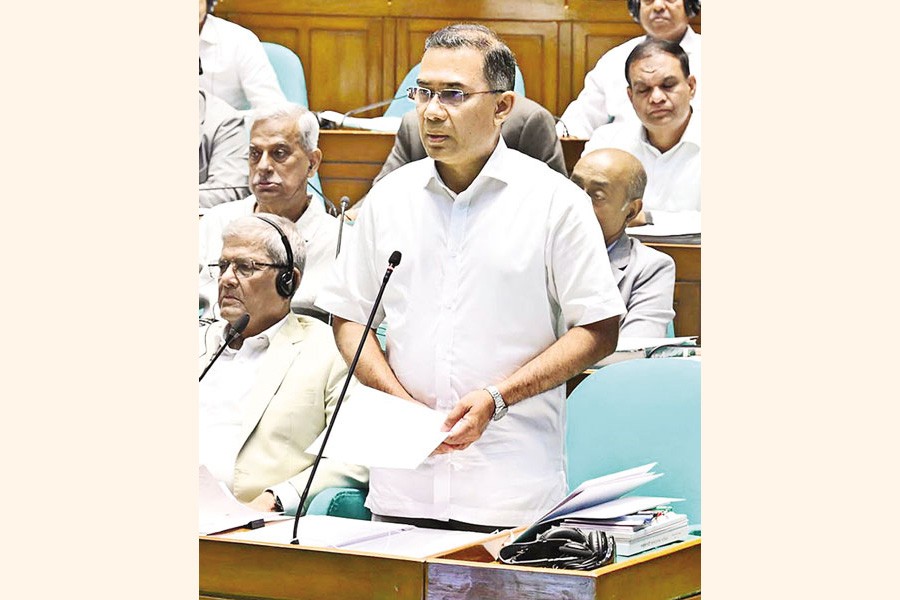
Prime Minister Tarique Rahman reaffirms his government's pledge to implement the long-delayed Teesta Barrage Master Plan "at any cost" as a national priority aimed at addressing chronic water shortages and transforming agriculture in northern Bangladesh.
Addressing parliament on Monday during general discussion on the proposed 2026-27 national budget, Rahman outlined an expansive policy agenda that combined major infrastructure projects with agricultural support, education reform, energy restructuring and initiatives to stimulate what he describes as "creative economy".
The prime minister deplores that successive governments had failed to resolve the long-standing water crisis affecting northern Bangladesh and insisted his administration is determined to deliver a permanent solution.
"The two major concerns of the people and elected representatives from Rajshahi and Rangpur are the Padma and the Teesta rivers," he told lawmakers. "The BNP has always been a pro-agriculture and farmer-friendly government. Whenever we have had the opportunity to govern, we sought to ensure people's right to water."
He announces that alongside plans to construct a Padma Barrage to conserve excess monsoon water for dry-season irrigation, the government would move ahead with the Teesta Barrage Master Plan, describing it as a project of national importance.
The affirmation of commitment comes days after Dhaka and Beijing agreed to begin a joint feasibility study on the Teesta River Comprehensive Management and Restoration Project following the prime minister's visit to China, placing renewed attention on one of Bangladesh's most politically sensitive water- management initiatives.
Beyond the Teesta, Rahman announces a nationwide programme to restore rivers and canals as part of broader efforts to improve irrigation and agricultural productivity.
Although many regions experience extensive flooding during the monsoon, farmers frequently struggle to access irrigation water during dry season, he notes. To address the imbalance, the government plans to excavate and re-excavate 20,000 kilometres of canals over the next five years.
According to the prime minister, nearly 900 kilometres of canal restoration has already been completed during the past three months.
Agriculture featured prominently throughout the prime minister's wrapping-up address on the budget, set to be passed today.
Rahman says the government has already fulfilled one of its key election pledges by writing off agricultural loans of up to Tk 10,000, including accumulated interest, benefiting around 1.3 million farmers. It was done during its first cabinet meeting after assuming office.
He also announces the introduction of Farmer Card designed to provide direct financial assistance to the peasants. Under the programme, eligible farmers will receive Tk 2,500 annually alongside access to ten additional government services. The administration expects to distribute approximately 4.3 million cards during the 2026-27 fiscal year.
Seeking to diversify Bangladesh's economic base, the prime minister announces plans to bring industries such as film, theatre, music, digital content creation, gaming, fashion, software development and OTT platforms under the umbrella of a national "creative economy".
He argues that these sectors could become important drivers of employment and export earning as Bangladesh moves towards a more knowledge-based economy.
Rahman also unveils in the House measures aimed at strengthening sports development, including the introduction of a national honorarium framework for high-performing athletes and plans to incorporate sports as an independent subject within the national curriculum.
A nationwide youth sports talent programme modelled on the late President Ziaur Rahman's "Notun Kuri" initiative will also be introduced.
Highlighting the importance of remittance and overseas employment, the prime minister says the government is exploring new labour markets while preparing to introduce an Expatriate Card that would simplify access to government services for Bangladeshi migrant workers both abroad and upon their return home.
Crediting former President Ziaur Rahman with opening labour markets in the Middle East, he says the incumbent administration intends to expand opportunities for skilled Bangladeshi workers globally.
Rahman sharply criticises the previous political administration's management of the energy sector, accusing it of encouraging excessive dependence on imported fuels while neglecting domestic gas exploration.
He argues that these policies had created opportunities for corruption and left Bangladesh vulnerable to external shocks.
This government, he says, would prioritise domestic gas exploration alongside renewable energy development in an effort to restore transparency and reduce import dependence.
Turning to education, Rahman describes human capital as Bangladesh's greatest national asset and pledges reforms aimed at rearing a more skilled and ethically grounded workforce capable of supporting long-term economic development.
The prime minister also defends the proposed Tk9.38-trillion budget for the imminent fiscal year, describing it as a "life-friendly budget" intended to provide practical relief to households amid continuing economic challenges.
"This is a budget centred on people's lives," Rahman told the House, arguing that the government has sought to produce a realistic fiscal plan despite difficult economic conditions inherited after taking office.
He points to the tax waiver on 61 essential consumer goods and notes that, unlike previous years, the announcement of the budget was not followed by sharp increases in prices of daily necessities.
"We believe we have been able to provide at least some relief to people from all walks of life."
Rahman acknowledges that his administration inherited an economy under considerable strain.
He cites high inflation, declining foreign-exchange reserves, capital flight, a depreciating currency and what he describes as years of corruption, policy failures and financial mismanagement that had weakened investment and disrupted production.
He also criticises what he calls "vanity projects" undertaken by the previous government, arguing that they had left Bangladesh burdened with costly domestic and foreign debts without generating sufficient economic returns.
At the same time, the prime minister has stressed that his government did not intend to use the country's economic difficulties as an excuse for inaction.
"We cannot deny the crisis, but neither do we want to hide behind it," he told the parliament. "With public support, political goodwill and sound policies, we are confident that Bangladesh can overcome these challenges."
Reflecting on the government's first months in office, Rahman says the administration assumed responsibility amid economic fragility while simultaneously managing the Ramadan period and attempting to keep essential commodities affordable.
"Our journey has just begun," he says. "Through collective effort, we believe we can restore stability and lay the foundation for a stronger economy."
Prime Minister Tarique Rahman describes the proposed national budget for the 2026-27 fiscal year as "a journey towards an inclusive economy," saying that the government's objective is to free the economy from the grip of a privileged few and ensure broader participation by ordinary citizens.
"The goal of this budget is to build an economy that works for everyone. Our aim is to liberate the economy from the control of a handful of beneficiaries and ensure the participation of the common people."
He notes that genuine development cannot be measured solely by GDP growth. "Development becomes meaningful only when ordinary households experience greater comfort and security-when the poor receive social protection, young people find jobs that match their qualifications, and farmers receive fair prices of their produce."
mirmostafiz@yahoo.com
© 2026 - All Rights with The Financial Express

