The government plans to import more than 1.7 million tonnes of fertiliser from the Middle East and alternative sources to ensure supply for the Aman season starting in June, amid a sharp drop in local production.
Output at domestic fertiliser factories has nearly come to a halt due to a fuel crisis, forcing the authorities to rely heavily on imports to safeguard food security.
Global fertiliser prices have surged to a four-year high amid escalating geopolitical tensions, including conflicts involving the United States, Israel and Iran. Disruptions in the Strait of Hormuz -- a key shipping route handling around 20 per cent of global fuel and 30 per cent of fertiliser -- have further worsened the situation.
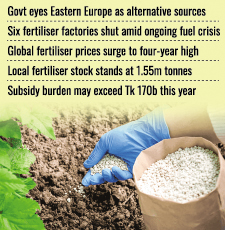
According to the Ministry of Agriculture, Bangladesh currently holds around 1.55 million tonnes of fertiliser stock, including 0.35 million tonnes of urea and 0.55 million tonnes of DAP, with the remainder comprising TSP and MOP.
Urea stocks are expected to last until June, while non-urea fertilisers may be sufficient until October, a senior ministry official said. Bangladesh imports fertiliser from countries such as Saudi Arabia, the United Arab Emirates and Qatar, all of which depend on the Hormuz route for shipping. Non-urea fertilisers are also sourced from Russia, Canada, Morocco, China, Tunisia, Jordan and Egypt.
The country remains heavily dependent on imports for both urea and non-urea fertilisers. Each year, Bangladesh requires around 6.5 to 6.8 million tonnes of fertiliser, including 3.0 to 3.2 million tonnes of urea. Local production meets only 0.8 to 0.9 million tonnes of demand.
Following the disruption in the Hormuz route and shutdown of local factories, the government has decided to import 1.7 million tonnes of fertiliser to meet demand for the Aman and upcoming winter crops.
As a precaution, an additional 0.3 million tonnes of urea will be imported to mitigate any supply disruption after June.
Officials said Bangladesh is also exploring new import arrangements, including deals with Egypt for DAP and TSP, while proposals from Latvia, Belarus, Brunei and Vietnam are under discussion.
Several fertiliser plants -- including Ghorashal Polash Fertilizer PLC, Karnaphuli Fertilizer Company Limited and Shahjalal Fertilizer Company Limited -- have suspended production due to gas shortages.
Production at DAP Fertilizer Company Limited in Chattogram has also stopped due to an ammonia shortage, further tightening supply.
"There is little chance of reopening the factories unless the Hormuz route situation improves. For now, imports remain the only viable option," a ministry official said.
Agriculture Secretary Dr Rafiqul I Mohamed said the government is working to diversify import sources beyond the Hormuz route and promote climate-smart technologies to reduce dependence on costly imports.
"Our immediate priority is to ensure uninterrupted fertiliser supply for the upcoming seasons at any cost," he said.
Agri value chain expert Prof Dr Rashidul Hasan said the government has allocated Tk 170 billion for fertiliser subsidies this year.
He noted that urea prices have risen by 50-55 per cent, while DAP, MOP and TSP prices have increased by 20-30 per cent over the past two months, warning that subsidy costs may rise further.
Despite the price surge, he stressed the need to ensure a steady supply of key agricultural inputs to protect food security. Meanwhile, the United Nations Office for Project Services (UNOPS) said the disruption in the Strait of Hormuz has significantly affected global fertiliser supply.
A large share of the world's oil, gas and fertiliser raw materials passes through the route, and its disruption has pushed prices to record highs, said UNOPS Executive Director Jorge Moreira da Silva.
He warned that prolonged disruption could severely impact global agricultural production, reduce food output and trigger a widespread food crisis. Developi ng and low-income countries are likely to be hardest hit, as rising fertiliser prices threaten food security, he added, urging swift diplomatic action to avert a humanitarian crisis.
tonmoy.wardad@gmail.com
© 2026 - All Rights with The Financial Express

