Government's domestic borrowing from nonbanking sources bloats as institutional and individual depositors pour their money into secure government securities (G-Sec) failing to find better alternative investment choices as yet, sources say.
Normally, major portion of government's domestic debts to meet budgetary shortfall comes from the banking sector while the remaining smaller quantum is generated from the nonbanking sources.
Now, things start changing course as the share of contribution of the nonbanking avenues like institutional and individual depositors continues rising.
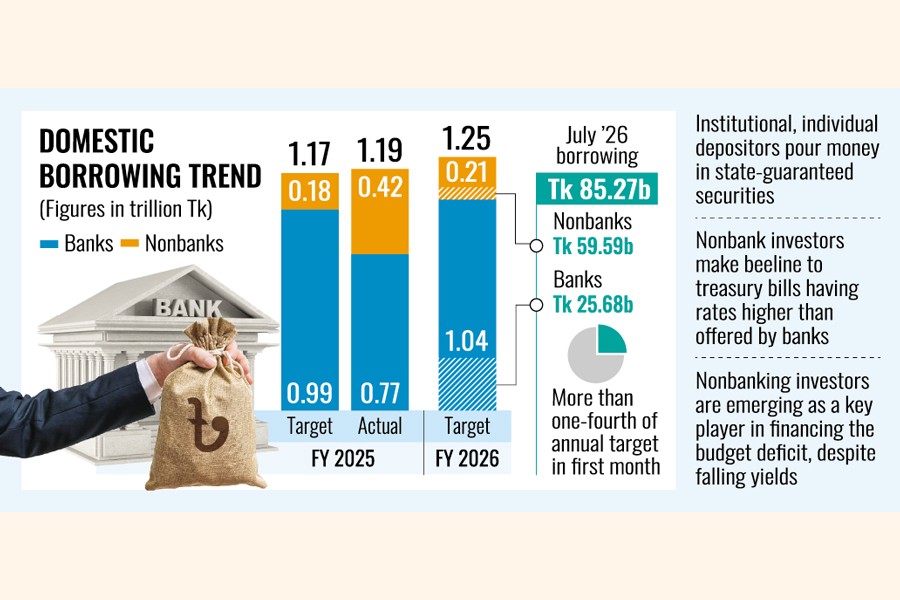
In the current national budget for FY'26, the target of total domestic borrowing has been set at Tk 1.25 trillion, Tk 1.04 trillion of which planned to be borrowed from the banking system while Tk 210 billion from the nonbanking sources.
According to data with Bangladesh Bank (BB), the government borrowed Tk 85.27 billion domestically in July, as the fiscal year began. Of the amount, Tk 25.68 billion came from the banks while nonbanking sources contributed Tk 59.59 billion, which is more than one-fourth of the fiscal target.
In the FY'25, the domestic borrowing came to Tk 1.19 trillion against the initial target of Tk 1.17 trillion. Banks altogether contributed Tk 771 billion against the target of Tk 990 billion. On the other hand, nonbanking sources contributed Tk 423 billion--Tk 243-billion higher than the target.
Seeking anonymity, a BB official says there are two areas in the bidding on government securities: competitive and non-competitive. Primary-dealer banks and other banks bid for competitive area while institutional and individual investors normally put their stakes on non-competitive ones.
In the competitive area, the official further explains, the participants need to compete with one another over rates. And the government will decide regarding the cut-off yield considering its overall liabilities and requirements.
"So, there is a risk of not getting their bids accepted. That's why institutional and individual investors chose non-competitive option," the central banker told The Financial Express.
Citing the auction guidelines, the official says there is a maximum ceiling of 30 per cent of the notified amount in each auction for the non-competitive bidders. "Now, it's crossed 20 per cent and we're receiving huge response from the institutional and individual investors."
Another central banker, who also preferred not to be quoted by name, has says they have witnessed more participation of such investors in the treasury bills where the rates are much higher than that offered by the commercial banks.
He mentions that the government imposed restrictions discouraging provident funds from the saving-certificate instruments. "So, these funds have now been diverted to the G-Sec market. This is another reason behind the increased fund flow from nonbanking sources."
However, the downturn in the yields of risk-free government-guaranteed security instruments continues following a policy twist. Despite the fact, the contribution of the nonbanking sources keeps mounting mainly because of existing overall economic sluggishness.
According to the dada, the cut-off yield on 91-day, 182-day and 364-day treasury bills dropped to 9.90 per cent, 9.79 per cent and 9.68 per cent respectively on September 28, 2025 from 11.03 per cent, 11.16 per cent and 10.95 per cent recorded on July last respectively.
jubairfe1980@gmail.com
© 2026 - All Rights with The Financial Express

