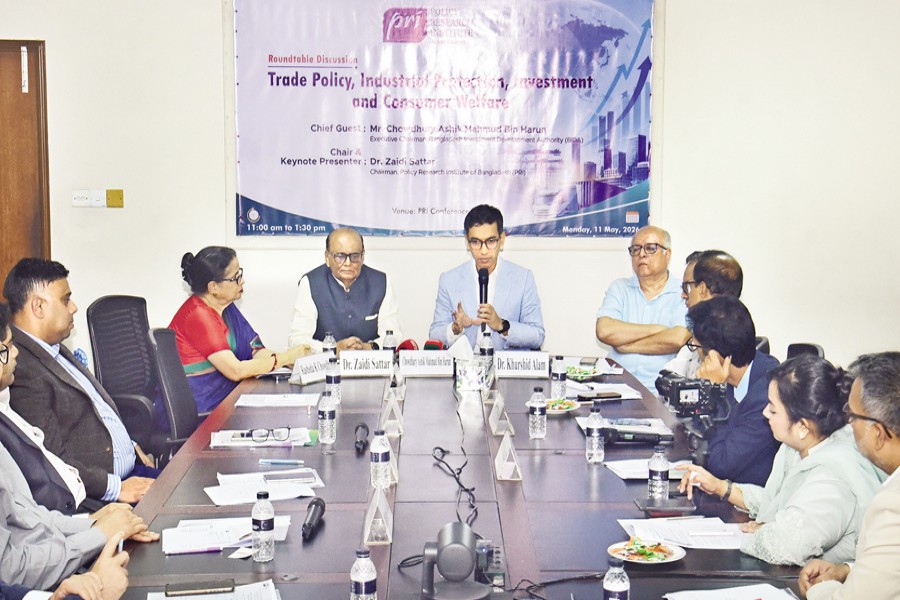
 Bangladesh Investment Development Authority (BIDA) Executive Chairman Chowdhury Ashik Mahmud Bin Harun speaks at a roundtable organised by the Centre for Trade Policy and Protection Research of the Policy Research Institute of Bangladesh (PRI) at the PRI Conference Room in the capital on Monday. — FE Photo
 A gradual shift away from excessive "industrial protectionism" is underscored by experts as they say policy chokehold undercuts export competitiveness, discourages investment and raises consumer costs.
Eventually, they opine, Bangladesh's current regulated trade and tariff regime constrains long-term economic growth at large.
Speaking at a roundtable organised by the Policy Research Institute of Bangladesh (PRI) in Dhaka on Monday, they called for a gradual shift away from excessive industrial protectionism towards a more open, competitive and execution-oriented policy framework.
Also highlighted by them in this regard are weak institutional coordination, policy fragmentation and governance challenges within the country's investment and trade administration. The speakers suggest modernisation of "trade governance", reduction of tariff distortions, greater institutional coordination and stronger emphasis on competitiveness, productivity and consumer welfare to sustain Bangladesh's long-term economic transition.
The roundtable, titled 'Trade Policy, Industrial Protection, Investment Impacts, and Consumer Welfare', was organised by PRI's Centre for Trade and Protection Policy Research (CTPPR) with support from the Foreign, Commonwealth and Development Office (FCDO) in PRI's conference room.
Speaking as chief guest, BIDA Executive Chairman Ashik Chowdhury acknowledges many of the structural concerns raised during discussion and says Bangladesh must gradually move away from long-standing protectionist policies as it prepares for post-LDC-graduation challenges.
He notes that the country's biggest challenge lies not necessarily in policy formulation but in implementation.
"At the principle level, there are policies regarding these problems but no execution," the investment promoters regrets.
Describing the state machinery as fragmented, Ashik, who was picked for the job by the post-uprising interim regime, says the government often functions as a "complex organism" where institutions operate independently instead of collectively.
He draws a metaphor to explain the situation: "It's like a forest where there are many tigers and many lions, and each has their own interests."
He says ministries and agencies connected to trade, investment and industrialisation frequently fail to coordinate effectively, making execution difficult for investors on the ground.
Referring to operational bottlenecks at Chittagong seaport, he says investors continue to face significant "rent-seeking behaviour" and logistical hassles when importing raw materials or transporting goods to factories.
"When an investor lands a product or raw material at Chittagong port and tries to take it to their factory, the kind of trouble they face is the real issue."
Ashik notes that the Prime Minister's Office is currently acting as the main coordinating authority across ministries and reveals that a 180-day performance-assessment initiative is underway within the government.
"The objective is to establish a more performance-driven culture in public administration."
He makes it clear that BIDA does not solely focus on foreign investors and reiterates the importance of domestic investment for Bangladesh's economy.
"The lion's share of total investment in Bangladesh comes from local investment and will continue to do so in the future."
While acknowledging the importance of foreign investment for technology transfer and efficiency gains, Ashik says employment generation has now become government's central economic priority.
He further discloses that investment-promotion agencies have submitted 46 recommendations to the revenue authorities, including 19 proposals related to deregulation and VAT reforms, aimed at reducing policy uncertainty for businesses.
The BIDA chief also identifies energy crisis as a major obstacle to attracting both domestic and foreign investment.
In his keynote address, Dr Zaidi Sattar describes Bangladesh's trade policy as a contradictory mix of inward-looking protectionism and outward-looking export promotion, arguing that the absence of a coherent strategy has hindered export diversification beyond the ready-made garments sector.
"The interest of these two groups diverges," he notes, referring to exporters and import-substituting industries. "The group that would like to see the domestic market protected wants high tariffs and restricted imports, while exporters need lower tariffs because high tariffs create anti-export incentives."
Warning against restrictive import policies, he says, "You can't boost exports by restricting imports."
Dr Sattar notes that Bangladesh's average nominal tariff stands at around 28 per cent, nearly four times higher than the average among lower-middle-income countries.
He criticises the growing use of supplementary and regulatory duties, describing them as hidden protectionist tools embedded within the revenue system. Tariff policy now accounts for nearly 75 per cent of the country's trade-policy framework.
He also cites a "crocodile tariff" structure, where output tariffs remain significantly higher than input tariffs, increasing protection for domestic industries while discouraging exports.
He cites a PRI research that shows nearly 39 per cent of Bangladesh's non-garment export products are globally competitive but face strong anti-export bias due to the tariff regime.
Dr Sattar deplores that Bangladesh attracts foreign direct investment equivalent to only around 1.0 per cent of GDP, far below Vietnam and Thailand.
He argues that consumers ultimately bear the cost of "industrial protection" through higher prices, criticizing weak coordination among the Ministry of Commerce, the NBR and Bangladesh Bank in trade policymaking.
AHM Shafiquzzaman, president of the Consumers Association of Bangladesh (CAB), told the meet that excessive protectionism benefits a small group of producers while burdening nearly 180 million consumers through higher prices.
"We are protecting three hundred thousand salt farmers, but consumers are paying Tk 40 per kilogramme for salt. If the market were opened, perhaps consumers could buy it within Tk 10," he says.
Former NBR member Md Farid Uddin argues Bangladesh's tax system places excessive burdens on consumers through indirect taxation and calls for separating tax-policy formulation from implementation to ensure fairness and transparency.
Dr M Masrur Reaz, chairman of Policy Exchange Bangladesh, told the audience that the country's revenue-centric fiscal framework failed to support investment, competitiveness and economic diversification.
"If you increase tax burden by 1.0 per cent, your FDI goes down by 3.7 per cent," he observes.
Rasheda K Chowdhury criticises the absence of consumer voices in trade-policy discussions and says rising prices are affecting access to technology, education and healthcare.
Former Dhaka Chamber of Commerce and Industry (DCCI) president Taskeen Ahmed says Bangladesh must gradually abandon protectionist approaches as the country transitions beyond LDC status.
"Whenever you tried to become more protective, you restricted growth in the process," he adds.
Former trade negotiator Taufiq Ali argues that trade policy should function as a tool to support a clearly defined national industrial policy rather than operate independently.
bdsmile@gmail.com
© 2026 - All Rights with The Financial Express

