Bangladesh may see its economic growth a bit better to 5.0 per cent in the current fiscal, compared to the past year, with inflation falling below the double-digit line and consumption rising, says the ADB.
The Asian Development Bank (ADB) in its latest forecast mentions that Bangladesh's gross domestic product (GDP) growth in the last fiscal year (FY) 2024-25 was 4.0 per cent in a modest rise from its last April outlook of 3.9 per cent.
In its Asian Development Outlook (ADO) September 2025, released Tuesday, the Bank says the growth is expected to recover in FY2026 with improved domestic demand and inflation easing, although downside risks from factors like US tariff turmoil hang over.
However, the latest forecast for FY2026 (5.0 per cent) is slightly lower than ADB's April forecast of 5.1 per cent for this year, on account of US tariffs. "In addition, tight fiscal and monetary policies may further weigh on investment."
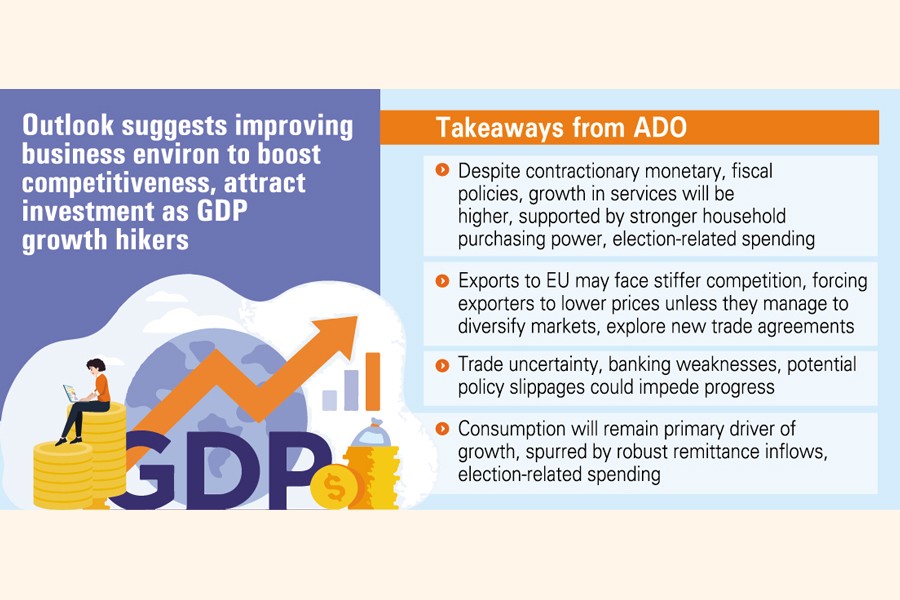
The ADB optimism is, however, underlined with a note of caution that given the uncertain impact of the US tariffs on Bangladesh's international trade and elevated banking-sector vulnerabilities, achieving higher growth will require improving the business environment to boost competitiveness and attract investment, as well as securing reliable energy supplies.
Meanwhile, the World Bank in its April forecast showed much lower GDP growth at 3.3 per cent for Bangladesh in the FY25 while 4.9 per cent in the current fiscal year.
Bangladesh Bureau of Statistics (BBS) in its provisional estimation has shown 3.97-percent growth in the last financial year (FY2025).
The latest ADB-drawn economic outlook states: "The growth was supported by a rebound in manufacturing late in the year despite political unrest, labour disruption, flooding, and high inflation that dampened demand."
"Services are expected to drive growth in tandem with a return to normal growth in agriculture, assuming favorable weather and government policy support. Despite contractionary monetary and fiscal policies, growth in services will be higher, supported by stronger household purchasing power and election-related spending," it adds.
The Asian bank forecasts investor confidence should improve with general election scheduled for February 2026 and ongoing finance-sector reforms to strengthen the stability, transparency, and efficiency of the finance system.
However, industrial-output growth is expected to decelerate as US tariffs on Bangladesh exports tamp down GDP growth.
The ADO portrays a mixed picture of export. It predicts that exports should continue to grow on expected recovery in major destinations for Bangladesh's exports, but at a slower pace due to the possible impact of 'US Economic Trends and Prospects in Developing Asia: South Asia Tariffs' regime. "Net exports are likely to drag down economic growth marginally."
According to the ADB arithmetic of economic advances, a 20-percent US tariff on Bangladesh exports since August 2025 will likely hit exports to the US substantially and thus impact GDP.
It mentions that these exports amounted in FY2025 to 18 per cent of total exports and 1.9 per cent of GDP. In its count, the new tariff will raise average duties on Bangladesh exports to the US from 15 per cent to 35 per cent, with apparel tariffs climbing from 16.8 per cent to 36.8 per cent and some items such as manmade-fiber sweaters reaching 52 per cent.
And this tariff trouble will result in "disproportionately affecting women workers".
"While the tariffs are less stringent than those applied to India or to China, they can erode demand for Bangladesh exports to the US. In addition, exports to the European Union will face stiffer competition, forcing exporters to lower prices unless they manage to diversify markets, explore new trade agreements, and take measures to enhance competitiveness," the ADO said.
"Future growth will depend on improving the business environment to boost competitiveness and attract investment, and on ensuring reliable energy supplies," says Hoe Yun Jeong, ADB Country Director for Bangladesh, in remarks on the outlook.
Pointing out that the impact of US tariffs on Bangladesh's trade remains to be seen, and vulnerabilities in the banking sector persist, he says addressing these challenges is essential to achieving higher economic performance.
He notes that some downside risks to the FY2026 outlook persist. "Trade uncertainty, banking- sector weaknesses, and potential policy slippages could impede progress. Maintaining prudent macroeconomic policies and accelerating structural reforms are critical to strengthening resilience."
On a flashback on inflation in the two past fiscal years, the ADB outlook mentions that the rate was estimated to rise from 9.7 per cent in FY2024 to 10.0 per cent in FY2025, driven by limited competition in wholesale markets, inadequate market information, supply-chain constraints, and the weakening of the taka.
Looking ahead, the ADO September 2025 forecasts that consumption will remain the primary driver of growth in FY2026, spurred by robust remittance inflows and election-related spending.
However, it alerts, contractionary monetary and fiscal policies, along with heightened investor caution, are expected to dampen investment.
Global tariff hikes, including a 20-percent tariff on Bangladesh exports to the US, and stiffer competition in the EU, are expected to weigh on exports and growth. Exporters may be compelled to reduce unit prices in response to this heightened competition, the Manila-based lender says.
About the financial sector, the ADB has said banks remain under considerable stress, primarily from high non-performing loans (NPLs), a legacy of prolonged regulatory forbearance and weak institutional governance.
Recently tightened loan classification standards pushed up the system-wide NPL ratio from 12.6 per cent at the end of June 2024 to 24.1 per cent by the end of March 2025, with NPLs in state-owned commercial banks now exceeding 45 per cent.
The asset-quality reviews undertaken with support from the ADB and other development partners are expected to reveal further vulnerabilities, with implications for credit growth and broader financial and macroeconomic stability.
For addressing these financial-sector challenges, the ADB in its ADO suggests a set of dos: stricter provisioning, credible bank restructuring and recapitalization, enhanced regulatory capacity in Bangladesh Bank, the central bank, and the creation of a robust bank-resolution framework.
About the downside risk to the economy, the ADB says trade uncertainty arising from new US tariffs and potential disruption from geopolitical tensions could hinder export growth.
"Poor implementation of the new managed float exchange rate policy could worsen external imbalances. Despite recent monetary tightening, higher election-related spending and unsterilized liquidity support to weak banks may raise inflation and pressures on the foreign- exchange market while weakening governance reform."
If banking-sector weaknesses persist, credits could tighten, growth slow, and fiscal liabilities rise, the ADO reads. Government financing needs may rise due to weak domestic revenue.
Further downside risks are climate-related shocks and potential slippage in fiscal and monetary management.
"These issues underscore the importance of maintaining prudent macroeconomic policies and accelerating structural reform to fortify economic resilience in FY2026," the development financier suggests.
© 2026 - All Rights with The Financial Express

