An unchecked influx of people into Dhaka from insufficiently served countryside demographically elevates the Bangladesh capital to world's second-densely-populated city but downgrades its basic civic services - healthcare, in particular, left in disarray.
According to a recent UN report, Dhaka is home to 36.6 million and jumps to second place from ninth. However, experts believe the real figure is much greater than the estimation for overconcentration of population in the centripetal capital sans adequate provisions for shelter, sanitation, healthcare facilities in particular.
In this context, analysts say, expanding the medical facilities for the burgeoning population remains a big challenge for government healthcare providers, though it's a mandatory and key indicator of a healthy population and developed city.
Public health and urban health specialists, talking to The Financial Express, warn that without special concentration on the health-service condition of the city, people would be exposed to health vulnerability. The existing services and institutions "are extremely insufficient against the huge population".
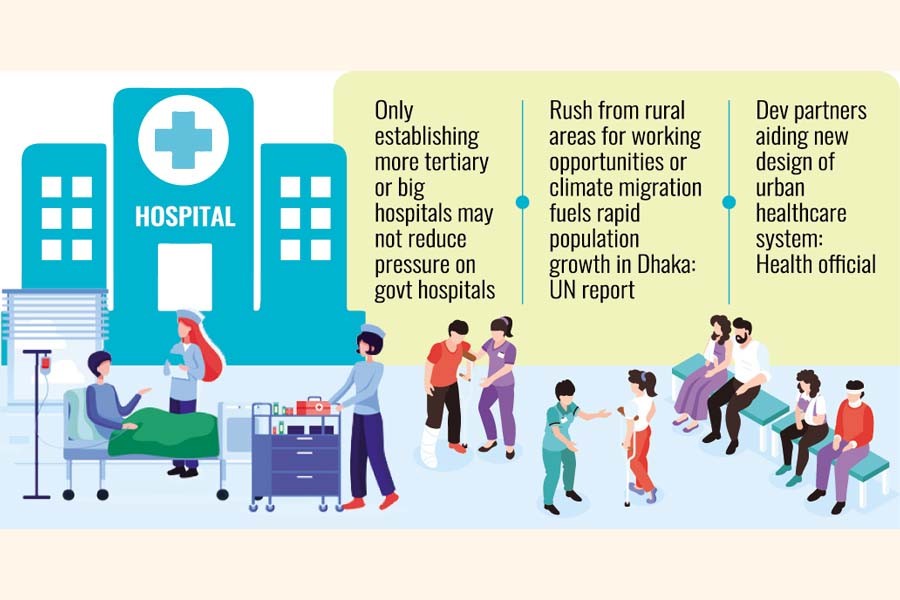
Therefore, only establishing more big government hospitals may not help reduce the pressure of patients, though suggestions are rife that establishing more tertiary healthcare facilities would help reduce the pressure of patients on government hospitals.
Officials at the Directorate-General of Health Services have told the FE that out of 32 government hospitals, four are in Dhaka and out of 21 specialised, 14 in Dhaka. And, total 20 major government hospitals are in Dhaka. Officials fear that some new big infrastructures may create pressure on the city of outside patients further.
Health expert Be-nazir Ahmed, a former director of disease control at the DGHS, told the FE that there is definitely a serious gap between the demand and health services available in the city.
"Dhaka city is not only providing 36.6-million population but Dhaka provides major treatment for all the 180 million people of the country. And, this causes huge pressure on the hospitals, and doctors in Dhaka," he explains.
In such a situation, providing proper treatment remains a big challenge. Patients need more hospitals in Dhaka. Against about 2400 seats in Dhaka Medical Hospital over four to five thousand people usually get admitted there. "Apart from hospitals, there are serious needs of health staffers," says the former DGHS official.
According to World Bank and WHO accounts, Bangladesh has one of the lowest densities of doctors, nurses, and midwives per capita in South Asia (around 0.7 physicians and 0.61 nurses per 1,000 people), meaning a serious lack of health staffers in the sector against a big number of support-seekers.
The UN report has projected that Dhaka would become world's largest city by 2050, saying that the rush of people from rural areas into Dhaka for working opportunities or internal migration due to climate disasters have caused the rapid population growth in Dhaka.
Because of the unplanned urbanization, more people will come in the city, further expanding the need for healthcare support. Therefore, experts suggest decentralizing healthcare and establishing more specialized and tertiary education facilities at district level.
Furthermore, strengthening the primary-healthcare system could help improve the situation.
"If we could provide better primary health service in Upazilas, then pressure will be reduced in the district. Similarly, if the district hospitals can ensure service, then it will help reduce the pressure of outside patients in Dhaka.
"We need a systematic tier-based health system and new specialist institutes to address the growing population, including in Dhaka city," Be-nazir Ahmed suggests.
Furthermore, Bangladesh spends lowest for the health sector in its national budget and GDP.
And, for an improved healthcare system, there is no alternative to fresh investment and increased allocation in the budget. The urban healthcare in Dhaka is largely insufficient against the population and available health staffers, says the physician.
Public health and urban health expert Prof Dr Abu Jamil Faisal told the FE that Dhaka doesn't need to establish more tertiary hospitals or community clinics rather redesign and develop effective systems with the existing resources
"So many people go to nearby pharmacies for primary health issues and check with practitioners or doctors there," he notes.
"We need registered pharmacies and medical practitioners are available there 24/7 for primary healthcare. If required, they will refer patients for specialists or tertiary healthcare services," the expert explains.
Professor Faisal thinks it would not require any new investment. With the existing manpower and infrastructure, the government can develop and implement the system.
There are about 2,000 practitioners in Dhaka and only with 150 of them the primary-healthcare system can be improved for the bigger population, he continues.
Citing such examples in India and other developed countries, he says the government can move for it with the help of the private sector. The government can provide a tiny subsidy like Tk 30 for each visit out of the total visit fee of Tk 50 to the practitioners practicing at private hospitals or pharmacies without requiring new infrastructure -- and this is called strategic purchase.
Furthermore, Bangladesh still hasn't established a referral system in the healthcare system. Therefore, all the patients rush to specialised hospitals in Dhaka.
"Without the referral and communications system a proper health sector cannot be established," he stresses.
Dr. Abu Hussain Md. Moinul Ahsan, director, DGHS, admits that the hospitals and other arrangements are not sufficient in Dhaka against the huge population. Due to urbanization and migration to Dhaka, population continues to increase.
"However, Dhaka holds the majority of the government tertiary hospitals and specialist hospitals. Yes, so many people live in Dhaka and so many and most of the hospitals are based in Dhaka," he says.
"We along with the development partners are working to design an urban healthcare system to improve the situation with greater importance," he told the FE writer.
nsrafsanju@gmail.com
© 2026 - All Rights with The Financial Express

