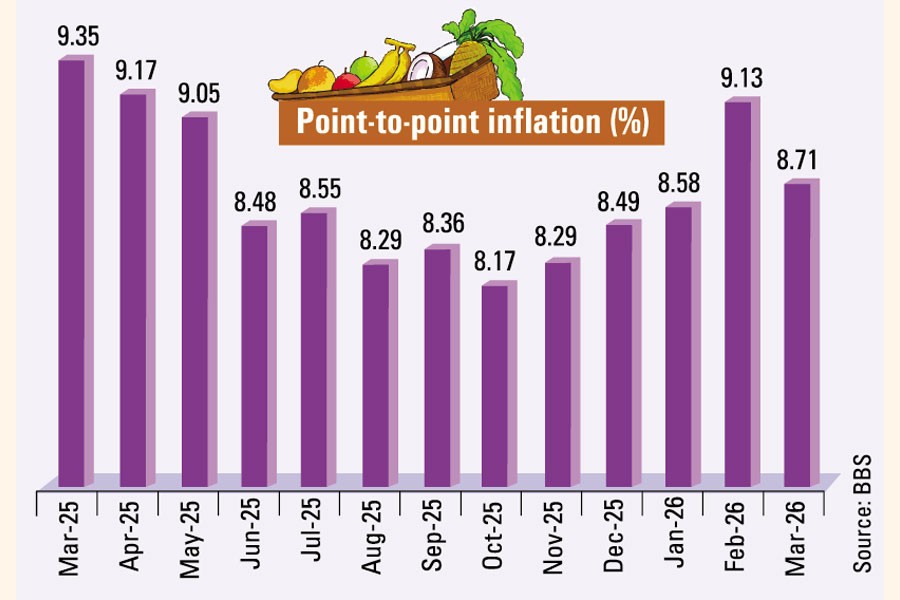
Inflation in Bangladesh eases in March count as food prices give some respite although rising energy costs amid global crisis fire up nonfood price indices.
Data released Sunday by the Bangladesh Bureau of Statistics (BBS) showed headline inflation rate having fallen to 8.71 per cent in March, down 0.42-percentage points from the previous month, as measured by the consumer price index (CPI).
 Food inflation declined across both rural and urban areas, helping ease overall price growth.
At the national level, food inflation stood at 8.24 per cent, down by 1.06-percentage points from February.
In contrast, prices of nonfood commodities stayed on an upturn, pushing up nonfood inflation to 9.09 per cent, in a rise by 0.08- percentage points. The higher nonfood inflation reflects higher costs for fuels, transport and other related services.
In rural areas, food inflation dropped to 8.02 per cent, while nonfood inflation increased to 9.38 per cent.
In urban areas, food inflation fell to 8.78 per cent, but core inflation - which excludes food - edged up to 8.62 per cent.
The 12-month moving average inflation rating also declined slightly to 8.60 per cent in March, from 8.65 per cent a month earlier.
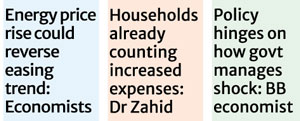
Economists say the recent escalation in energy prices, linked to turmoil in the Middle East, could reverse the easing trend.
Oil prices have surged amid disruptions following the conflict involving Iran and US-Israel forces, with key shipping routes remaining affected since late February.
Centre for Policy Dialogue distinguished fellow DrDebapriya Bhattacharya recently said inflationary pressures could intensify in the coming months, particularly due to higher fuel and fertiliser costs that may feed into food prices.
"Food-security risks linked to rising input costs could push inflation higher," he said.
However, a sustained rise in energy prices could broaden inflationary pressures if businesses pass on higher costs and workers demand wage increases.
Higher energy costs tend to raise the price of a wide range of goods and services, which contributes to inflation upturn, says DrZahid Hussain, an independent economist.
He notes that households are already counting increased expenses, particularly for fuels, including liquefied petroleum gas (LPG).
An economist at the central bank says policy responses would depend on how the government manages the shock.
Measures such as subsidies or tax cuts could cushion households but may require tighter monetary policy, while allowing prices to pass through could dampen economic growth and eventually necessitate rate cuts.
He says the Bangladesh Bank or the central bank should continue its tight stances.
"Basic economic theory suggests central bank should look through temporary supply shocks, as monetary policy operates with a lag," he adds.
jasimharoon@yahoo.com
© 2026 - All Rights with The Financial Express

