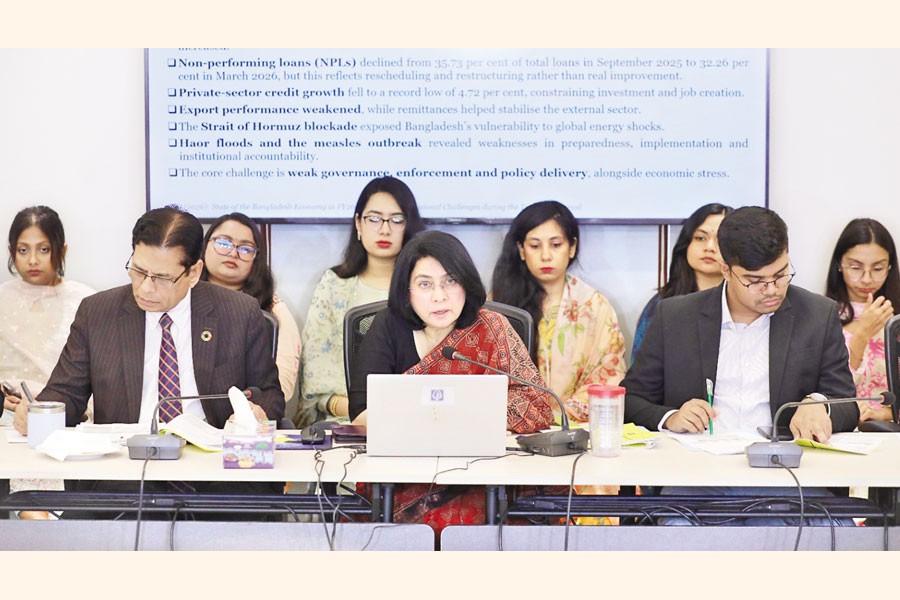
 Centre for Policy Dialogue (CPD) Executive Director Dr Fahmida Khatun addressing a press conference in the city on Thursday. —FE photo
 Investor confidence has yet to recover despite the easing of political uncertainty in Bangladesh, according to the Centre for Policy Dialogue (CPD).
It says businesses are waiting for clearer signals on the government's reform agenda and the upcoming national budget before making significant investment decisions.
 "One major uncertainty relating to the political transition has been resolved. However, investors may be waiting for the budget proposals and the government's strategy regarding reforms," CPD Distinguished Fellow Dr Mustafizur Rahman told a press conference in Dhaka on Thursday.
He said the current administration had been in office for only a short period and its impact was yet to be fully reflected in economic data.
"Our available data mainly cover the July-March or July-April period. The new government's contribution is reflected in only a few months. We should allow some more time before making a full assessment," he said.
Dr Rahman said private investment remained weak, as reflected in sluggish growth in private-sector credit and a declining trend in capital machinery imports.
"The government has given some positive signals, but these have not yet been translated into investor confidence," he said, adding that the authorities were attempting to stimulate investment through refinancing schemes.
Dr Rahman emphasised that sustainable economic growth would require stronger participation from the private sector.
"If the government invests Tk 1.0, the private sector contributes around Tk 4.0. Therefore, the private sector must come forward," he said.
However, he cautioned that it was still too early to judge the effectiveness of the government's initiatives.
Dr Rahman also said Bangladesh should review its tariff agreement with the United States in light of recent developments.
He warned that a proposed additional tariff by the United States on imports from countries accused of failing to prevent forced labour could undermine Bangladesh's export competitiveness.
The Office of the US Trade Representative (USTR) has proposed imposing additional tariffs on products from 60 countries, including Bangladesh, alleging inadequate measures against imports produced with forced labour.
Under the proposal, an additional tariff of 10 to 12.5 per cent could be imposed on imports from the affected countries.
"The US imposed reciprocal tariffs on 60 countries, but only nine countries have signed agreements with Washington. Bangladesh currently faces an average tariff of around 15 per cent in the US market. With the additional duties agreed under the tariff arrangement, the total tariff burden could rise significantly," Dr Rahman said.
He argued that the agreement should be revisited in view of the changed circumstances.
"The agreement needs to be reviewed and renegotiated. Imposing an additional tariff will not solve the forced labour issue; rather, it may worsen the situation," he said.
Responding to a question on the proposed new pay scale for government employees, Dr Rahman said a revised salary structure was being considered after more than a decade, following the implementation of the last pay scale in 2015.
"It may not be possible to implement the entire package at once. A phased implementation supported by a clear roadmap could be outlined in the upcoming budget," he said.
CPD Executive Director Dr Fahmida Khatun said Bangladesh's economy continued to face multidimensional challenges amid persistent inflationary pressures and structural weaknesses.
"The economy remains vulnerable due to both domestic structural weaknesses and various external shocks," she said.
She also pointed out that wage growth remained below the inflation rate, eroding the purchasing power of low- and fixed-income households.
"The recent increases in fuel and electricity prices have made it even more difficult for ordinary people to manage their household expenses," she said.
Dr Khatun stressed that macroeconomic stabilisation alone would not be sufficient without institutional reforms.
"Policy support without accountability can only postpone solutions to the underlying problems," she added.
jasimharoon@yahoo.com
© 2026 - All Rights with The Financial Express

