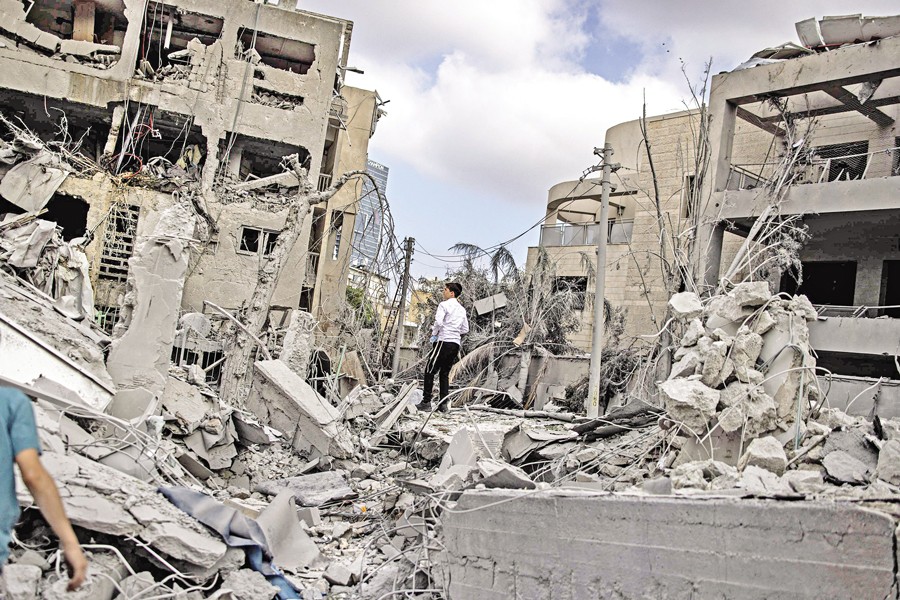
 An Ultra-Orthodox Jewish man inspects the damage at the site of an Iranian missile strike in Bnei Brak, east of Tel Aviv, on Sunday. — AFP
  Multiple explosions have been heard around Tehran as Israel issues new threats to residents of the Iranian capital, warning of imminent attacks, report agencies.
Iran launched a new wave of ballistic missile attacks on Israel -- including Tel Aviv and Haifa -- killing at least eight people hours after the Israeli military again bombed the Iranian capital, Tehran.
Israel said Monday it planned to strike military sites in the city. The Israeli military has issued similar evacuation warnings for civilians in parts of Gaza and Lebanon ahead of strikes.
Iran fired a new wave of missile attacks on Israel early Monday, killing at least five people, while Israel claimed it had achieved air superiority over Tehran and could fly over the Iranian capital without facing major threats.
Report from Washington, added US President Donald Trump on Sunday urged Iran and Israel -- who are locked in an exchange of military strikes -- to "make a deal," but suggested they might need to "fight it out" first.
"I think it's time for a deal," Trump told reporters, as Israel and Iran exchanged a fresh barrage of missile strikes and threatened more devastation in a conflict that appeared to be intensifying.
"But sometimes they have to fight it out, but we're going to see what happens," Trump said, speaking at the White House before heading to Canada to take part in a G7 summit.
Meanwhile, the aircraft carrier USS Nimitz was leaving Southeast Asia on Monday after cancelling plans to dock in Vietnam, amid reports it is headed to the Middle East to boost the US presence as Israel and Iran do battle.
Israel and Iran traded deadly fire for a fourth day on Monday in their most intense confrontation in history, fuelling fears of a drawn-out conflict that could engulf the Middle East.
However, another report from London added Stocks rose and oil prices retreated Monday as fears of a wider Middle East conflict eased even as Israel and Iran pounded each other with missiles for a fourth day.
The dollar and safe-haven gold declined slightly.
"As things stand, investors seem less fearful than they were going into the weekend of the possibility that the war between Israel and Iran spreads across the Middle East, and beyond," said David Morrison, senior market analyst at financial services provider Trade Nation.
"It appears that most of the Israeli airstrikes and missile launches avoided the most significant parts of Iran's energy infrastructure. And so far Iran's retaliation has done relatively little damage," he added.
On the fourth day of the conflict, the Israeli military said it had destroyed more than 120 surface-to-surface missile launchers in central Iran, a third of Iran's total.
It also said fighter jets had struck 10 command centres in Tehran belonging to Iran's Quds Force, an elite arm of its Revolutionary Guard that conducts military and intelligence operations outside Iran.
"At this time, we can say that we have achieved full aerial superiority over Tehran's skies," said military spokesperson Brig. Gen. Effie Defrin. Israeli strikes "amount to a deep and comprehensive blow to the Iranian threat."
Iran, meanwhile, announced it had launched some 100 missiles and vowed further retaliation for sweeping attacks on its military and nuclear infrastructure that have killed at least 224 people in the country since Friday.
One missile fell near the American consulate in Tel Aviv, with its blast waves causing minor damage, US Ambassador Mike Huckabee said on X. He added that no American personnel were injured.
Israel said so far 24 people have been killed and more than 500 injured as Iran launched more than 370 missiles and hundreds of drones.
Iran accuses Israel of hitting a hospital in the west of the country, and Iran's health ministry says at least 224 people have been killed by Israeli strikes since Friday
The latest conflict began when Israel launched an assault on Iran's top military leaders, uranium enrichment sites and nuclear scientists that it said was necessary to prevent its longtime adversary from getting any closer to building an atomic weapon.
Iran maintains that its nuclear program is peaceful, and the U.S. and others have assessed that Tehran has not pursued a nuclear weapon since 2003. But the head of the International Atomic Energy Agency has repeatedly warned that the country has enough enriched uranium to make several nuclear bombs if it chooses to do so.
Iran has retaliated by firing waves of ballistic missiles at Israel. The back-and-forth has raised concerns about all-out war between the countries and propelled the region, already on edge, into even greater upheaval.
Powerful explosions, likely from Israel's defense systems intercepting Iranian missiles, rocked Tel Aviv shortly before dawn on Monday, sending plumes of black smoke into the sky over the coastal city.
Authorities in the central Israeli city of Petah Tikva said that Iranian missiles had hit a residential building there, charring concrete walls, shattering windows and ripping the walls off multiple apartments.
© 2026 - All Rights with The Financial Express

