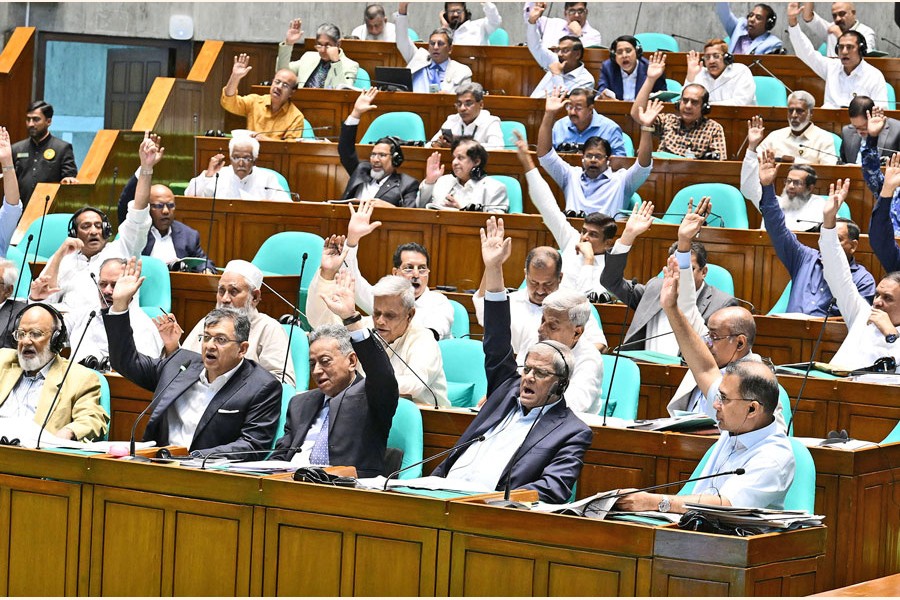
 Prime Minister Tarique Rahman and other MPs raise their hands as parliament approves the Tk 9.38 trillion budget for FY27 on Tuesday. — PID
 Parliament Tuesday approved a Tk 9.38-trillion national budget for fiscal year (FY) 2026-27 through clearing the new government's generous spending plans, after weeks of debate and rejection of over 1,300 opposition-backed cut motions.
The budget, which takes effect today (Wednesday), the first day of the new fiscal year, was passed by voice vote following three weeks of parliamentary discussions, criticisms and several amendments.
The Jatiya Sangsad (JS) also passed the Finance Bill 2026, after approving 68 amendments, on Monday.
To facilitate implementation of the budget, Finance Minister Amir Khosru Mahmud Chowdhury moved the Appropriations Bill 2026 seeking parliamentary authorisation for government expenditure of Tk15.154 trillion, including charged expenditure that is not subject to voting.
This one is Bangladesh's 55th national budget and the first presented by the BNP-led government formed following this year's parliamentary election, held in February.
Mr. Khosru had rolled out the budget on June 11 last with fiscal measures touted as business-and investment-friendly, with some intended reliefs for the consumers hit by high inflation.
During the ensuing three-week debate, lawmakers from the BNP, Jamaat-e-Islami, the National Citizen Party (NCP), independent members and opposition parties scrutinised the government's fiscal plans, raising concerns over tax policy, inflation, revenue mobilisation, social protection and sectoral allocations.
In his concluding speech before the vote, the finance minister said the government had incorporated several recommendations made by lawmakers. Among the most significant changes, made in the Finance Bill 2026, is an increase in the tax-free income threshold to Tk0.4 million.
The government has also withdrawn a controversial proposal that would have restricted the registration of land and apartments below government-assessed values.
Also relaxed is the requirement for submitting Taxpayer Identification Number (TIN) for certain banking services.
Before the budget vote, parliament approved 59 demands for grants for various ministries and divisions by voice vote.
Opposition lawmakers, however, moved 1,342 cut motions seeking reductions in allocations worth Tk 1.0, all of which were rejected.
During the debate, lawmakers raised concerns over the pace of economic reforms, project implementation, currency depreciation and river erosion, while calling for greater accountability in public spending.
Speaking on the allocation for the Economic Relations Division (ERD), NCP lawmaker Akter Hossain questioned the government's reform agenda.
Responding, Finance Minister Mr. Chowdhury said adequate funding would be essential to carry out the reform programme effectively.
"The financial institutions division needs adequate funding for conducting the reforms in the banking sector."
The Planning Division alone faced 28 cut motions.
During discussion on the Implementation Monitoring and Evaluation Division (IMED), opposition lawmaker Abdul Bari Sardar of Rajshahi moved a token cut motion, urging stronger project oversight and greater transparency in development spending.
Responding on the cut motions, Commerce Minister Khandaker Abdul Muktadir said, "The government would prioritise improving the ease of doing business, diversifying exports and strengthening export development to enhance Bangladesh's external trade competitiveness."
Foreign Minister Dr Khalilur Rahman highlighted the impact of the continued depreciation of the local currency on government spending and sought higher budgetary allocations for the construction of Bangladesh's chancery buildings in several countries.
The passage of the budget concluded this year's parliamentary budget session, with lawmakers extensively debating fiscal priorities, economic reforms and public expenditure before endorsing the government's spending blueprint.
jasimharoon@yahoo.com
© 2026 - All Rights with The Financial Express

