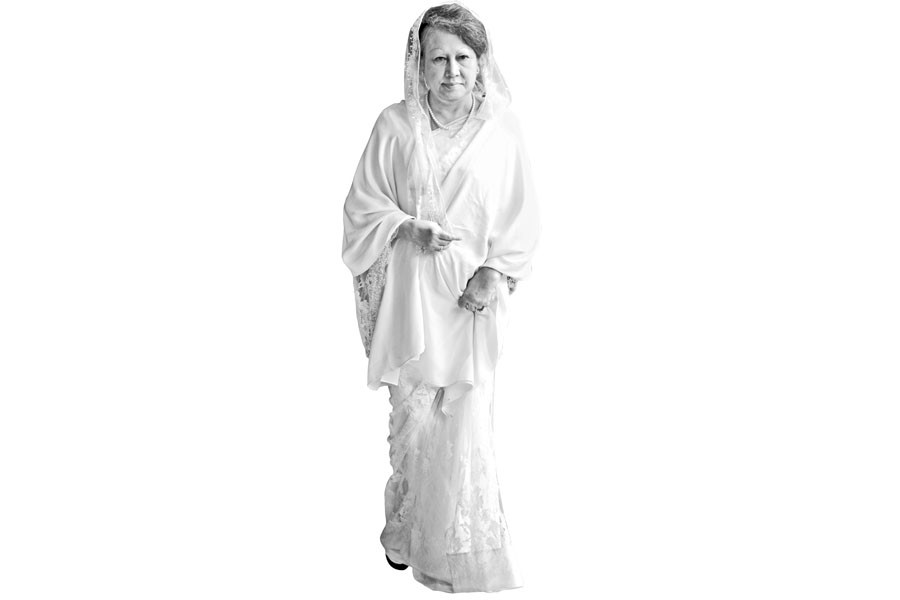
Khaleda Zia, Bangladesh's first elected female Prime Minister and one of the nation's most enduring political figures, passed away Tuesday.
The octogenarian chairperson of Bangladesh Nationalist Party (BNP) was declared dead at 6:00 am in Evercare Hospital in Dhaka, after days on life support.
The passing of Begum Zia, who grew to political prominence from the status of a private homemaker after the assassination of her husband, president Ziaur Rahman, marks the end of a remarkable era in South Asian politics, closing a life defined by resilience, uncompromising struggle, and a steadfast commitment to democracy.
She had been receiving treatment for multiple complex health issues, including liver and kidney complications, heart disease, high blood pressure, diabetes, arthritis, and infection-related problems since her release from confinement on charges her party dismissed as fabricated.
Despite the best efforts of medics, her condition deteriorated rapidly, and she was placed on life support and undergoing regular dialysis over the past several months.
For more than four decades, Khaleda Zia stood at the centre of Bangladesh's turbulent political landscape, embodying both the hopes and the hardships of a nation in transition -- the latest one just on the cusp through post-uprising polls set in motion by Monday's nomination filing.
She had her nomination filed barely a day before for running in the February-12th general election.
Born into a traditional household, Khaleda Zia began her life as a homemaker. Her entry into politics was neither planned nor conventional.
She stepped into politics following requests from BNP leaders and supporters in January 1982, seven months after the assassination of her husband, Shaheed President Ziaur Rahman, by renegade army officers in May 1981.
At the time, she was not yet forty. Initially appointed Senior Vice-Chairperson, she later became Acting Chairperson and eventually Chairperson of the party. Her rise was swift, but it was also fraught with challenges. Many doubted whether a woman with no prior political experience could lead a major party in a male-dominated society. Yet Khaleda Zia defied expectations, gradually transforming herself into a determined, courageous leader.
Through the anti-Ershad movement in the 1980s she earned the fame of an 'Uncompromising Leader'.
Her political identity was forged in the crucible of struggle against the dictatorship in 1983 when she led the formation of a seven-party alliance to topple General Hussain Muhammad Ershad's regime.
For nine years, she had spearheaded relentless protests, boycotts, and demonstrations. Arrested thrice during this period, she earned the reputation of being an uncompromising leader.
The mass uprising of 1990 finally toppled Ershad. In the general election of February 1991, BNP won overwhelming public support. Khaleda Zia ran for five constituencies -- Bogura-7, Dhaka-5, Dhaka-9, Feni-1, and Chattogram-8 -- and won all of them by large margins. With BNP's victory, she became Bangladesh's first female Prime Minister, and only the second woman in any Muslim-majority country to hold that office.
Electoral record without defeat:
Khaleda Zia's electoral record remains unmatched in Bangladesh's history. Across five general elections, she contested 23 constituencies and won every single one. Even in elections where BNP failed to form the government, she remained undefeated in her constituencies.
In 1996, she contested five seats -- Bogura-6, Bogura-7, Feni-1, Lakshmipur-2, and Chattogram-1 -- and won them all, though the Awami League formed the government. In 2001, she again contested the polls from as many constituencies, including Bogura and Khulna, and won each by overwhelming margins, returning as Prime Minister for a third term.
In 2008, when the Election Commission limited candidacies to three constituencies, she contested Bogura-6, Bogura-7, and Feni-1 -- and won all three.
Trials and personal sacrifices:
In her political career, Begum Khaleda Zia was arrested a total of five times -- thrice during the anti-Ershad movement, once under the army-backed caretaker government in 2007, and once during the rule of the Awami League government.
After joining active politics on January 3, 1982, she was arrested thrice during the anti-Ershad movement: on 28 November 1983, 3 May 1984, and 11 November 1987. However, in those instances she was not imprisoned for long periods.
In 2007, amid a political crisis when the army-backed government assumed power, Khaleda Zia was arrested. On September 3, 2007, police detained her from her residence on Moinul Haque Road in the Dhaka cantonment area. When her bail petition was rejected, she was confined in a special sub-jail set up within the National Parliament complex.
During this imprisonment, she observed both Eid-ul-Fitr and Eid-ul-Azha inside prison, meeting family members on the festival days. At the time, her two sons -- Tarique Rahman and the late Arafat Rahman Koko -- were also incarcerated.
In January 2008, following her mother's death, she was released on parole for six hours to see her mother's body. After nearly 372 days in custody, she was freed on bail on 11 September 2008.
Her resilience was tested again in 2010, when she was evicted from her cantonment residence where she had lived for 28 years.
She moved to a rented house in Gulshan named "Firoza." In 2013, during intense political protests, barricades were placed outside her home to confine her.
She was sentenced to a total of 17 years in prison in the fabricated Zia Orphanage Trust and Zia Charitable Trust corruption cases during the Awami League government in 2018.
On 8 February 2018, she was sent to jail -- first to the Nazimuddin Road prison, and later, due to health reasons, to Bangabandhu Sheikh Mujib Medical University (BSMMU) Hospital.
While she was confined, her younger son, Koko, died in Malaysia in June 2018. Her elder son, BNP's Acting Chairman Tarique Rahman, lived abroad due to ill health.
Reflecting on her losses, she then said: "I lost my husband at a young age. I lost my mother while in prison. I lost a son while confined in my office. Another son remains disabled abroad due to torture. In this life without family, the people of Bangladesh are my family."
She remained effectively incarcerated for more than two years.
On March 25, 2020, the government suspended her sentence conditionally, allowing her to receive treatment at home, which was effectively equivalent to house arrest. She remained politically inactive until the student-mass uprising of 2024.
On August 5, 2024, following the mass uprising that toppled Sheikh Hasina's government, she was released from confinement.
Her sentence was annulled by an executive order of the President. On 27 November of the same year, she was acquitted of the corruption cases.
Two days later, at a BNP rally, she delivered a brief video message urging the nation, "Let us build a society based not on destruction, revenge, or vengeance, but on love, peace, and knowledge."
Through her long years of imprisonment and political struggle, Begum Khaleda Zia left behind a unique and significant chapter in the political history of Bangladesh.
In her later years, Khaleda Zia came to be respected by all sections of people across party lines as a symbol of unity.
Her words reflected the maturity of a leader who had endured decades of struggle, persecution, and sacrifice, yet still envisioned a future rooted in reconciliation.
With her demise, Bangladesh has lost its true guardian, a unifying symbol of sovereignty, independence, and democracy.
Meanwhile, her only surviving son, Tarique Rahman, who is the party's acting chairman, has returned from exile in London and taken over full charge of the Bangladesh Nationalist Party.
Azizjst@yahoo.com
© 2026 - All Rights with The Financial Express

