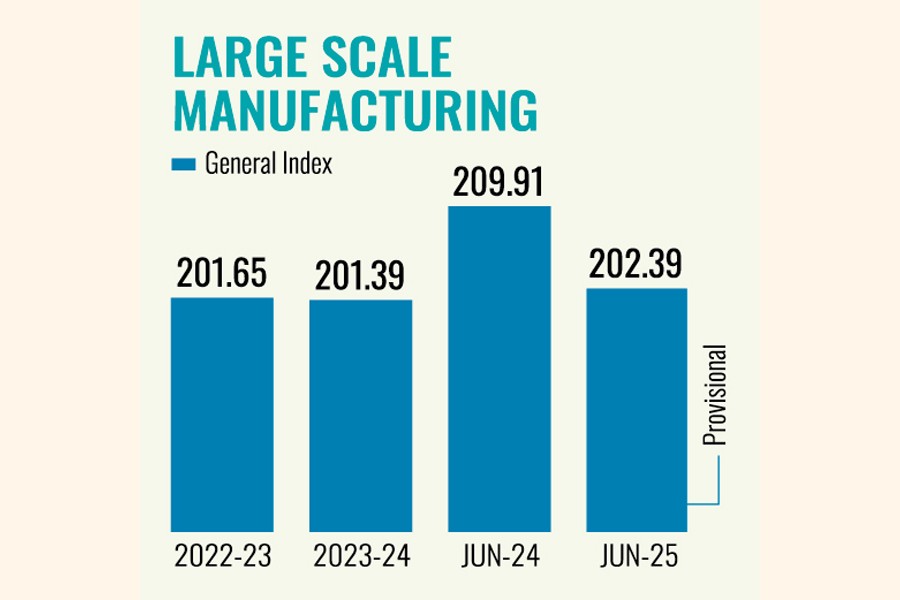
Bangladesh's large manufacturing sector contracted 3.58 per cent year on year in June after recording a healthy growth in May 2025, according to the latest data from the Bangladesh Bureau of Statistics (BBS).
This happens to be a second spell of contraction in the past fiscal year after August fall by 1.13 per cent when countrywide political movement against the Hasina government crippled economic activities. The former prime minister was toppled that month and fled to India.
Clothing and textiles, together accounting for over 72 per cent of the manufacturing index weight (100), remain the key drivers of performance, making the broader index highly sensitive to changes in these sectors and that reflected in June.
During the month under review, the output of wearing apparel or ready-made garment (RMG) contracted 6.55 per cent. However, the textile sector expanded, though less than 1.0 per cent, during the month, according to the official data.
This sector contributes to the country's GDP by more than 11 per cent and employs more than 5.0 million of the workforce, underscoring its critical role in the country's economy.
Out of the 23 divisions within the large industrial sector, only seven manufacturing divisions experienced contraction during the month under review while 16 expanded.
Among the sectors that posted negative growth, tobacco production dropped by more than 20 per cent, and coke and refined petroleum declined by 34 per cent in the month, while pharmaceuticals by 6.78 per cent.
Among the sectors that posted robust growth, manufacturing of other transport equipment by 33.61 per cent, manufacturing of motor vehicle, trailer and semi-trailers saw more than 21 per cent, paper and paper and paper products by 7.56 per cent.
Economists and manufactures attribute the June contraction partly to the global trade uncertainty, including the turbulent tariff action by US president Trump's administration, which had hurt Bangladesh's many manufacturing sectors.
They, however, say as Bangladesh is now relatively in favourable position, the future economic activity is likely to pick up.
Dr M. Masrur Reaz, chairman and CEO of the think-tank Policy Exchange Bangladesh, told the FE that the manufacturing sector was on an upswing in a turnaround. "Trump tariff made the economic activities volatile."
"The forex market is stable and the demand for import rising," he notes, adding that the domestic demand is also on the upswing.
The policy analyst, however, suggests inflationary pressure should be eased more to make investment-friendly environment.
jasimharoon@yahoo.com
© 2026 - All Rights with The Financial Express

