Bangladesh's proposed budget for the fiscal year 2026-27 faces a "near-impossible revenue challenge" amid mounting debt obligations, subsidy pressures, and growing political commitments, speakers warned at a pre-budget dialogue on Monday.
The dialogue, titled "National Budget 2026-27: Political Promises and Citizen Expectations," was organised by the Citizen's Platform for SDGs, Bangladesh, in association with the Centre for Policy Dialogue (CPD) at a hotel in the capital's Gulshan.
Presenting the keynote paper, CPD's Additional Director of Research Towfiqul Islam Khan said the government was considering a revenue target of around Tk 6,950 billion for FY27, which would require at least 42 per cent growth over the revised target of the current fiscal year.
He said such growth would be extremely difficult under the existing structure, noting that Bangladesh had achieved its highest revenue growth of slightly above 27 per cent in 2011 and never reached a comparable level since then.
Towfiqul warned that the country's tax-to-GDP ratio had fallen to around 6.8 per cent, while tax exemptions and concessions were costing the government almost as much revenue as it collected.
Without reforms to tax exemptions and broadening the tax net, he said, it would be difficult to sustain development expenditure, subsidies, and social protection programmes.
He also highlighted rising subsidy pressures in the food, electricity, liquefied natural gas (LNG), agriculture, and remittance sectors, saying higher global energy and commodity prices could significantly increase fiscal burdens in the coming year.
On the proposed Ninth Pay Commission recommendations, he said the full implementation of the new salary structure could require an additional Tk 1.06 trillion.
Although raising salaries for public employees was politically attractive, he cautioned that it could place pressure on development spending, subsidies, and social safety programmes.
The presentation also reviewed several proposed welfare initiatives, including the Family Card, Farmers Card, mid-day meals, free school uniforms, free Wi-Fi in educational institutions, and multimedia classrooms.
While these initiatives were people-oriented, the study identified weaknesses in beneficiary selection, data verification, complaint management, and local-level implementation.
Towfiqul further warned about Bangladesh's debt situation, noting that the International Monetary Fund (IMF) had classified the country as facing a moderate debt risk.
He said increasing reliance on bank borrowing could crowd out private-sector credit and intensify inflationary pressure.
Speaking at the event, Dr Debapriya Bhattacharya, a distinguished fellow at the CPD, urged the government to formulate a budget grounded in economic realities rather than overly ambitious revenue and expenditure assumptions.
He said the country was currently facing multiple economic pressures, including inflation, exchange-rate instability, and weak employment generation, while the government appeared to be focusing more on programmes such as Family Cards and canal excavation than macroeconomic stabilisation.
Dr Debapriya criticised the tendency to raise development expenditure targets despite low implementation rates under the Annual Development Programme (ADP).
"Forty to 50 per cent of the ADP projects remain unimplemented, yet allocations are being increased further without cleaning up the existing project pipeline," he said.
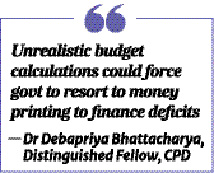
He warned that unrealistic budget calculations could eventually force the government to resort to money printing to finance deficits, potentially worsening inflation.
Social Welfare and Women and Children Affairs Adviser Abu Zafar Zahid Hossain said the government's primary objective was to strengthen support for low-income people.
He said the government planned to bring four million families under the Family Card programme by June next year, which would require around Tk 145 billion in the upcoming fiscal year.
According to him, the authorities were using national identity card data alongside door-to-door data collection to ensure transparency and effectiveness in beneficiary selection.
He also stressed the need to reduce delays in project implementation, saying projects should be completed within the stipulated deadlines rather than repeatedly revised.
CPD Distinguished Fellow Professor Mostafizur Rahman said the budget should assess how much citizens contributed to the state and what services they received in return.
He also called for a measurable assessment of corruption.
He warned that around Tk 140 billion might be required for interest payments on loans in the next budget and stressed the need to reduce debt dependence.
Referring to discussions on tariff concessions in trade arrangements with the US, including aircraft-related agreements, he said a comprehensive assessment was needed to determine whether Bangladesh would actually benefit and how competing countries might respond.
Former Bangladesh Knitwear Manufacturers and Exporters Association president Fazlul Haque said greater emphasis should be placed on the quality of expenditure rather than merely increasing sectoral allocations.
He said recent years had shown major gaps between allocations and implementation, with corruption occurring in between.
Maintaining spending quality without expanding allocations could help reduce the budget deficit, he added.
Fazlul also said liquidity shortages in the banking sector and power supply problems had yet to be fully resolved, though some improvement had become visible in the investment climate in recent months.
The dialogue also saw a sharp exchange between Jamaat-e-Islami MP Saiful Alam Khan and BNP reserved-seat MP Mahmuda Habiba over allegations of extortion in Karwan Bazar.
Saiful claimed that extortion amounting to Tk 20-30 million was taking place daily in the market area and alleged the involvement of politically connected groups.
Rejecting the allegation, Mahmuda described the claims as "fabricated" and said specific names should be provided to law enforcement agencies instead of making general accusations.
The event was attended by economists, policymakers, development practitioners, business leaders, and civil society representatives ahead of the national budget announcement next month.
bdsmile@gmail.com
© 2026 - All Rights with The Financial Express

