Chief Adviser of the post-uprising government Prof Muhammad Yunus takes on the onus of deciding when the referendum will be held as squabbling political parties stand divided on the timing.
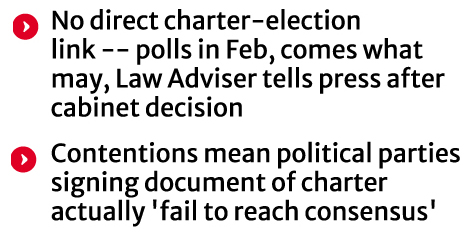
Law Adviser Dr Asif Nazrul apprised journalists at press briefing of the decisions of the meeting of the Council of Advisers held Thursday, also reaffirming that the general election will be held, as tentatively scheduled, in February despite such contentions.
 "The dispute over the referendum has reached its peak. At some point, we will have to make a decision on these issues. The decision will be taken by the Chief Adviser. We will be there to assist him," he said.
He makes sure that no individual will make the decision of their own -- it will be the Chief Adviser's call. "If he needs to consult us, he will, and once we make a decision, we will stand firmly by it. And the decision will be made very soon."
The Law Adviser laments that after 270 days of dialogue, the discord among the major political parties is deeply disappointing.
"In the midst of such a sharp division, how a consensus document can be passed -- this has posed a very difficult challenge for us."
Asif Nazrul pointed out that the parties actually failed to reach consensus on some vital questions.
"Previously, we learned that there were differences over the content. Now we see two kinds of disagreements have emerged -- one regarding the procedure for passing it, and another concerning the timing of the referendum.
"The political parties that supported the July uprising have now taken such rigid, contradictory, and agitated positions. If you continue to take such stances, what should the government do? After so many months of discussions, if you still cannot agree, we are truly having to rethink what we should do next."
Further explaining government position, the law adviser said, "If any political party tries to impose an ultimatum or pressure us unilaterally, it only means there is no consensus among them. What they are really seeking is government endorsement of their partisan position. Unfortunately, they were given enough time for discussion. The disunity they are now showing calls into question where they have taken the spirit of July."
In the cabinet meeting, there was a general discussion about this lack of consensus, he informed.
"The National Consensus Commission has presented two options -- one is a 'July Charter Implementation Ordinance,' a referendum, and automatic constitutional amendment if it is not done within 270 days. We will examine whether there is any precedent for this or whether it is even possible. The second option is to leave this responsibility to the elected parliament. There is intense disagreement among the political parties over which of these two options is more acceptable."
Asked by journalists whether this political discord would affect holding of the national elections, he said, "Whatever anyone says, we will hold the national election in the first half of February. It is not an absolute truth that all responsibilities rest solely on us and not on parliament. We will do as much as possible, perhaps even everything, but political consensus is essential."
There is a third option after the election -- the elected parliament can function as a constitutional reform assembly. They also have responsibilities. "I do not see a direct link between the July Charter and the election. We are determined to hold the national election in February."
The National Consensus Commission submitted its recommendations to the Chief Adviser last Tuesday on how to implement the July Charter. It recommended holding a referendum for the implementation of the charter, either before the national election or on election day itself.
However, Jamaat-e-Islami has demanded that the referendum be held before the national elections to give the July Charter a legal basis, and that the election should be conducted accordingly.
The BNP, on the other hand, insists that the referendum must be held the same day as the election, leaving no room for further discussion.
The BNP has also expressed anger over the Commission's recommendations, saying that many issues have been added which were not part of the original July Charter signed by the political parties, while their notes dissent "omitted".
Shafiqul Alam, Press Secretary to the CA, moderated the briefing.
mirmostafiz@yahoo.com
© 2026 - All Rights with The Financial Express

