Government exchequer gasps under fiscal-pressure buildup as power-sector subsidy is projected to overshoot its budgetary mark in the current fiscal year (FY)-much of the burden stemming from overrated hiring of private plants.
The government had already disbursed Tk 320 billion during the first nine months (July-March) of FY2025-26, and the amount is likely to reach some Tk 430 billion at the fiscal yearend, Ministry of Finance (MoF) officials say.
With an estimated Tk 110 billion required to make up the gap for the remaining three months (April-June), the total subsidy requirement for the fiscal comes to nearly Tk 430 billion, says a senior MoF official.
Consequently, the finance ministry is finalising a revised national budget substantially raising the power-sector allocation from its initial cap at Tk 370 billion, they say.
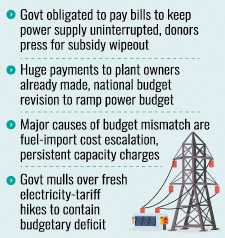
A major cause of the budget mismatch is an underestimation of fuel-import costs and persistent capacity charges paid to power producers against capacity not used.
Officials from Bangladesh Power Development Board (BPDB) and the Ministry of Power, Energy, and Mineral Resources also point to several compounding factors for the subsidy enhancement in the revised budget this year.
The power board purchases electricity from private independent power producers (IPPs) at high costs--ranging from Tk 14 to Tk 26 per kWh--while sells to consumers at a much lower average retail price of Tk 8.95 per unit.
Volatility on the international energy market and the escalating cost of importing liquefied natural gas (LNG) and furnace oil have significantly pushed up overall production expenses.
"Massive structural obligations to pay private plants for unutilised capacity continue to drain state coffers," says one official.
MoF officials say the losses have continued to widen amid allegations that the previous Awami League government had approved power plants through non-transparent processes and allowed irregularities and corruption in power purchases.
The then government also left behind large unpaid liabilities in the power sector when it was removed from office in August 2024 in a people-power movement.
After taking charge, the Professor Yunus-led interim government had to clear a large part of those arrears to avoid disruptions to electricity supply. Around Tk 620 billion in outstanding payments had to be settled to maintain uninterrupted supply, with the funds drawn in a lump sum from the finance ministry.
A hefty sum of subsidy in the revised budget gives a respite to the government as it has already paid a good amount of overdue bills to the private power producers, officials mention.
All 133 private and public-sector power stations across Bangladesh have a combined generation capacity of nearly 20,697 megawatts a day. Out of the total, 78 private-sector power plants have a production capacity of nearly 8,778mws a day.
Besides, BPDB imports 1,160mw power from India where Adani power station from Jharkhand alone supplies nearly 750 megawatts a day.
Finance ministry and power division officials say the government will pay out all the arrears and dues to the IPPs and rental power plants gradually within this financial year (FY2026).
Among the private-sector producers are Indian conglomerate Adani Power, Bangladesh-China Power Company Plant (Payra power plant), 450mw Power Ltd, 210mw Rural Power Co Ltd, 335mw Summit-Meghnaghat Power Ltd and 414mw Sembcorp NWPC Ltd, 145mw Aggreko International Projects, United Power and Doreen Power.
The bills of the rental power plants and IPPs are paid from BPDB's income and the subsidies provided by the finance ministry
Meanwhile, this ongoing upward budget revision on subsidy clashes directly with international obligations.
The International Monetary Fund (IMF) has made subsidy rationalisation in the power sector a strict prerequisite for releasing future tranches of its multi-billion-dollar loan package.
The IMF has repeatedly pressed the government for a clear, multi-year roadmap to eliminate power subsidies entirely by aligning retail prices with actual generation costs.
To contain the mounting fiscal deficit, the government is currently mulls over a fresh round of electricity-tariff hikes. However, policymakers are walking a tightrope as any increase in power prices will trigger a cascading effect on domestic production costs, fuel retail inflation, and heighten the cost-of-living crisis for ordinary citizens.
The IMF mandates that domestic payment arrears in the power and fertiliser sectors must be completely slashed to zero by June 2026.
© 2026 - All Rights with The Financial Express

