Most private-sector power plants implemented during the previous Awami League government's tenure were steeped in blatant "corruption, fraud and irregularities" in the process of executing deals, investigators found.
A national committee formed after the fall of the past government in a student-mass uprising last year to dig out suspected anomalies in power- plant deals revealed such findings in its report submitted Sunday.
"The corruption was massive and it can't be accepted at all," said the committee chief, retired High Court judge Moinul Islam Chowdhury, while submitting the interim report to Power, Energy and Mineral Resources Adviser Muhammad Fouzul Kabir Khan at the latter's office in Dhaka.
Overall electricity tariffs, exacted under the power-purchase agreements (PPAs) with the government, for different sorts of consumers increased by around 25 per cent owing to this corruption, he said.
And if government subsidy is deducted, the hike in tariffs due to sops would get bloated to 40 per cent in total.
The committee saw through all the deals and necessary documents of the power plants that were awarded and implemented under the now-defunct Quick Enhancement of Electricity and Energy Supply (Special Provision) Act 2010.
These power plants were awarded without any competitive biddings under the special law that offered indemnity to all those involved in the power dealings.
Following writ petition the High Court (HC) directed Power Division and Bangladesh Power Development Board (BPDB) to submit details of anomalies involving India's 1,496-megawatt Adani power plant within 60 days till December.
The adviser hoped that the report to the HC could be submitted within the stipulated timeframe.
Corruption in power sector was so massive that the payments from state-owned power entities to the owners of private-sector power plants increased 11.1 times to US$7.8 billion during the fiscal year 2023-2024 from only US$ 638 million during 2010-2011 although power generation increased only 4.4 times during this period spanning 13 years.
"We could not find any justification against such escalation in payments," says former lead economist at the World Bank Dr Zahid Hossain.
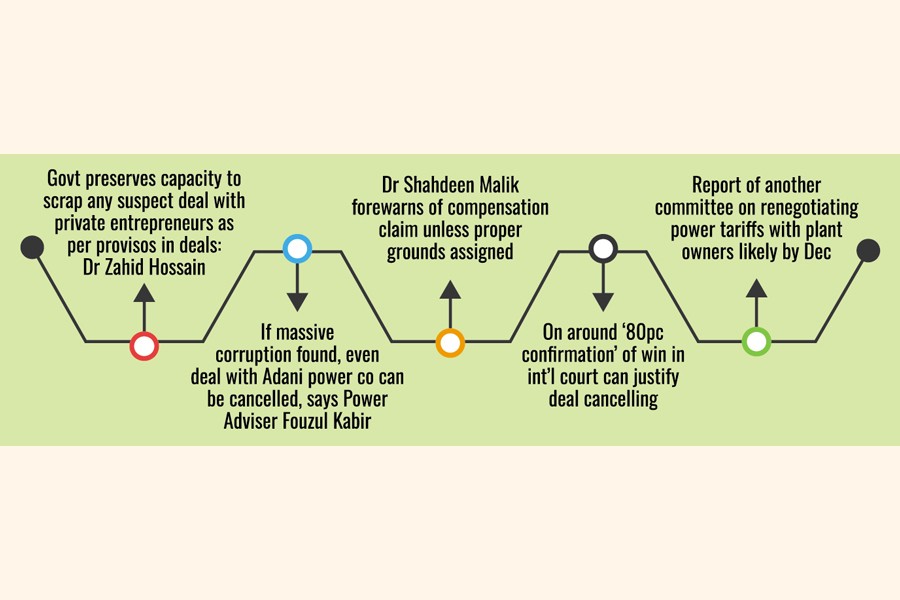
Responding to queries, the energy adviser said the government has the capacity to cancel any deal as there are provisions of cancelling deals in the respective deals.
"But before cancelling any deals we must detect proper grounds," he told reporters.
"If massive corruption is found, we could even cancel the deal of India's Adani power plant," he said
Eminent lawyer Shahdeen Malik cautions of facing compensation claim if any deal is cancelled without assigning proper grounds.
The power plants might go to international court against any sort of deal cancellation, he says.
"If we have around 80-percent confirmation of winning in international court, we can go for cancelling deals."
Other members of the committee, including Professor Abdul Hasib Chowdhury of the Electrical and Electronics Department at Bangladesh University of Engineering and Technology (BUET), Ali Ashfaq, fellow chartered accountant (FCA), and Prof Moshtaq Hossain Khan of the Faculty of Law and Social Science, the University of London, also spoke on the occasion about their findings.
The post-uprising interim government constituted the five-member national committee on September 5 last year to review the deals inked under the special law.
As per the terms of reference (TOR), the expert panel checked whether government interests were protected in the deals already inked under the special act.
It scrutinized data from 2008 to 2024 to prepare the interim report.
In the recommendation of its interim report, the committee points out ways to check corruption and suggests future steps to stop recurrence of such sops.
The final report could be submitted within next couple of months, said the committee chief.
Another committee constituted to renegotiate tariff rates with the power-plant owners who bagged projects under the already-annulled special law would submit its report by December, expects power secretary Farzana Mamtaz.
Headed by retired professor of BUET and distinguished professor of Green University of Bangladesh Dr Md Kamrul Ahsan, this committee was constituted to find out ways of reducing power-purchase costs and state debt burdens.
"Like the national committee, this one is also progressing with their works," said the power secretary.
Although the committee report is confidential, the government might publish a reduced version of the committee report for public perusal.
azizjst@yahoo.com
© 2026 - All Rights with The Financial Express

