Stakeholders and experts Monday demanded removing various bottlenecks and facilitating investments in the renewable-energy (RE) sector to achieve the target of generating 10,000 megawatts of green power by 2030.
They said it was high time to shun fossil fuel-based power and promote renewable energy to avert severe load-shedding in the future.
Providing the required land for setting up renewable energy-based plants and government guarantees to make projects bankable, ensuring policy certainty, lowering import duties on solar equipment and batteries, restoring approval for the 37 green power plants that the interim government scrapped, and lowering bank loan interest rates were among the demands they presented to facilitate a clean energy boost.
They put forward the demands at the Fourth Bangladesh-China Renewable Energy Forum organised by the Centre for Policy Dialogue (CPD) at a hotel in the capital.
CPD Research Director Dr Khondaker Golam Moazzem moderated the event, while Research Associate Abrar Ahmed Bhuiyan delivered the keynote.
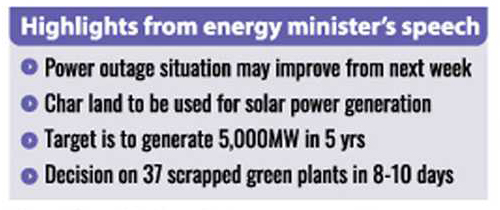
Speaking as the chief guest, Power, Energy and Mineral Resources Minister Iqbal Hassan Mahmood said the government had decided to provide the required land to private sector investors to facilitate clean energy generation.
In this regard, the prime minister himself had decided that all unused public land would be taken by the government for renewable energy generation under a public-private partnership (PPP), he said.
He said char (sandbar) land would also be used to generate solar power.
"Our target is to generate 5,000MW in five years. Thus, we want to start facilitating investments as soon as possible," said the minister.
Mr Mahmood said the government now owed independent power producers (IPPs) Tk 560 billion in power bills.
"Unless we pay the bill, they will not bring coal and produce power."
He said two plants in Khulna could not start generating power due to the gas crisis.
"Now our only solution is solar power, in which our prime minister is very interested."
Mr Mahmood expressed hope that the power outage situation might improve to some extent from next week.
Regarding the demand for restoring approval for the 37 renewable energy-based power plants, the minister said he had already asked the ministry to inform him of the reasons behind the cancellations.
"I am hopeful about making a decision on them in eight to 10 days."
Speaking as the special guest, Chowdhury Ashik Mahmud Bin Harun, executive chairman at the Bangladesh Investment Development Authority (BIDA), said the government wanted to see the growth of industrial-scale solar under the public-private partnership model, with private financing on government land.
"The first such project is going to be set up in Sonagazi of the Feni district," he said.
He said the government was hopeful that with the creation of an enabling environment, a massive jump in solar project developments would be visible soon.
Also, he said, the bankability issue would also go away since the government itself was a partner of such projects.
In the next budget, the duty issue on battery storage systems for solar power plants would also be resolved, he said.
Speaking as the guest of honour, Chinese Ambassador to Bangladesh Yao Wen said it was high time for Bangladesh to make the transition from relying on fossil energy to renewable energy.
"If Bangladesh really wants to get rid of this (relying on fossil fuel), we need to have a systematic solution to this. And China will be a part of it," he said.
Han Kun, president of the Chinese Enterprises Association in Bangladesh, focused on the state of government guarantees in Bangladesh.
"If you want foreign investments, you certainly have to provide government guarantees," he said.
Alamgir Morshed, executive director at Infrastructure Development Company Limited (IDCOL), also underscored the need for ensuring government guarantees for attracting investments.
"A project cannot be bankable without a government guarantee."
Mostafa Al Mahmud, president of the Bangladesh Solar and Renewable Energy Association (BSREA), said the country must go for an energy transition to avoid a power crisis in the future.
"Steps have to be taken to lower interest rates on bank loans, resolve the guarantee issue, and ensure policy certainty to attract investments in the renewable energy sector," he said.
Vidiya Amrit Khan, vice president at the Bangladesh Garment Manufacturers and Exporters Association (BGMEA), underscored the need for lowering the import tax on good-quality batteries to help solar energy storage for night-time consumption.
Renewable energy expert Dipal Chandra Barua, Chief Executive Officer of Omera Renewable Energy Limited Masudur Rahman, former Bangladesh Textile Mills Association (BTMA) director Razeeb Haider, Associate Professor of accounting at the University of Dhaka Dr Moshahida Sultana, and BSREA Director Imran Chowdhury also spoke on the occasion.
syful-islam@outlook.com
© 2026 - All Rights with The Financial Express

