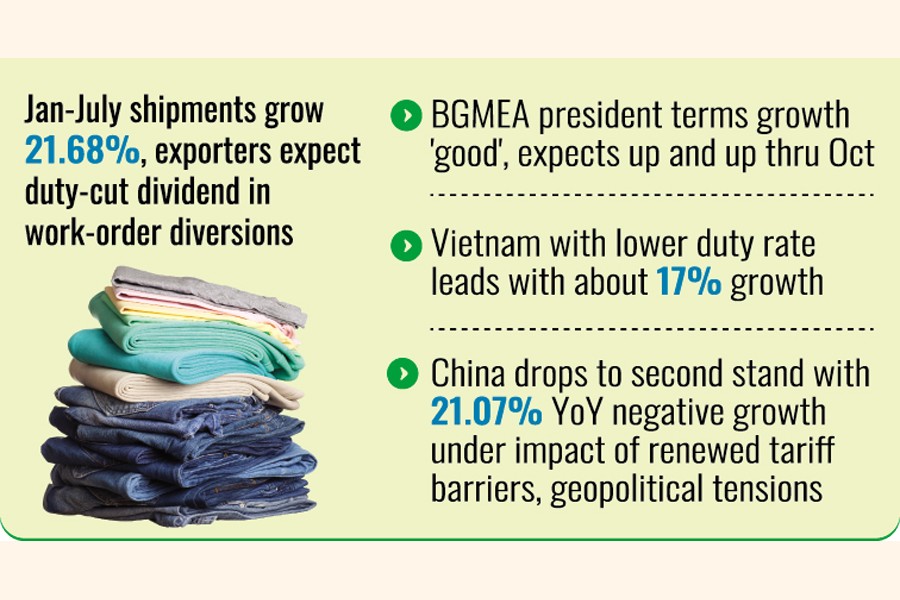
Bangladesh's apparel export to the United States posted a robust 21.68-percent growth in the first seven months of 2025 and exporters expect a better tomorrow as Trump tariff turmoil changes trade equations.
According to US official count, the export to the country's single-largest market grew both in terms of value and volume during the period-even under shadows of much-talked-about oncoming tariff hikes.
Readymade garment exports from Bangladesh during the January-July period singly fetched US$4.98 billion, marking the 21.68-percent growth, according to the data released Tuesday by OTEXA, an affiliate of the US Department of Commerce.
Bangladesh earned US$ 4.09 billion by trading out its main export item to the US in the same period of 2024.
The growth rate also surpassed the global average of 4.98 per cent, placing Bangladesh ahead of main competitors, though Vietnam became top exporter pushing China behind in the changing trade paradigm.
During the period, Bangladesh shipped 1.59 billion square meters of garments, 20.34-percent higher than 1.32 billion square meters sent in the corresponding period of last year.
America's overall apparel imports during January-July amounted to US$45.79 billion, up from $43.62 billion in the corresponding period of last year.
The rise reflects improved consumer demand and the ongoing recalibration of supply chains, particularly in response to trade and tariff shifts involving China.
Vietnam, during the first seven months of 2025, led the apparel export to the US, having shipped RMG items worth US$9.45 billion, accounting for a growth of about 17 per cent.
China dropped to the second position with US$6.92 billion worth of apparel shipments with a 21.07-percent year-on-year negative growth, highlighting the effects of renewed tariff barriers and ongoing geopolitical tensions.
Asked about the latest situation, Mahmud Hasan Khan, president of Bangladesh Garment Manufacturers and Exporters Association (BGMEA), termed the growth 'good' and expected the growth to continue through October onward.
"August and September growth might slow a bit as some buyers delayed placing work orders over uncertainty related to tariffs," he notes.
"Besides, there were some advance shipments to meet the July-31st deadline and avoid possible enhanced tariffs by the Trump administration," he explains the situation on the cusp of shifts in trade dynamics.
On July 7, US President Donald Trump officially notified Bangladesh of a flat 35-percent tariff to be imposed on all Bangladeshi exports. The rate was reduced on August 01 to 20 per cent, following intense negotiations and tradeoffs.
However, there was a clause that if the exporters could ship their products to the inland container depot by July 31, they would be charged tariff at the old rate, which sent exporters in scrambles to dispatch the products as early as possible.
The BGMEA leader, however, observers that though Chinese orders have been shifting from the US due to high tariffs, China is increasing its share to EU market aggressively by offering 'much lower prices' to EU buyers to offset US market-share decline.
Meantime, India's apparel exports rose by 16.10 per cent to US$3.30 billion during the January-to-July period.
Indonesia recorded a 16.82-percent increase to US$2.66 billion in apparel shipments, continuing its steady growth as a supplier to the US market. Cambodia witnessed a rise by 24.45 per cent in exports, reaching US$2.37 billion, during the period under consideration.
Pakistan also recorded a growth of 11.82 per cent to bag US $1.34 billion from the US market.
Munni_fe@yahoo.com
© 2026 - All Rights with The Financial Express

