Parliament passes two separate bills removing the maximum age limits for top posts in Bangladesh Securities and Exchange Commission and the Insurance Development and Regulatory Authority, amid sharp criticism from the opposition.
Finance Minister Amir Khosru Mahmud Chowdhury placed the Bangladesh Securities and Exchange Commission (Amendment) Bill 2026 and the Insurance Development and Regulatory Authority (IDRA) (Amendment) Bill 2026 in the Jatiya Sangsad on Thursday.
Both were, however, passed by voice vote, with Deputy Speaker Barrister Kayser Kamal presiding.
Under existing laws, the maximum age for the BSEC chairman and commissioners was 65, while the IDRA chairman and members could not serve beyond 67. The newly passed amendments remove these bars, allowing the government to appoint individuals of any age to these regulatory positions.
During an unscheduled discussion, Akhtar Hossain, a leader of the National Citizen Party and MP from Rangpur-4, expressed "deep concern" over the changes.
He questions whether the amendments are designed to benefit a particular individual, saying that public suspicion has arisen over the removal of age limits for such important positions.
"Just two laws are passed here. We know the ruling party holds a majority and can pass legislation as it wishes -- that is the reality of this House," he says. "But if you examine the substance of the bills, both remove age restrictions from the Securities and Exchange Commission and the Insurance Authority. The change may appear minor, but its impact is profound."
Akhtar notes that the previous limits -- 65 for BSEC and 67 for IDRA -- are being scrapped under the pretext of appointing "efficient and competent" individuals.
"The question is whether this is being done for a specific individual or as part of a long-term policy," he says. "If laws are amended to place particular persons in positions -- as seen previously in the case of the central bank -- it would contradict the finance minister's claim of merit-based appointments."Responding to the criticism, Finance Minister Amir Khosru Mahmud Chowdhury said the amendments were intended to ensure flexibility in appointing experienced professionals.
He argues that life expectancy in Bangladesh has risen significantly -- from 52 to around 72 years -- making previous age limits outdated.
"The changes are necessary so that we can utilise the services of a large and experienced segment of the population in the financial sector," he told parliament.
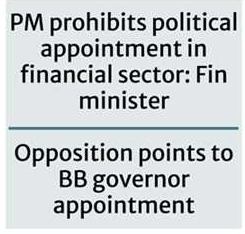
He also mentions that the prime minister has issued clear instructions that no appointments in the financial sector would be made on political considerations.
The debate escalated when Opposition Deputy Leader Abdullah Mohammed Taher questioned the government's claim of neutrality, asking how a person allegedly linked to the BNP's election operations committee had been appointed governor of the central bank. The finance minister rejected the allegation, stating that the governor is not even a primary member of the ruling party.
Opposition Leader Dr Shafiqur Rahman strongly opposed the minister's statement. Criticising the government's activities over the past two months, he said that the way changes were being introduced in key policy areas had effectively extinguished public expectations.
Referring to the appointment of the governor of Bangladesh Bank, he alleges that "the manner in which the former governor was removed and a new one appointed did not support democratic norms". He notes with concern that by removing age restrictions, "everything is being politicised, with priority being given to particular groups or families".
In response to the opposition leader's allegations, Finance Minister Chowdhury again takes the floor and says the government is responding to opposition questions even beyond the parliamentary Rules of Procedure. He argues that during past governments of the Bangladesh Nationalist Party, discipline in the financial sector had been maintained because appointments were not made on political considerations.
Making a major announcement on behalf of the current government, he says the prime minister has decided that no political individual would be appointed in the financial sector.
Regarding the current governor of Bangladesh Bank, he says: "'The proof of the pudding is in the eating'. Let us wait and see. If his performance demonstrates any partisan influence, then you may say so. For now, we are observing his performance."
He adds that a person may be supporter of a political party, but if they are qualified, there should be no problem with their appointment. Citing the proverb again, he urges the opposition to remain patient and judge based on performance.
Opposition Chief Whip Nahid Islam also criticises the appointment, claiming that for the first time a businessman has been made governor of Bangladesh Bank allegedly to facilitate loan rescheduling for defaulters.
Later, in his speech, the finance minister said loan rescheduling is a natural process in business.
He mentions that the businessmen associated with BNP were heavily harassed and oppressed during the 16- year regime of Awami League.
"They were put in jail month after the month, they were deprived of loans which were sanctioned to them. How can a businessman repay their loan while he is in jail?" he questions.
mirmostafiz@yahoo.com
© 2026 - All Rights with The Financial Express

