Essential commodities may get costlier as the government is set to hike source tax on the same in the upcoming national budget, sources say, amid fears of inflation going further up.
Currently, the tax at source on essential commodities is 0.5 per cent each on local procurement and imports.
The rate might be doubled 1.0 per cent in the next financial year's budget to be placed in parliament on June 11, 2026.
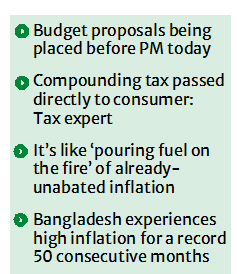
Officials say all fiscal proposals would be placed before the Prime Minister today (Thursday) for his approval.
In the current budget, the government has halved source taxes from 1.0 per cent to 0.5 per cent to help lower prices of essential commodities, including sugar, soybean oil, rice paddy, wheat, potatoes, and onions.
In an effort to ease the burden on marginal farmers and suppliers, the interim government also had cut the source tax on income from the supply of essential commodities like paddy, rice, wheat, potato, jute, and tea leaf.
The tax at source is collected on letters of credit (LCs) for essential goods and also local procurement as well.
"Source tax on the import of essential commodities does not significantly affect revenue collection or the final price of goods. Yet, a section of traders use it as a pretext to raise prices," budget speech for the current fiscal year says.
"Considering this, a decision has been made in the upcoming budget to reduce the source tax. To help keep essential commodity prices affordable, the source tax on local letter-of-credit commission is being halved," it adds.
As the government expected the prices of several items would decline, it didn't happen in the last one year-all through under high inflation.
The country is experiencing high inflation for 50 consecutive months. Such persistent high inflationary pressure for such a long time is record in the world.
The items subject to pay source tax include paddy, wheat, potatoes, onions, garlic, peas, chickpeas, lentils, ginger, turmeric, dried chillies, pulses, maize, coarse flour, flour, salt, sugar, edible oils, black pepper, cinnamon, nuts, cloves, dates, cassia leaves, computers and computer parts, and all varieties of fruits.
Responding to an FE query, tax expert Snehasis Barua says as corporate entities increasingly expand into the supply chain for essential commodities, they face a significant fiscal hurdle: the frequent inability to deduct tax at source (TDS) during procurement.
"This limitation forces companies to gross up taxes, inherently driving up the cost of goods. To mitigate this, the minimum tax on gross receipts on sale of essentials should have been reduced from 1.0 per cent to 0.5 per cent to align with the prevailing TDS rate."
Instead, he points out, under the proposed structure, businesses will be subjected to a dual burden of a 1.0 -percent TDS on purchases and a 1.0-percent minimum tax on sales.
"Inevitably, this compounding tax is passed directly to the consumer, pouring fuel on the fire of already-unabated inflation," says Mr Barua in response to a query.
doulotakter11@gmail.com
© 2026 - All Rights with The Financial Express

