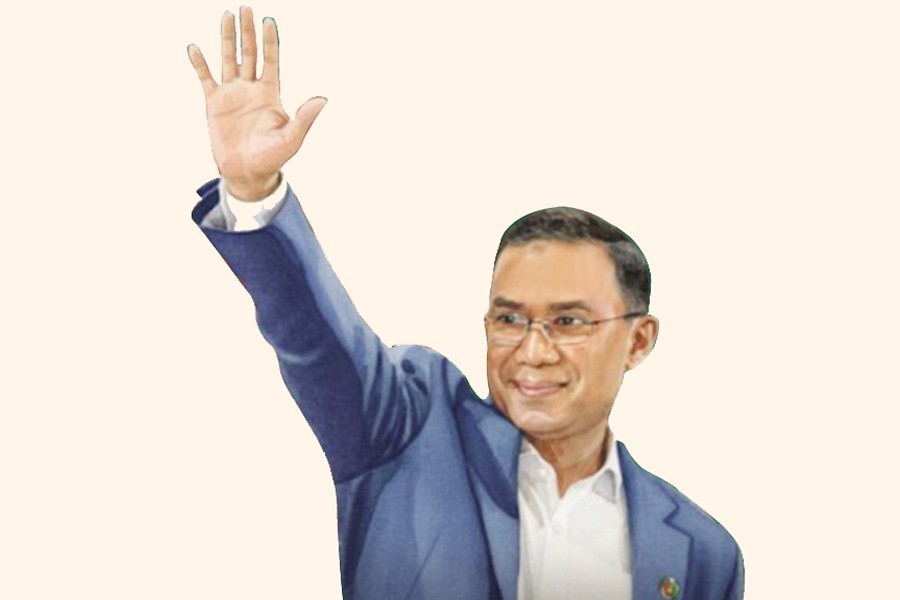
After nearly eighteen years in forced exile, Tarique Rahman is set to return to Bangladesh today to a rousing reception in a homecoming his party describes as historic, with far-reaching implications for the country's post-uprising political milieus, especially surrounding the upcoming elections.
The acting chairman of the Bangladesh Nationalist Party (BNP), who has lived in London since 2008 during the long rule of Sheikh Hasina, whose government was toppled in the 2024 uprising, is scheduled to arrive at Hazrat Shahjalal International Airport at 11:55am today (25 December) aboard a regular Biman Bangladesh Airlines flight from London, according to BNP officials.
His return ends years of speculations, uncertainty and repeated postponements that had come to symbolise the country's prolonged political standoff set off by the 1/11/2007 putsch.
"In the skies of Bangladesh's contemporary politics, for a long eighteen years, there had been a void, a cry of anguish, and the echo of sighs," BNP secretary-general Mirza Fakhrul Islam Alamgir reminisces.
In a statement on Tuesday he said, "Now those have emerged as a beacon of immense expectation. The acting chairman of the BNP, Mr Tarique Rahman, who for nearly two decades was kept confined within the web of vindictive politics and conspiratorial false cases, is returning to his beloved motherland in a heroic guise."
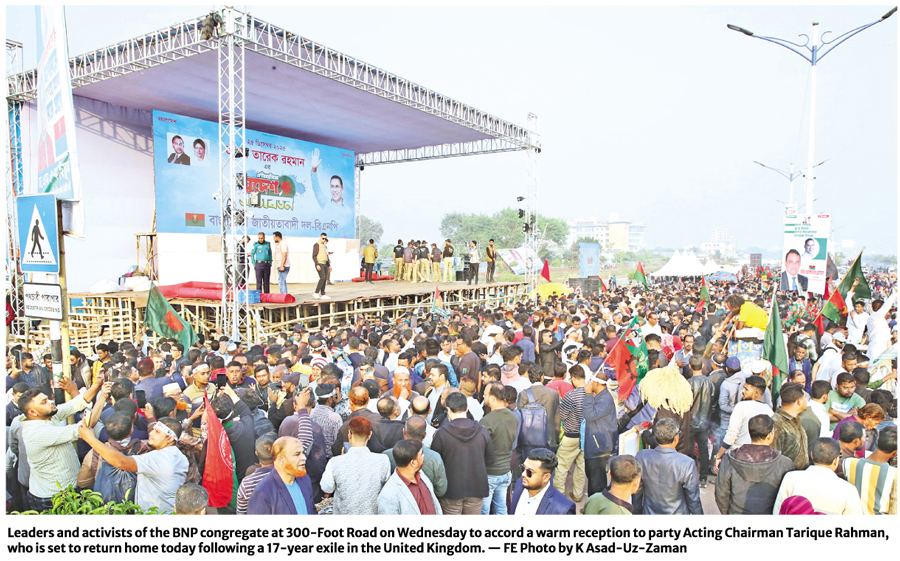
According to details shared by BNP standing committee member Salahuddin Ahmed at a briefing in Gulshan on Wednesday afternoon, Rahman will drive directly from the airport to a public reception in the 300-foot road area in Purbachal, bypassing any stopovers in central Dhaka.
"There, he will deliver a brief speech. He will be the only speaker at the reception," says Salahuddin Ahmed.
Following the reception, Rahman will travel to Evercare Hospital to visit his ailing mother, former prime minister and BNP chairperson Khaleda Zia, who has been undergoing treatment for chronic health complications. He will then return to his residence in Gulshan later in the evening.
BNP leaders say extensive preparations have been taken across the capital to manage crowds, ensure security and maintain order, with supporters converging from different parts of the country to witness the moment. Authorities have imposed temporary restrictions around the airport to prevent overcrowding.
Rahman's itinerary extends beyond his arrival day, reflecting both personal mourning and political re-engagement.
On Friday, 26 December, after Jumu'ah prayers, he will visit the tomb of his father, former president Ziaur Rahman, followed by a visit to the National Martyrs' Memorial in Savar -- a symbolic act intended to underline his party's nationalist credentials.
On 27 December, Rahman is scheduled to apply for voter registration, formally re-entering Bangladesh's electoral framework after years abroad. The same day, he will visit the grave of Sharif Osman Hadi, the slain spokesperson for Inqilab Mancha and a prominent figure in the July mass uprising, before heading to the National Institute of Traumatology and Orthopaedic Rehabilitation (Pangu Hospital) to meet protesters injured during last year's anti-government movement.
BNP insiders say the schedule is deliberately designed to blend personal grief, political symbolism and public outreach, as Rahman seeks to reassert himself as a national leader rather than a distant figure directing politics from afar in exile.
Tarique Rahman's departure from Bangladesh in 2008 followed a period of intense political upheaval, arrests and prosecutions after the military-backed caretaker government and later the Awami League returned to power. Convicted in several corruption and criminal cases -- verdicts BNP maintains were politically motivated -- Rahman remained in the UK while leading the party in his mother's absence as she faced imprisonment and legal pressure at home.
For nearly two decades, name of the scion of the Zia family has hovered over Bangladeshi politics as both a rallying point for the opposition and a lightning rod for controversy. Supporters portray him as a victim of authoritarian repression, critics accuse him of avoiding accountability. His prolonged absence became emblematic of a political system in which exile replaced dialogue and courts were widely viewed as politicised.
Repeated announcements of his imminent return -- often followed by silence -- fuelled confusion and scepticism. Only in recent weeks, following the fall of the Hasina government and the installation of an interim administration, did the prospect become concrete.
BNP leaders say Rahman's physical presence will transform the party's electoral preparedness and morale ahead of the crucial next national elections. His return is expected to consolidate party unity, energise grassroots networks and sharpen the opposition's challenge to rivals.
"This is not just a return of a person, but the return of political balance," says one senior BNP leader, speaking on condition of anonymity.
Political analysts note that Rahman's homecoming could significantly alter Bangladesh's electoral equation. For the interim government, it presents both an opportunity to demonstrate political openness and a challenge in managing competing mobilisations without unrest.
Other parties have reacted cautiously, while civil-society figures have called for restraint, urging all sides to ensure the moment strengthens democratic participation rather than deepening polarisation.
As Bangladesh prepares to witness Tarique Rahman step onto home soil after eighteen years, the moment carries layers of meaning -- for his party, for a wounded opposition movement, and for a nation attempting to move beyond a cycle of repression and retaliation.
Whether his return heralds the beginning of political reconciliation or a new phase of confrontation remains to be seen. But few doubt that, from Wednesday onward, Bangladesh's political sky will no longer feel as empty as it once did.
Bangladesh's interim government is giving the "highest priority" to the security of acting BNP chairman Tarique Rahman on his homecoming from prolonged exile.
Speaking at a briefing on Wednesday afternoon at the Foreign Service Academy in Dhaka, the chief adviser's press secretary, Shafiqul Alam, said the government was working closely with the Bangladesh Nationalist Party (BNP) to meet all security requirements requested for Rahman's return Thursday.
"We welcome Tarique Rahman's return to Bangladesh," Alam said. "Discussions are ongoing with his party regarding the security he requires. Whatever level of security the BNP has asked for is being looked after in consultation with them."
Asked whether Rahman would be provided with elite, SSF-style state security - typically reserved for heads of state and government - the press secretary declined to give details. The matter should be clarified by the BNP itself, he said.
"However," he added, "from our side, the issue is being treated with the utmost importance."
Rahman, the elder son of former prime minister Khaleda Zia, is expected to arrive in Dhaka today, marking his first return since leaving the country in 2008 during the tenure of the previous Sheikh Hasina government.
The government's assurances on security come amid large-scale preparations in the capital and concerns over crowd control, political rivalry and the broader law-and-order situation.
During the same briefing, Alam also reaffirmed government position on the upcoming national elections, stating that the Awami League will not be able to contest after the Election Commission cancelled the party's registration.
"The government's position is clear---As the Election Commission has cancelled the Awami League's registration, the party cannot participate in this election."
Addressing concerns over communal unrest, Alam condemned the recent killing of Dipu Chandra Das in Mymensingh, describing the incident as "strongly denounced" by the government.
"Based on video and visual evidence, at least 12 persons involved in the killing have been arrested," he told the press. The government's legal adviser, he added, had announced that the case would be tried under the Speedy Trial Act.
Alam stresses that protecting religious minorities remained a top priority for the administration. "You have seen that during Durga Puja and other major religious festivals, adequate security arrangements were in place."
The press secretary also addressed the killing of Osman Hadi, a prominent activist whose death has sparked outrage in recent weeks. He said the government was treating the case with the "highest priority", with all security agencies involved in the investigation.
Police and other agencies have arrested a number of suspects, Alam said. "They are receiving some important clues."
mirmostafiz@yahoo.com
© 2026 - All Rights with The Financial Express

