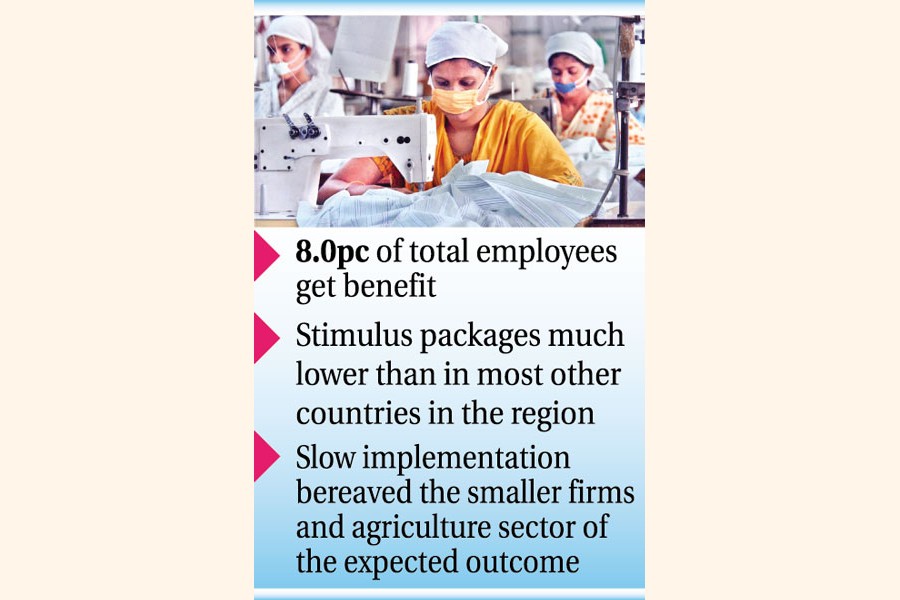
The government's stimulus packages of Tk 1.13 trillion have little impact on the employment sector as they only benefited 8.0 per cent of the total workforce employed.
Even if the packages, which were announced to help offset the economic fallout from the Covid-19 pandemic, were fully implemented, as low as 12 per cent of the total employment could have been reached, the Centre for Policy Dialogue (CPD) said.
The total amount of stimulus packages was much lower than most other countries in the region while slow implementation has not produced the expected outcome for smaller firms and the agriculture sector in case of employment protection and creation.
The views came at a virtual discussion on "Employment Implications of Stimulus Packages: Challenges for Recovery."
The CPD and Oxfam Bangladesh jointly organised it.
The dialogue discussed the outcomes and implications of public policy interventions on the employment dynamics induced by the Covid-19 pandemic.
CPD distinguished fellow Professor Mustafizur Rahman chaired the event while executive director Dr Fahmida Khatun and distinguished fellow Dr Debapriya Bhattacharya and labour secretary KM Abdus Salam, addressed it.
"Only 8.0 per cent of the country's total employment has been covered by the government's 19 stimulus packages. If the full implementation of the packages were possible, an estimated 12 per cent employment would have been covered," CPD senior research fellow Towfiqul Islam Khan said.
For the agriculture sector, the packages reached only 0.27 million, which could be 0.96 million if fully implemented, he said while presenting the keynote paper.
About 4.65 million and 0.13 million employment in large industries and services and SMEs respectively have got protection from the support, he said, adding the number could be 6.18 million and 0.44 million respectively if fully implemented.
Large industries were better prepared to receive the stimulus packages given their more organised nature and enhanced technical capacity, he said, adding safety net measures were also extremely limited.
The SMEs had a general lack of awareness with regard to the stimulus packages while their technical capacity is also low, Mr Khan said, suggesting the design of the packages should have taken these into cognisance.
The lenders followed a cautious approach while disbursing the stimulus to smaller entrepreneurs and the stimulus packages gave inadequate attention to marginalised and vulnerable employment sectors as well as marginalised population/areas, he added.
There are still some confusion and complexities over the requirement for collateral for loans in the scheme for smaller enterprises and new and small entrepreneurs are finding it difficult to get access to the loans, the paper said, adding the designs of the stimulus packages lack incentives for employers to sustain employment.
In his speech, the labour secretary said 2020 is a year of challenges for the country because of the coronavirus and longer floods.
Referring to the government's different measures, he said factories were reopened with strict maintenance of safety and health guidelines.
Senior research fellow at the Bangladesh Institute of Development Studies Dr Nazneen Ahmed said garment workers, especially aged 35 or more, could not go back to their work as factories were unwilling to hire them again after reopening.
Factories are retaining young and fresh workers while raising workload or targets by reducing the workforce, she noted adding that rejoining of retrenched workers aged 40 has also become uncertain.
She recommended creating alternative employment for the middle-aged and skill workers.
President of Socialist Labour Front Razequzzaman Ratan said low-income groups are severely affected due to the pandemic as many of them have lost their jobs.
He also alleged the implementation of packages, especially for the agricultural sector, is not much visible.
He recommended ensuring the support for SMEs, saying it would help protect informal employment.
The Bangladesh Employers' Federation president Kamran T Rahman said about 65 million people are employed across the country, of which 12 million are in the formal and the remaining 50-55 million are in the informal sectors.
"We need to sharpen our focus on the entire labour market", he noted.
The government announced packages in time, but the problems are their distribution by banks, he said, adding due to banks procedures, many are not getting the support.
The BEF leader called for the simplification of banking procedures, creating local demand, enhancing skill and ensuring financial support for returned migrant workers.
Dr Debapriya Bhattacharya said though the measures were taken timely, the size of packages is not sufficient for protecting employment and compared to other countries as many who needed the support most did not get
Bangladesh has received about US$4.0 billion as international assistance, he said, adding there is no statistics of how much of it has been spent directly or indirectly for employment.
Speakers from different parts of the country at the virtual event alleged that many marginal people and organisations are not well informed about the government-announced support and how they could be availed recommending proper publicity.
Some of them said young people despite having training did not get loan as they don't have any guarantee.
Munni_fe@yahoo.com
© 2026 - All Rights with The Financial Express

