A slowdown in public works following the regime-changing political upheavals narrow Bangladesh's budget deficit as a blessing in disguise as the interim government couldn't utilise much of the budgetary outlay, official statistics show.
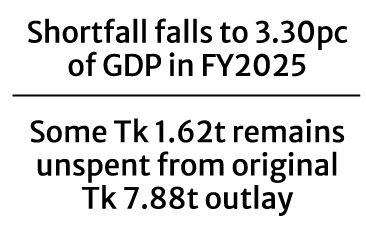 The budget deficit contracted to 3.30 per cent of the GDP in the last fiscal year (FY 2024-25) by official count, which mitigated government borrowing pressures but, economists say, the pared-down spending stymies economic expansion and job creation.
The previous government, which crafted the budget before its fall, had projected a deficit of 4.6 per cent to GDP in the Tk 7.88-trillion expenditure target (excepting loans, advances and net outlay of food account) in the original national budget for FY2025.
A fat sum of Tk 1.62 trillion remained unspent from the budget outlay in the last fiscal year, according to preliminary data released by the Ministry of Finance in the interregnum.
Following the lower budget spending, the government after the first half of the past FY revised down the total expenditure target to Tk 7.38 trillion.
Economists say the Bangladesh government has successfully contained its budget deficit for the FY2025, posting a figure significantly lower than initial projections, but fails to expand public and private investment with resultant lower economic growth.
The final budget deficit for FY2024-25, which concluded on June 30, is estimated to have settled at 3.3 per cent of the gross domestic product (GDP), marking a notable reduction from the initial target of 4.6 per cent.
Furthermore, this represents a considerable improvement over the previous FY2023 final deficit of 4.7 per cent of GDP, the official data show.
Although the government has spent Tk 4.74 trillion, 93.7 per cent of the revised Tk 5.06 trillion outlay in the operating budget, but failed to utilise most of the money from the development budget in the last fiscal, according to the MoF data.
The rate of operating-budget expenditure was higher than that in the previous FY2024 as the government ministries and divisions spent 91 per cent of their Tk 4.53-trillion revised outlay.
In the FY2025, the interim government's performance was billed bleak in utilising the budgeted development funds as its implementing agencies could utilise only Tk 1.517 trillion or 65.53 per cent of the total Tk 2.316 trillion worth of revised development budget.
A MoF official says since the project-implementing agencies had failed to implement their project against the annual targets, the overall budget expenditure got reduced.
"Since the expenditure in interest payment bloated for the last fiscal year, the operating-budget- utilisation rate was higher," he adds.
The MoF official says the government maintained tight control over development and non-essential expenditures to counter inflationary pressures and conserve foreign-currency reserves.
"A lower budget deficit signals a reduced reliance on domestic and foreign borrowing," says the finance official about one major reason for tight-fisted spending.
He thinks this moderation in government borrowing is expected to ease pressure on the domestic credit market, potentially leaving more liquidity available for the private sector and contributing to a gradual stabilisation of interest rates.
He opines that this fiscal performance provides a much-needed foundation for the upcoming fiscal cycle.
"The successful deficit compression offers the government greater policy space to allocate resources towards social protection, infrastructure development, and managing essential imports without excessively burdening the national debt," the official further explains.
Dr M.A. Taslim, Economics Professor at the Independent University, Bangladesh (IUB), tells the FE that ease of budget deficit is better from the government borrowing front, "but it is not good when we think about development works".
"If the government fails to invest its budget funds in development works, the GDP growth, employment and poverty reduction will be slowed down. So, the government should apply prudent policy to reap benefit from the development expenditure," he notes.
Economist Dr Muinul Islam notes that the lower public investment has already impacted the GDP growth as well as poverty reduction and employment.
The economy has already passing through a "relative stagnancy" due to the lower growth over the last couple of years.
"Although lower rate of deficit will save Bangladesh from borrowing from the banks and external sources, development could be affected. So the government has to take prudent macroeconomic policy," the economist suggests.
© 2026 - All Rights with The Financial Express

